Returned minister threatens Israel with…‘continued conversations’

The return of the Conservative MP Alistair Burt to his old job of Middle East minister was widely welcomed by MPs on both sides of the divide during Foreign Office questions on July 11.

He was a former chairman of Conservative Friends of Israel who became more and more blunt in his comments on the Israeli government the longer he stayed in the job – paying several visits to the Palestinian village of Nabi Saleh and the Bedouin village of Khan al Ahmar.

He lost his job and returned to the backbenches in October 2013 and has now achieved what few sacked ministers ever achieve: he has returned from the back benches and been reappointed to his old job.

But there were signs that the new Alistair Burt has come back a chastened man. He still “strongly condemns” the illegal settlements, but sometimes he adopts a more measured tone, threatening the Israelis with “continued conversations in relation to suggestions that new housing units should be built in East Jerusalem”:

Tommy Sheppard (Edinburgh East) (SNP): What steps he is taking to encourage the Israeli authorities to stop the building of illegal settlements in Occupied Palestinian Territories.

Alistair Burt: We regularly raise these issues with Israel, calling for a reversal of the policy of settlement expansion. I reiterated that in the House of Commons last week, and recently both the Foreign Secretary and I have made statements strongly condemning proposals for new settlement expansion in both the West Bank and East Jerusalem.

Tommy Sheppard: Only last week, the right-wing Israeli Government announced a further expansion of the illegal settlement programme, so it is clear that, whatever action the British Government are taking, it is not working. Is it not therefore time that Her Majesty’s Government gave a more robust response to this problem, including by discouraging investment in and trade with the illegal settlements, and ensuring the proper labelling of imported goods so that they are designated as coming from “an illegally occupied Palestinian territory”?

Alistair Burt: This is a long and difficult process, as he rightly knows. We have a policy on labelling, and continued conversations will go on with the state of Israel in relation to suggestions, such as we heard last week, that new housing units should be built in East Jerusalem. This is a complex process and the UK does not believe in boycotts or sanctions, but clear labelling has been in place for some time so that consumers can take their choice.

Sir Desmond Swayne (New Forest West) (Con): We have contributed to a number of EU structures that have been demolished. Will he ask the Government of Israel for our money back?

Alistair Burt: I think he is referring to some work done by the EU. The EU has not sought compensation from the state of Israel in relation to that, and no decision has been taken on any further action.

Ian Austin (Dudley North) (Lab): Settlements are a barrier, but they are far from the only barrier to peace. The building blocks for the peace process are trade and economic development in the West Bank; demilitarisation and democracy in Gaza; and support for co-existence projects that get Israelis and Palestinians working together, the funding for which, I am sorry to say, this Government have stopped. Will the Minister reinstate funding for co-existence projects, to build the peace process?

Alistair Burt: He understands this issue extremely well, and I agree with his analysis that this is a complex issue, where there are many different building blocks to try to revitalise the peace process, and settlements are far from the only barrier to that. Trade and investment remain important, but we will be looking further at what prospects there are for any new initiatives. I am aware of the co-existence projects that he mentions, and I will certainly be looking at that when carrying out my joint responsibilities in the Department for International Development.

Liz McInnes (Heywood and Middleton) (Lab): We are all glad to see the Minister for the Middle East back and working on this issue again, but this is the second time in the space of a week that the Foreign Secretary has declined to speak about the Middle East and devolved the job to the Minister instead—and that follows his failure even to mention Israel or Palestine in the Tory election manifesto. I simply ask the Minister: when are we going to hear the Foreign Secretary stand up and condemn the new illegal settlements?

Alistair Burt: I thank her for her warm welcome. I much enjoy being back in this role, no matter what is thrown at me as part of it. The Foreign Secretary strongly condemned the proposals that were announced for the West Bank recently. I like to think he has confidence in his Minister for the Middle East—as he has confidence in his full ministerial team—to answer appropriate questions, although I have never known him to be shy of answering a question when necessary.

MP who says “Israel-Palestinian conflict doesn’t matter” wins FAC vote

“Totally the wrong person to head such an influential committee”

The House of Commons Foreign Affairs Committee inquiry into the Middle East peace process seems likely to be abandoned after the defeat of chairman Crispin Blunt by relative newcomer Tom Tugendhat who has been an MP since 2015.
Tom Tugendhat MP
The former military intelligence officer is on record as saying that that the UK “was wrong” to support Resolution 2334 condemning Israeli settlements at the UN Security Council in December 2016 and that “the Israel-Palestinian conflict doesn’t matter”.

The MPs’ committee had already collected and published written evidence from 42 organisations and was ready to start oral hearings when Mrs May announced the election on April 18th.

Former chairman Crispin Blunt had said the committee wanted to examine the UK’s role in the Israel-Palestine conflict in the year of the centenary of the Balfour declaration.

He added that the inquiry could look at the activities of the Israeli diplomat who tried to recruit British supporters in a botched plot to “take down” the Deputy Foreign Secretary Sir Alan Duncan.

“The Government may have formally closed the issue of Shai Masot, but one of our terms of reference invites consideration of the way that foreign states and interested parties seek to influence UK policy.”

Political parties are now nominating MPs to sit on the Foreign Affairs Committee and the new committee will decide whether to continue with the inquiry, but it seems unlikely to happen under the chairmanship of Tom Tugendhat.

Indeed the inquiry – and fear of its consequences – may have been a factor in the election of Tom Tugendhat, a supporter of Theresa May, with 317 votes against 184 for Crispin Blunt and 71 for John Baron.

Tom Tugendhat has a degree in Islamic Studies, speaks Arabic and was a military intelligence officer in Iraq and Afghanistan, but holds the surprising opinion that Arab people are no longer interested in the Israel-Palestine dispute (see article below).

If he persuades MPs on the committee to ditch the inquiry, the evidence from 42 organisations will remain on the House of Commons website at https://www.parliament.uk/business/committees/committees-a-z/commons-select/foreign-affairs-committee/inquiries1/parliament-2015/inquiry1/publications/

Conservative commentator Peter Oborne wrote in the Daily Mail: “Tom Tugendhat’s election as chair of the Commons Foreign Affairs Committee has been hailed as a triumph for moderation. I fundamentally disagree.

“Yes, the ambitious former soldier has a bright future. But his views make him totally the wrong person to head such an influential committee. He criticised President Obama’s admirable deal for nuclear peace with Iran. He opposed British support for the UN vote condemning Israel’s settlement programme in the West Bank.

“He supported Western military intervention in Syria. And he is ambiguous about Saudi Arabia’s murderous campaign of bombing in Yemen (though, to be fair, he has expressed reservations about some of the methods).

“By calling Mr Tugendhat a moderate, the implication is that his predecessor as committee chairman, Crispin Blunt, is an extremist. In fact, Mr Blunt was widely admired for holding the Foreign Office to account whenever it failed. I fear Mr Tugendhat owes his job to backers of the Iraq War. He has a big challenge to prove he is not a Cabinet stooge.”

It was a mistake to vote for UNSC2334, says new chair of Foreign Affairs Committee

From the Spectator: “Like all the best mistakes, it was done for the right reasons. Knowing that for once the US wouldn’t veto, the UN Security Council passed a resolution condemning settlement building in the occupied Palestinian Territories.

“The UK was no doubt keen to be with the consensus but we were wrong to back the Resolution. This time was different. Not because Israel has changed, nor the expansion of the settlements is exacerbating the efforts towards a settlement, but because the world has changed and so have we.

“The Arab Spring showed that the Israel-Palestinian conflict doesn’t matter…… The voices in the Arab Spring protests called for many things, from jobs to freedom, but nothing about Palestine. The Muslim Brotherhood, students and even Salafists who met in Tahrir Square demanded the downfall of the Mubarak regime. In the face of unemployment and kleptocracy, Israel was irrelevant….
.
“Backing an outgoing US administration, an anti-Zionist myth, and many dictators’ propaganda message doesn’t just undermine Israel and ignore recent tectonic change, it hurts our regional allies and weakens us. To write our own future we need to think more about the message our votes send and be prepared to stand against consensus. This time we got it wrong.”


Extracts from July 2017 House of Commons debate on Israel-Palestine

Minister drops recognition pledge

Dr Matthew Offord (Hendon) (Con): Does the Minister agree that any recognition of a Palestinian state before direct peace talks between the two states, Israel and Palestine, would not only be counterproductive but would damage a long-term two-state solution?

Alistair Burt: It is not the UK Government’s intention to recognise a Palestinian state; we believe it should come in due course, at the conclusion of the talks to settle the issue, and I do not believe that position is going to change.​

Jo Swinson (East Dunbartonshire) (LD):  Given the Minister’s comments, it seems that that position has moved and that recognition is being ruled out until the end of talks on a peace process rather than being something that the Government would be able to do at any time?

Shadow Foreign Secretary Emily Thornberry (Islington South and Finsbury) (Lab): Six years ago, the then Foreign Secretary said: “We reserve the right to recognise a Palestinian state…at a moment of our choosing and when it can best help bring about peace.”—[Official Report, 9 November 2011; Vol. 535, c. 290.]

Let me, then, urge the Minister and the Government to seize the moment we are now offered by the Balfour centenary to throw our support behind Palestinian statehood, just as we threw our support 100 years ago behind Israeli statehood.

When violence and extremism are rising on all sides, when hard-liners are assuming increasing control, when the humanitarian crisis is getting even worse, and when all eyes are on an American President whose grand plan for peace exists only in his mind, we need the ​British Government, more than ever, to show some leadership and to show the way towards peace—and recognition of Palestinian statehood would be one significant step in that direction

Richard Burden (Birmingham, Northfield) (Lab): We have never said—no one has ever said—that recognition of Israel should be a matter of negotiation. Israel is recognised as a matter of right, and quite rightly so, but if we believe in even-handedness between Israel and Palestinians, that same right must apply to Palestinians. It is time, on the 100th anniversary of the Balfour declaration, to fulfil what the House voted for on 13 October 2014 and recognise the state of Palestine.

Tracy Brabin (Batley and Spen) (Lab/Co-op): Recognising Palestine as a state gives moral and political support to moderate Palestinian voices pushing back against violent extremists, and I would encourage the House to decide on a timeframe for that to happen.

Balfour centenary to be marked ‘sensitively’

Middle East Minister Alistair Burt: I wish to recognise that this is the centenary of the Balfour declaration. This is a part of our history that divides opinion in this country and in the region, and we will treat it sensitively. I do not think it is incompatible to be proud of the UK’s role in the creation of the state of Israel and yet to feel sadness that the long-standing issues between the relative communities created by it have not yet been resolved. It was a historic statement and the UK is proud of its role in the creation of Israel, but it is unfinished business and, accordingly, in this centenary year we are especially focused on encouraging the Israelis and the Palestinians to take steps that will bring them closer to peace.

Crispin Blunt (Reigate) (Con): Last November, the then Minister for the Middle East assured the House that the British Government would neither celebrate nor apologise for the Balfour declaration. I welcomed that position for its acknowledgement that although for many the declaration was the beginning of their deliverance from centuries of persecution, for others its unfulfilled passages were the root of their communal loss. In such a context, celebration or apology betrays the legitimate historical sensitivities of either party, when we should be focused on how to move the issue forward to the benefit of both parties.

This is a touchstone issue for millions of Arabs and Muslims, and I do not think I am exaggerating when I say that their eyes will be on us. The centenary must be handled with the utmost care and consideration. In the conversations that I had with almost all Arab ambassadors in my capacity as a former Chair of the Foreign Affairs Committee, it was clear that uncertainty and anxiety surround the centenary.

Mary Robinson (Cheadle) (Con): Regional players and previously hostile states are moving closer towards accepting an ideal of peace, and I note that at the Security Council briefing on the peace process last month, the Arab League Secretary-General reaffirmed a commitment to the 2002 Arab peace initiative. Perhaps this provides an opportunity for constructive dialogue.

As we commemorate 100 years since the Balfour declaration and our support for the region, we should revive the effort for peace through meaningful talks and truly make 2017 the anniversary of the Balfour declaration and an anniversary for peace.

Ross Thomson (Aberdeen South) (Con): The Balfour declaration of 1917 is one of the most significant and important letters in history. as we proudly mark the centenary year of the Balfour declaration, we are presented with a unique opportunity to renew the Middle East peace process.

Settlements and occupation

Minister condemns settlements (1): The United Kingdom’s view is clear and unchanged: settlement building seriously undermines the prospects of two states for two peoples. I am extremely concerned by reports this week of plans to construct more than 1,800 new housing units in East Jerusalem. In the UK’s view, all settlements are illegal under international law. If confirmed, the plans would be the latest example of an accelerating policy of illegal settlement expansion. That would take us further away from a two-state solution and raises serious questions about the Israeli Government’s commitment to achieving the shared

Minister condemns settlements (2): It has long been our position that settlement activity is ​illegal and that it undermines the viability of two states for two peoples. We are gravely concerned that an increase in the pace of settlement construction in East Jerusalem and the West Bank presents a strategic threat to a peaceful resolution of this conflict. As a strong friend of Israel, we urge the Israeli Government to show restraint on the construction of settlements

Crispin Blunt (Reigate) (Con):  What steps are the Government taking to ensure that this country will adhere to the UN Security Council’s demand that, in international relations, states make a distinction between Israel and the occupied territories? Will the Minister guarantee that, as the UK leaves the EU, it will continue to make that kind of diplomatic differentiation? Does he agree that the UK should not be trading with illegal settlements?

Richard Burden (Birmingham, Northfield) (Lab): The key issue is not whether we are doing all that we can to encourage talks, but what we are doing to help to achieve change in practice. We need to think about where we have leverage to enable us to do that, and one of the areas in which we have leverage is the issue of settlements. Of course we all disapprove of settlements—no announcement of a new settlement goes by without an expression of disapproval from our Government, and I welcome that—but is it not time that we started using the leverage that we have and that we use in other parts of the world? Settlements are illegal. When Crimea was annexed by Russia, we applied a series of disincentives to companies that colluded with that illegality. Why is it so difficult for us to do the same in relation to settlements in the occupied territories?

Stephen Kinnock (Aberavon) (Lab): The blockade and effective occupation of Gaza, and the illegal settlements, imperil not only the children of Palestine, subjecting them to a form of collective punishment for acts that they played no part in committing, but the future of Israel itself. They create a deep divide in Israeli society that Pardo sees as potentially the beginning of a path to civil war.

This year, 2017, marks the 50-year anniversary of the occupation. We must ask ourselves what a further 50 years of the politics of oppression, aggression and division will mean. Currently, we see an Israel in clinical denial, sipping cappuccino on the lip of the volcano, and a Palestine in clinical despair, with an acute sense that politics is incapable of delivering a solution. As the former Mossad chief has made clear, the root cause of both is the blockade and the occupation. I hope that today the House will speak with one voice, for the sake of both the Palestinian and Israeli people, in calling for an end to the blockade, for immediate humanitarian assistance in Gaza, and for an end to the illegal settlements.

John Howell (Henley) (Con): I would be the first to admit that settlement expansion is counterproductive, and I have made that point to the Israeli Government.

John Spellar: Although settlements may not be an obstacle, they are certainly a problem, especially at a time, as My friend mentioned, when Israel’s relations with the surrounding Arab states are at a better pitch than many of us can ever remember. Is it not, therefore, regrettable that the Netanyahu Government are proceeding with settlements when this could be a unique opportunity?

Joan Ryan: I never made any secret of my opposition to settlement building. It is regrettable. A better move towards peace would be if Mr Netanyahu did what I suggested when I stood on a platform with him, and he froze all settlement building.

Ms Nusrat Ghani (Wealden) (Con): The current governing coalition in Israel is the most right-wing in the country’s history. Since the start of the year, the Israeli Government, emboldened by the new Trump Administration, have announced the creation of more than 6,000 new buildings in the Occupied Palestinian Territories, and have attempted to legitimise them through the Land Regularisation Bill. The retroactive legalisation of 55 settlements and roughly 4,000 housing units is a significant step away from a peaceful solution.

I am pleased that the United Kingdom voted for resolution 2334 and condemned the passage of the Land Regularisation Bill, but the Government must now step forward and fill that vacuum.

There are three areas in which the Government can exert pressure. First, the Israeli blockade of the Gaza strip is neither productive nor appropriate, and the Minister must call for its further relaxation. Relaxing the blockade would weaken Hamas’s hand in the region, and allow for further reconciliation with the Palestinian Authority. Secondly, to that end, we must encourage ​Israel to allow more reconstruction aid to enter Gaza. Tension in the Gulf states has meant that Qatari attempts to get aid in have proved fruitless, and Israel is well positioned to help to rebuild a war-torn society. Thirdly, the draconian restrictions in place on Palestinians wanting to move across the West Bank continue to stoke further tensions, and by easing some of this control Israel could firmly send a message that it wants a peaceful solution and is willing to work towards it.

Andy Slaughter (Hammersmith) (Lab): There is the remorseless growth of settlements. In the last year or so, we have seen a change in the type and intensity of settlement growth. The 1,800 units in east Jerusalem, including around Sheikh Jarrah in the heart of east Jerusalem, that have been announced in the last couple of days are a fundamental game-changer, as are E1 and the new settlements between Bethlehem and east Jerusalem. All of those will make a viable Palestinian state impossible. There has been a 70% increase in settlement building on the West Bank in the last year. These are continuing breaches of international humanitarian law and the fourth Geneva convention. Just last week, the Secretary-General of the UN, António Guterres, said that “the only way to achieve the inalienable rights of the Palestinian people” is by ending the occupation. That is the issue at the heart of this and unless it is addressed, we will get nowhere.

Wes Streeting (Ilford North) (Lab): I have seen at first hand the impact of Israeli Government policy towards Palestinians living in the West Bank. The ongoing expansion of illegal Israeli settlements cannot be justified, nor can the demolition of Palestinian homes, nor can the use of byzantine laws to seize land from its rightful owners, nor can the military court system, which violates the very principles of natural justice, and nor can the regular intimidation of Palestinian civilians and international aid workers, who too often are victims of settler violence.

Tracy Brabin (Batley and Spen) (Lab/Co-op): Only last year, the United Nations passed a resolution condemning the occupation. Settlements are illegal under international law. They breach the fourth Geneva convention, which prohibits the transfer of the occupier’s “own civilian population into the territory it occupies”.

But the UN resolution was passed only because of President Obama’s support, and now, with a new and very different President in place, we need clarification on what conversations the Government have had with him.

Other issues

Shadow Foreign Secretary:  If the Government call a debate on such a serious foreign policy issue as the future of talks between Israel and Palestine—this is the first time a Government have done so for 10 years, I believe—and that debate is held in Government time, it would not be unreasonable to expect the Foreign Secretary himself to make the effort to lead the discussion.

Since the Yom Kippur war in 1973 the Conservative party has published 12 manifestos. The most recent election is only the second time it has failed to mention the Middle East even once in its whole manifesto.

Britain has always wanted to be able to co-ordinate its foreign policy with the Americans, and this Government are so weak and wobbly that they feel they have to be in lockstep with Donald Trump. That is where we have the difficulty in relation to Middle East policy, and that may be one of the reasons why the Foreign Secretary will not come to the Dispatch Box and why Israel and Palestine were not mentioned in the Tory manifesto.

If the Minister of State will not say those things today, we can only come to two equally unpalatable and pitiful conclusions: either the Government have abdicated Britain’s leadership role and are simply waiting to take their cues from Trump Tower, or they see no point in putting pressure on the Trump Administration, because they know they will simply be ignored—just like they were over climate change.

Theresa Villiers (Chipping Barnet) (Con): There have been no official peace talks since 2014, but I believe there are grounds for hope. Israel’s relationship with a number of other countries has improved somewhat in the face of shared concern over matters such as the rise of Daesh and the hegemonic ambitions of Iran, which is now involved so heavily in many conflicts in the Middle East. collective dispossession. That shared concern appears to have opened up new channels of communication and co-operation, and led to a concerted regional push to revive the peace process.

Joanna Cherry (Edinburgh South West) (SNP): As a lawyer, I wish to address the Israeli Government’s flouting of international law and their failure to observe the rule of law in the Occupied Palestinian Territories. Two parallel systems of ​law operate in the Occupied Palestinian Territories, depending on whether someone is an Israeli or a Palestinian, and that is not right. One law covers Israeli civilians who have been transplanted into the occupied territories, but Palestinians are subject to military law. Israel is the only country in the world that automatically prosecutes children in military courts.

Does the Minister really believe that an Israeli military court that behaves in such a fashion, and that has a conviction rate of just short of 100%, is one that can command the confidence of the international community? I do not, and I think it is important that Members from all parties speak out against Israel’s violation of international law and of the rule of law. There should be no pussyfooting around these issues. Just as we must condemn terrorism, we must condemn so-called democratic states that violate international law and do not observe the principles of the rule of law.

Israel has a proud history as a democratic state, but the policies of its Government are the greatest weapon—the greatest tool—that its opponents could have, striking as they do at the heart of Israel’s proud tradition as an independent democratic state.

Stephen Kinnock (Aberavon) (Lab) on Gaza: According to the UN, we are seeing a process of “de-development” in Gaza, so that by 2020 the strip may well be technically uninhabitable. Some 96% of groundwater in Gaza is unfit for human consumption and the sea is polluted with sewage. Power shortages mean that were it not for the increasingly ​hard-to-obtain fuel that runs emergency generators, hospitals would go dark. That would mean up to 40 surgical operation theatres, 11 obstetric theatres, five haemodialysis centres and hospital emergency rooms serving almost 4,000 patients a day being forced to halt critical services.

Naz Shah (Bradford West) (Lab): Some would argue that the conflict between Israel and Palestine is small by comparison with that in, say, Syria. In reality it is massive in terms of its symbolism and the way it is used. It has a significant impact on how terrorism operates in the region and beyond. It is used to recruit and encourage extremists across the world. We must understand that peace would be more than a stabilising factor within the region; it would go beyond that. In the battle against vicious ideologies like that of Daesh, we cannot and must not underestimate the importance of the Israel-Palestine debate in the wider context of its influence on terror.

I call on the Government to tell us not what they think but what they intend to do. How are we going to move this process forward? As I said the last time I spoke, it is time to move beyond condemnation to accountability.

The fact remains that we have seen 50 years of occupation and 10 years of blockade, and engagement in every peace process that has taken place since 1967 is not unilateral. What has the Oslo agreement brought Palestinians? There has been a 600% increase in the number of illegal settlements. It is time to move beyond condemnation.

Tommy Sheppard (Edinburgh East) (SNP): What is happening to democratic debate and expression inside the state of Israel. Hagai El-Ad is the director of an organisation called B’Tselem, an Israeli human rights organisation based in Jerusalem. Earlier this year he addressed the United Nations.

The response of Prime Minister Benjamin Netanyahu was personally to launch a Facebook tirade against him and to threaten to change the law to prevent people doing national service from working for that organisation. As a consequence, others joined in and that organisation and its officials received thousands of threats, including death threats.

Breaking the Silence is an organisation that is composed of veterans of the Israeli army; only those who have served in the IDF can be members of Breaking the Silence. It is fair to say that it does not take a mainstream position; it is critical of the occupation. What is the response of Israeli politicians? Some in the Knesset have tabled motions calling for the organisation to be outlawed as a terrorist organisation. That did not get very far, but a law has been passed in the Knesset to make it illegal for Breaking the Silence to go into schools and colleges and speak to young people about the choices facing them.

Liz McInnes (Heywood and Middleton) (Lab): The Foreign Office stated in December last year, after the Brexit outcome was known, that the UK’s financial aid to the Palestinian Authority was best channelled directly through EU funding programmes. The Foreign Office said that the mechanism “offers the best value for money and the most effective way of directly providing support.”

Do the Government intend to continue their participation in that funding programme even after Brexit? If not, what alternatives are they putting in place to ensure that they achieve the same value for money and the same effectiveness of outcomes?


Ten Thousand Palestine Supporters Converge on London. By Miko Peled

https://wordpress.com/read/feeds/2465038/posts/1524814267

Don’t Fall For Character Assassination – Marwan Barghouti is a Man of Peace

Read the article by Palestine’s most prominent woman politician Dr Hanan Ashrawi in Newsweek Thursday April 27th 2017:

Hanan Ashrawi

“When 1,500 Palestinian prisoners go on hunger strike to struggle for their rights, the jailer will use every diversionary tactic in the book to ensure that nobody asks the only relevant question: are their demands just and justified? Let me be the voice of the hunger strikers now, since many of them are in solitary confinement as punishment for having protested their detention conditions peacefully.”

Read more

Read more about the hunger strike:

  1. Don’t Fall For Israel’s Character Assassination—Marwan Barghouti Is A Man Of Peace, By Hanan Ashrawi  April 27, 2017 http://www.newsweek.com/marwan-barghouti-man-peace-israel-apartheid-591021
  2. Jack Khoury, Ha’aretz, April 19, 2017. “Palestinian Hunger-striking Prisoners’ Lawyers Call Boycott of All Israeli Court Sessions.” Available at: http://www.haaretz.com/middle-east-news/palestinians/.premium-1.784148
  3. Samidoun Palestinian Prisoner Solidarity Network, April 17, 2017. “Demands of the Strikers.” available at: http://samidoun.net/2017/04/1500-palestinian-prisoners-launch-largest-collective-hunger-strike-in-years-take-action-in-support/#demands
  4. Ma’an News, April 19, 2017. “Palestinian women join hunger strike, lawyers declare boycott of Israeli courts.” Available at: https://www.maannews.com/Content.aspx?id=776498
  5. Marwan Barghouthi, New York Times, April 16, 2017. “Why We Are on Hunger Strike in Israel’s Prisons.” Available at: https://www.nytimes.com/2017/04/16/opinion/palestinian-hunger-strike-prisoners-call-for-justice.html
  6. Ma’an News, April 19, 2017. “Activist group cries foul over Israeli outrage at Marwan Barghouthi op-ed.” Available at: https://www.maannews.com/Content.aspx?id=776504
  7. Chaim Levinson, Ha’aretz, November 29, 2011. “Nearly 100% of All Military Court Cases in West Bank End in Conviction, Haaretz Learns.” Available at: http://www.haaretz.com/nearly-100-of-all-military-court-cases-in-west-bank-end-in-conviction-haaretz-learns-1.398369. Some sources cite the US State Department figure of an approximately 90 percent conviction rate. See: https://www.state.gov/j/drl/rls/hrrpt/2015/nea/252927.htm In either case, the conviction rate reflects the lack of a fair trial process for Palestinians under occupation. Lisa Hajjar, “Courting Conflict: The Israeli Military Court System in the West Bank and Gaza.” University of California Press, 2005, p. 59.
  8. Defence for Children International – Palestine. “Issues – Military Detention.” Available at: http://www.dci-palestine.org/issues_military_detention
  9. United Nations Committee on the Rights of the Child, “Concluding observations on the second to fourth periodic reports of Israel, adopted by the Committee at its sixty-third session (27 May – 14 June 2013).” Available at: http://www2.ohchr.org/english/bodies/crc/docs/co/CRC-C-ISR-CO-2-4.pdf
  10. Defense for Children International – Palestine, No Way to Treat a Child: Palestinian Children in the Israeli Military Detention System, 2 (2016), http://bit.ly/29W41mB.
  11.  Addameer Prisoner Support and Human Rights Association, 2012. “Eyes on Israeli Military Court: A collection of impressions.” Available at:
  12. http://www.addameer.org/sites/default/files/publications/eyes_on_israeli_military_court-_a_collection_of_impressions.pdf
  13. International Court of Justice. 9 July 2004. “Legal Consequences of the Construction of a Wall in the Occupied Palestinian Territory”.
  14. International Covenant on Civil and Political Rights, G.A. Res. 2200A (XXI), art. 14, U.N. Doc. A/6316 (1966), http://www.ohchr.org/Documents/ProfessionalInterest/ccpr.pdf; UN Human Rights Committee, General Comment No. 32, Article 14: Right to equality before courts and tribunals and to a fair trial, ¶ 22, UN Doc. CCPR/C/GC/32 (Aug. 23, 2007), http://www.un.org/en/ga/search/view_doc.asp?symbol=CCPR/C/GC/32.
  15. Addameer Prisoner Support and Human Rights Association, “Administrative Detention. December 2015. Available at: http://www.addameer.org/israeli_military_judicial_system/administrative_detention
  16. UN News Centre, “Solitary confinement should be banned in most cases, UN expert says,” October 18, 2011. Available at: http://www.un.org/apps/news/story.asp?NewsID=40097#.WPjiBtKGNPY
  17. Defense for Children International – Palestine, Palestinian children held in solitary confinement for longer periods, April 17, 2017. http://www.dci-palestine.org/palestinian_children_held_in_solitary_confinement_for_longer_periods
  18. Defense for Children International – Palestine, Palestinian children held in solitary confinement for longer periods, April 17, 2017. http://www.dci-palestine.org/palestinian_children_held_in_solitary_confinement_for_longer_periods
  19. Addameer Prisoner Support and Human Rights Association, “Family Visits.” http://www.addameer.org/publications/families-family-visits-0
  20. Amnesty International, “Israel must end ‘unlawful and cruel’ practices towards Palestinian prisoners.” April 13, 2017. Available at: https://www.amnesty.org/en/press-releases/2017/04/israel-must-end-unlawful-and-cruel-policies-towards-palestinian-prisoners/


Israel tries to steal Bethlehem’s tourist industry

Friday May 5th 2017

Israel is making a blatant attempt to steal Bethlehem’s tourist industry by forcing tour groups to sign a form promising not to book hotels in the occupied West Bank.

Travel agents were informed in a letter from the Interior Ministry that from May 15 their groups will not be allowed to stay in Bethlehem hotels. There has now been some delay, but the change is still going ahead.

The letter includes a “clarification” stating that the groups are permitted to visit Bethlehem and are only being blocked from spending the night there.

An estimated 1 million tourist nights are spent in Bethlehem every year, including overnights by independent travelers. Most are three-star hotels that charge about $22 to $25 per person a night, which is 25% to 50% of what a three-star hotel in Jerusalem costs.

The form relates primarily to groups of Christian tourists that visit Israel who also spend nights in Bethlehem, and not individual tourists, who are not required to receive entry permits in advance.

Trump the unpredictable promises Abbas: “We will get this done”

Thursday May 4th 2017

To say it sounded surreal would be an understatement.  Trump was not just meeting the Palestinian president Mahmoud Abbas in the White House, but was sounding positively effusive.

“I will do whatever is necessary to facilitate the agreement, to mediate, to arbitrate, anything they’d like to do,” he said. “I would love to be a mediator or an arbitrator or a facilitator and we will get this done.”

He went on: “Over the course of my lifetime, I’ve always heard that perhaps the toughest deal to make is the deal between the Israelis and the Palestinians. Let’s see if we can prove them wrong.”

Abbas, seasoned diplomat that he is, may have thought to himself: “I can’t believe this will  happen, but we’d better do everything we can to encourage him just in case it does.  You never know.”

According to the Israeli newspaper Haaretz, “the Palestinians have put Trump’s ego in their crosshairs, and they are emptying their entire arsenal of fawning phrases to hit their target. Everyone is in on the act, from Abbas all the way to Hamas leader Khaled Meshal, who also paid tribute on Wednesday to Trump the almighty.”

Trump has already laid claim to being the most unpredictable president ever, so it is no surprise that he is blowing hot and cold on the Israel-Palestine issue. He could switch back tomorrow to being the most pro-Israeli president of all time.

He may just be unrealistic about what he could persuade the Palestinians to accept. But what is clear is that he wants to try. According to Haaretz again, “in all the conversations that Netanyahu and Abbas’ advisers have had these past weeks with senior White House officials they were told the same thing – that the issue is a top priority for the president.”

Day of solidarity with Palestinian hunger strikers

Twelve things you should know about the strike

Over 1,100 prisoners have been on hunger strike for better prison conditions since April 17th. Marwan Barghouthi’s health is already in serious decline. He is taking only water and salt and refusing medical treatment.

Prisoners are demanding regular visits and an end to deliberate medical negligence, solitary confinement, administrative detention, and a long list of other demands.
hunger strike protest
Israeli prisons have punished hungers strikers by suspending family visits, preventing lawyers from visiting and putting leaders of the strike in solitary confinement.

Barghouthi has been threatened with prosecution for publishing an article in the New York Times setting out the prisoners’ demands. Yisrael Katz, Israel’s Minister for Intelligence, has called for his execution on Twitter.

In the article Barghouthi describes hunger striking as, “the most peaceful form of resistance available – it inflicts pain solely on those who participate and on their loved ones, in the hopes that their empty stomachs and their sacrifice will help the message resonate beyond the confines of their dark cells”.

Some members of Israel’s government have also suggested shutting down The New York Times bureau in Jerusalem as a punishment for publishing his article.

According to the human rights group Addameer, more than 800,000 Palestinians have been imprisoned or detained by Israel — equivalent to about 40 percent of the Palestinian territory’s male population.

Today, about 6,500 are still imprisoned, among them some who have the dismal distinction of holding world records for the longest periods in detention of political prisoners – over 30 years.

According to the US State Department, these prisoners face harsher conditions than Israeli criminals, including increased use of administrative detention, restricted family visits, ineligibility for parole and solitary confinement.

Israel labels the prisoners as “terrorists” but their former prime minister Menachem Begin is regarded as a hero for his role commanding the militant Irgun movement which carried out the 1949 bombing of the King David Hotel that left 91 dead.

The Israeli court service boasted in its annual report that the conviction rate for Palestinian suspects charged in its military courts in the West Bank is 99.74 per cent – without explaining that suspects stay longer in jail if they plead not guilty than if they plead guilty.

The UK media has met the strike with an almost total news blackout. Even the Guardian has not reported on the strike since the day it started – April 17th.

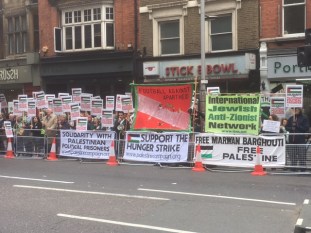
On May 6th as the strikers entered the 19th day of the strike a day of solidarity was be marked by vigils and demonstrations in 20 cities across the UK, including the one pictured next to the Israeli Embassy in Kensington, London.


Why we are on hunger strike in Israel’s prisons

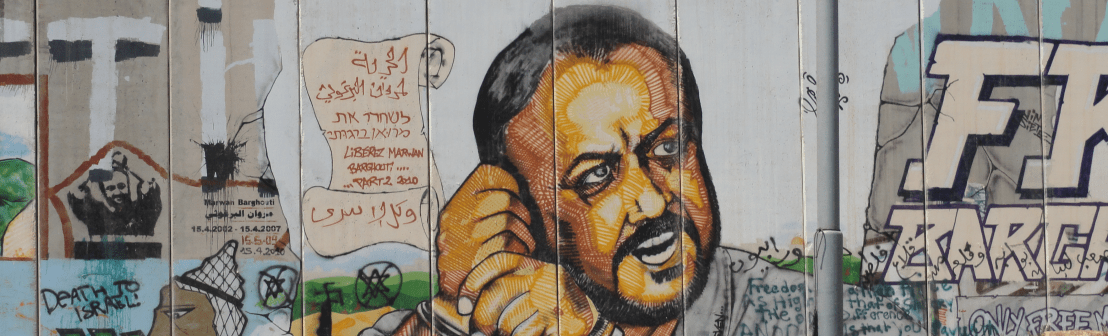
barghouti wall 2By MARWAN BARGHOUTI

APRIL 16, 2017

from the New York Times

HADARIM PRISON, Israel — Having spent the last 15 years in an Israeli prison, I have been both a witness to and a victim of Israel’s illegal system of mass arbitrary arrests and ill-treatment of Palestinian prisoners. After exhausting all other options, I decided there was no choice but to resist these abuses by going on a hunger strike.

Some 1,000 Palestinian prisoners have decided to take part in this hunger strike, which begins today, the day we observe here as Prisoners’ Day. Hunger striking is the most peaceful form of resistance available. It inflicts pain solely on those who participate and on their loved ones, in the hopes that their empty stomachs and their sacrifice will help the message resonate beyond the confines of their dark cells.

Decades of experience have proved that Israel’s inhumane system of colonial and military occupation aims to break the spirit of prisoners and the nation to which they belong, by inflicting suffering on their bodies, separating them from their families and communities, using humiliating measures to compel subjugation. In spite of such treatment, we will not surrender to it.

Israel, the occupying power, has violated international law in multiple ways for nearly 70 years, and yet has been granted impunity for its actions. It has committed grave breaches of the Geneva Conventions against the Palestinian people; the prisoners, including men, women and children, are no exception.

I was only 15 when I was first imprisoned. I was barely 18 when an Israeli interrogator forced me to spread my legs while I stood naked in the interrogation room, before hitting my genitals. I passed out from the pain, and the resulting fall left an everlasting scar on my forehead. The interrogator mocked me afterward, saying that I would never procreate because people like me give birth only to terrorists and murderers.

A few years later, I was again in an Israeli prison, leading a hunger strike, when my first son was born. Instead of the sweets we usually distribute to celebrate such news, I handed out salt to the other prisoners. When he was barely 18, he in turn was arrested and spent four years in Israeli prisons.

The eldest of my four children is now a man of 31. Yet here I still am, pursuing this struggle for freedom along with thousands of prisoners, millions of Palestinians and the support of so many around the world. What is it with the arrogance of the occupier and the oppressor and their backers that makes them deaf to this simple truth: Our chains will be broken before we are, because it is human nature to heed the call for freedom regardless of the cost.

Israel has built nearly all of its prisons inside Israel rather than in the occupied territory. In doing so, it has unlawfully and forcibly transferred Palestinian civilians into captivity, and has used this situation to restrict family visits and to inflict suffering on prisoners through long transports under cruel conditions. It turned basic rights that should be guaranteed under international law — including some painfully secured through previous hunger strikes — into privileges its prison service decides to grant us or deprive us of.

Palestinian prisoners and detainees have suffered from torture, inhumane and degrading treatment, and medical negligence. Some have been killed while in detention. According to the latest count from the Palestinian Prisoners Club, about 200 Palestinian prisoners have died since 1967 because of such actions. Palestinian prisoners and their families also remain a primary target of Israel’s policy of imposing collective punishments.

Through our hunger strike, we seek an end to these abuses.

Over the past five decades, according to the human rights group Addameer, more than 800,000 Palestinians have been imprisoned or detained by Israel — equivalent to about 40 percent of the Palestinian territory’s male population. Today, about 6,500 are still imprisoned, among them some who have the dismal distinction of holding world records for the longest periods in detention of political prisoners. There is hardly a single family in Palestine that has not endured the suffering caused by the imprisonment of one or several of its members.

How to account for this unbelievable state of affairs?

Israel has established a dual legal regime, a form of judicial apartheid, that provides virtual impunity for Israelis who commit crimes against Palestinians, while criminalizing Palestinian presence and resistance. Israel’s courts are a charade of justice, clearly instruments of colonial, military occupation. According to the State Department, the conviction rate for Palestinians in the military courts is nearly 90 percent.

Among the hundreds of thousands of Palestinians whom Israel has taken captive are children, women, parliamentarians, activists, journalists, human rights defenders, academics, political figures, militants, bystanders, family members of prisoners. And all with one aim: to bury the legitimate aspirations of an entire nation.

Instead, though, Israel’s prisons have become the cradle of a lasting movement for Palestinian self-determination. This new hunger strike will demonstrate once more that the prisoners’ movement is the compass that guides our struggle, the struggle for Freedom and Dignity, the name we have chosen for this new step in our long walk to freedom.

The Israeli authorities and its prison service have turned basic rights that should be guaranteed under international law — including those painfully secured through previous hunger strikes — into privileges they decide to grant us or deprive us of. Israel has tried to brand us all as terrorists to legitimize its violations, including mass arbitrary arrests, torture, punitive measures and severe restrictions. As part of Israel’s effort to undermine the Palestinian struggle for freedom, an Israeli court sentenced me to five life sentences and 40 years in prison in a political show trial that was denounced by international observers.

Israel is not the first occupying or colonial power to resort to such expedients. Every national liberation movement in history can recall similar practices. This is why so many people who have fought against oppression, colonialism and apartheid stand with us. The International Campaign to Free Marwan Barghouti and All Palestinian Prisoners that the anti-apartheid icon Ahmed Kathrada and my wife, Fadwa, inaugurated in 2013 from Nelson Mandela’s former cell on Robben Island has enjoyed the support of eight Nobel Peace Prize laureates, 120 governments and hundreds of leaders, parliamentarians, artists and academics around the world.

Their solidarity exposes Israel’s moral and political failure. Rights are not bestowed by an oppressor. Freedom and dignity are universal rights that are inherent in humanity, to be enjoyed by every nation and all human beings. Palestinians will not be an exception. Only ending occupation will end this injustice and mark the birth of peace.

Marwan Barghouti is a Palestinian leader and parliamentarian


Barghouthi prepares for hunger strike over prison conditions

Israel’s brutal treatment of its 6,000 Palestinian conflict prisoners – largely ignored by the media – will be forced into the headlines by Marwan Barghouthi’s threat to go on hunger strike on Easter Monday if the prisoners’ demands are not met.

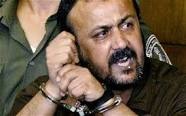
Marwan Barghouthi (right) was the general secretary of Fatah during the second intifada when he was abducted from the streets of Ramallah obarghouthin April 15 2002 by Israeli secret servicemen and sentenced to life imprisonment by an Israeli court.

He remains the most popular politician in Palestine according to the opinion polls despite spending the last 15 years in jail.

He has been wary of using the weapon of hunger strikes in the past, but now feels the deterioration in the way Palestinian prisoners are treated leaves no option.

The prisoners’ first demand is the reinstatement of fortnightly visits from their families after they were reduced to just once a month.

Israeli prisons fail to provide adequate food and shelter for Palestinian prisoners forcing them to rely on food and clothing brought by relatives. As the Jerusalem-based civil rights organisation Addameer says: “The military prison authority provides detainees with basic food rations. The provided rations do not meet necessary daily requirements, both in terms of quality and nutritional value.”

Prisoners also want an end to solitary confinement and ‘administrative detention’ – effectively internment without charge or trial, plus a resumption of the Hebrew Open University program allowing Palestinian prisoners to access education and to take school exams while in prison.

Medical issues are also central to their demands. They call for the closure of Israel’s Ramla prison hospital where many Palestinians are treated, due to its “inadequacy in providing medical care,” and quick and urgent surgery when needed.

Barghouthi believes the Israeli government is using the distractions of Trump, Syria and the Fatah-Hamas conflict to engage in a one-sided war against Palestinian prisoners.  Despite attempts to dissuade him, Barghouthi, who is 57, believes he has a responsibility to resist repressive measures against those who have no protection. Hundreds of prisoners will join the hunger strike alongside him.

According to the latest figures from the Israeli Prison Service, there were 5,988 Palestinian conflict prisoners in Israeli jails in August 2016, including 644 jailed without charge, 335 under 18, 57 women and two under the age of 14.  Some have been in prison more than 30 years.