Israel to demolish West Bank Bedouin village, ending year-long legal battle

The village, along with its tire school, has become the flagship of the fight against the removal of Palestinians from Area C, which is under full Israeli control

Amira Hass | May 25, 2018 

The High Court of Justice has approved the planned demolition of the village of Jahalin at Khan al-Ahmar in the West Bank, along with the village’s school made out of tires. The High Court has allowed the demolition at any time the government sees fit as of next month.

On Thursday, the court rejected two petitions against the demolition from residents of the village and from parents of children at the school who come from surrounding Bedouin communities. Justice Noam Sohlberg wrote in the ruling that the structures were built illegally and that no reason existed for the court to intervene in the defense minister’s decision to demolish them. Justices Anat Baron and Yael Willner concurred.

In August, Defense Minister Avigdor Lieberman announced that his ministry was preparing to remove the residents from Khan al-Ahmar and Sussia after all requests by the villages for a master plan and building permits where they had lived for decades were turned down. The petitions by the Jahalin residents were filed by attorney Shlomo Lecker. Over the past decade, both communities have become the flagship of the fight against the removal of Palestinians from Area C, which is under complete Israeli civil and military control.

The state is demanding that the approximately 200 residents of Khan al-Ahmar and Abu Hilweh move to an area that has been allocated to them by the Defense Ministry’s Civil Administration on land in the area of the town of Abu Dis (which was declared state land) and built houses on the lots where the Civil Administration is preparing infrastructure. A new school is also to be built in that area.

The area is on the edge of a half-urban Bedouin community where the state settled dozens of Bedouin families at the end of the 1990s, after it evacuated them from an area where they had lived for decades that was earmarked for the expansion of the city of Ma’aleh Adumim. Some of the families were forcibly evacuated at the end of the 1990s, while others agreed to move to the town following negotiations and in exchange for financial remuneration and grazing land.

The High Court ruling may become a precedent for dozens of other Bedouin communities that oppose the Civil Administration’s intention to concentrate them in permanent towns in the West Bank, including a town near Abu Dis (known as Jabel Jahalin or Kafr Jahalin). Thus they will have to urbanize their lifestyle.

To read mot#re


Burt u-turns on UN inquiry and calls for internal Israeli army inquiry instead

The UK’s European partners Spain, Belgium and Slovenia were among the 29 current member countries of the UN Human Rights Council that voted overwhelmingly to set up a UN inquiry into the killings.

Only the US and Australia voted against.

The UK voted for similar UN inquiries into the Gaza assault of 2014 and the earlier Gaza assault of 2008-9, known as the Goldstone Report.

Since the Gaza protest began on March 30 and the Israeli army started shooting unarmed protesters, Alistair Burt has been calling for an inquiry – and in the last few weeks he has explicitly called for an international inquiry under the UN’s auspices.

The language changed quite abruptly last week when the UK refused to support a motion to set up an international inquiry at the UN HCR in Geneva on the grounds that it did not explicitly mention Hamas.

On Monday he went further and called for an internal Israeli inquiry instead (though with an international ‘element’).

This was seen by many as a victory for Conservative Friends of Israel, who argued in the Commons that (a) Hamas was mainly responsible for the killings and (b) the Human Rights Council was ‘biased against Israel’.

Here are extracts from the debate in the Commons on Monday May 21st:

Richard Burden (Birmingham, Northfield) (Lab):  To ask the Foreign Secretary if he will make a statement on the decision of the UK Government to abstain from voting on the resolution of the United Nations Human Rights Council held on 18 May, calling for an independent investigation into recent violence in Gaza.

The Minister for the Middle East (Alistair Burt): We abstained on calls for a commission of inquiry into recent violence in Gaza during the UN Human Rights Council session on Friday. The substance of the resolution was not impartial and it was unbalanced. We could not support an investigation that refused to explicitly examine the action of non-state actors such as Hamas. An investigation of that kind would not provide us with a comprehensive assessment of accountability. It would risk hardening positions on both sides and move us further away from a just and lasting resolution to the Israeli-Palestinian conflict.

However, the United Kingdom continues to fully support the need for an independent and transparent investigation into recent events. We call directly on Israel to carry out a transparent inquiry into the Israeli Defence Forces’ conduct at the border fence and to demonstrate how this will achieve a sufficient level of independence. We believe this investigation should include international members. We urge that the findings of such an investigation be made public, and, if wrongdoing is found, that those responsible are held to account. The Foreign Secretary stressed the importance of Israel conducting an independent investigation when he spoke to Prime Minister Netanyahu on 16 May.

Richard Burden: Last Tuesday, the Minister assured the House that he endorsed calls for an international, independent and transparent inquiry into the appalling events unfolding in Gaza, yet when United Nations Human Rights Council resolved on Friday to set up a commission of inquiry to undertake precisely that kind of investigation, the UK failed to join 29 partner countries and instead abstained from the vote. The Government alleged that, as the Minister said today, the UN Human Rights Council resolution was “partial, and unhelpfully unbalanced”. May I remind the Minister that the remit of the UN inquiry is to investigate “all violations of international humanitarian law and international human rights law” and that it calls on Israel and “and all relevant parties” to co-operate fully with the inquiry? That includes Hamas and other Palestinian factions, as well as Israel. Which bit of the resolution and the remit do Ministers not understand?
May I put it to Minister that the Government’s feeble response to last week’s events in Gaza only encourages the culture of impunity that the Government of Israel too regularly display these days, apparently believing that whatever they do, they will in practice never be held to account? Will the Minister confirm that now the UN Human Rights Council has made its decision, the UK Government will get behind it? What consequences ​should follow if Israel, or anybody else, either refuses to co-operate with the inquiry or is otherwise found to be in breach of international law?

Alistair Burt: I draw attention to the detail of the resolution, which names the state of Israel in many cases right the way through. That follows a clear demonstration by the UN Human Rights Council in the past of a biased view towards Israel. I think it was the general nature of the resolution, clearly specifying Israel as opposed to any other, that caused concern. We of course were not alone. This is not a matter on which the United Kingdom is alone. There were 14 other abstentions, including by four other EU members, so it is not a question of the United Kingdom taking one view on this; it is a question of other states believing that if we want to get to the truth, it will have to be done another way.

I said last week, and I repeat, that we want an independent and transparent inquiry. The House has heard me say again today that if it is carried out by Israel, it must have an international element to it. It is very clear that if it is done solely by the Israeli legislative and judicial system, it is unlikely to carry the sort of confidence that the international community is looking for. That is what we will continue to press for, but this resolution in itself will not do the job we all want to see.

Emily Thornberry (Islington South and Finsbury) (Lab): I join Richard Burden in welcoming the independent UN investigation into violence in Gaza. While we have already heard debate about the wording of the resolution agreed by the Human Rights Council, I have to say, as I did last week, that that debate is frankly immaterial as long as the objective of setting up an independent investigation is achieved.​
The issue today is why the British Government, which claimed repeatedly last Tuesday to support that objective, chose three days later not to vote for it. The crux of that decision was made clear in the Government’s statement on Friday, which called for the Israeli authorities to be allowed to conduct their own so-called independent inquiry. If that sounds like a contradiction in terms, I am afraid we should not be remotely surprised. After all, this is the Government that say that Saudi Arabia should be allowed to investigate itself for bombing weddings in Yemen. This is the Government that say that Bahrain should be left to investigate itself for torturing children in prisons. Time and time again we see this: if you are an ally of the Government, you get away with breaking international law with impunity, and you are also allowed to be your own judge and jury, too.
Before the Minister gets up and extols the virtue of the Netanyahu Government, may I remind him of the last time that that Government were allowed to investigate themselves over an alleged breach of international law? In July 2014, four children were blown to pieces on Gaza beach while playing hide and seek in a fisherman’s hut. And the resulting investigation: a blatant piece of nonsense, full of basic untruths, exonerating the IDF completely and saying that the old fisherman’s hut was in fact a Hamas compound. That is what an independent investigation by Israel looks like. That, instead of an international commission of inquiry, is what this Government on Friday decided to support, and that is nothing short of a disgrace.

Alistair Burt: Of course I read her tweets over the course of the weekend. I remind her that among the other Governments that she was calling disgusting are those of Germany, Japan and, as I said, four other EU partners. It shows how careful we have to be in relation to this. Let me quote what the United Kingdom said in relation to the explanation of vote:

“Our abstention must not be misconstrued. The UK fully supports, and recognises the need for an independent and transparent investigation into the events that have taken place in recent weeks, including the extent to which Israeli security forces’ rules of engagement are in line with international law and the role Hamas played in events. The loss of life, casualties and volume of live fire presents a depressingly familiar and unacceptable pattern. This cannot be ignored.
To that end, in addition to abstaining on today’s resolution, we call directly on Israel to make clear its intentions and carry out what must be a transparent inquiry into the IDF’s conduct at the border fence and to demonstrate how this will achieve a sufficient level of independence. This investigation should include international members. The death toll alone warrants such a comprehensive inquiry.”

If we want to get to the bottom of this and find out what happened, I maintain that the HRC resolution was not the way to do it. We want the inquiry to succeed. That, we believe, is what we defended last week and will continue to pursue.

David Linden (Glasgow East) (SNP): We welcome the Human Rights Council resolution calling for an urgent independent investigation into the horrific killing of unarmed protestors in Gaza. It was a disgraceful decision of the UK to abstain from the HRC vote, and it flies in the face of previous statements from the Prime Minister and other Ministers in this House calling for an independent investigation. Given the mixed messages from the UK Government, will they now set the record straight and make it clear to the Israeli Government that deadly actions against protestors will not be tolerated by the international community? Finally, following this horrific incident, will the Foreign Secretary commit to joining his allies in concerting international pressure on the Netanyahu Government to lift the blockade on Gaza and put an end to Israel’s illegal occupation of the Palestinian territories?

Alistair Burt: In answer to the first part of the hon. Gentleman’s question, I refer to what I said earlier. In relation to the second, one thing that was clear from last week’s discussion at the UN Security Council was the recognition that, in the absence of being able to make any serious immediate move on the Middle East peace process, which ultimately will be the best way to overcome the issues at the heart of this, the international community —and Israel, Egypt and others with entry into Gaza—should first make changes and drive forward developments, including to infrastructure in Gaza, to change the nature of the lives of the people there. The UK firmly believes that, whatever else might have been behind the events of last week, the long-standing frustrations of the people of Gaza, caused by pressures upon them from more than just Israel but including Israel, should be relieved. We support the efforts that will be made to improve the conditions in Gaza.

Crispin Blunt (Reigate) (Con): Given that Gazans did all the dying and the Israeli soldiers did all the killing, how does the Minister expect an internal Israeli inquiry led by Brigadier General Baruch to be less partial and less unhelpfully unbalanced than the inquiry mandated by the UN Human Rights Council?

Alistair Burt: With respect to my friend, until we see the make-up of the inquiry process, we will not know the answer to that. I made it very clear that if Israel is not only to undertake its legal obligations for what has happened on its territory but to fulfil its own processes, an international element to the investigation will clearly be one of the most important things, and that should bring the transparent and independent element that the UK and others have called for in order to find out the answers to these questions.

Sir Desmond Swayne (New Forest West) (Con): Human rights are constrained and violence exacerbated by a water shortage that the UN says will render Gaza entirely uninhabitable by 2021. Does anyone have a plan?

Alistair Burt: I said during my statement last week that I had recently met the Quartet’s economic director, looking at existing proposals for improving the infrastructure in Gaza, including the water infrastructure. Again as I mentioned, it is clear to anyone who goes there what the circumstances are and how desperate the water and other situations are. The infrastructure needs improving, and improving quickly, and all parties involved in Gaza need to take steps to make sure it happens.

Paula Sherriff (Dewsbury) (Lab): Israel has maintained a temporary occupation for 51 years. It builds settlements illegally, demolishes homes illegally, confiscates land and water from occupied territory and blockades Gaza by air, land and sea. At what point do these illegal acts ever meet with any consequences?

Alistair Burt: I think that the circumstances of last week indicate—as the United Kingdom Government have said on many occasions—that there is no status quo in relation to Gaza. Conditions are getting worse, and circumstances are getting worse. As we rightly call on Israel in relation to issues such as settlements, in relation to Gaza we remain of the view that until these issues are settled there is no future, and no future for peace in the region.

Jo Swinson (East Dunbartonshire) (LD): Israeli forces have killed dozens of protesters and injured thousands in an appalling escalation of violence. I am sure the Minister will agree that the lethal use of firearms is legal only if it is unavoidable, to protect life. Given that Israeli officials have authorised soldiers to fire live rounds at people trying to damage or even coming within 100 metres of the border fence, how can he possibly have confidence in an investigation led by those officials rather than by independent voices?

Alistair Burt: As I said earlier, I believe that an independent element in any investigation is vital if anyone is to feel confident about finding out whether or not the circumstances were as She has described them.

Bob Blackman (Harrow East) (Con): Given that 50 members of Hamas and three members of Islamic Jihad were killed, and given that Hamas has now admitted that one of those incidents involved a gunfight between its members and the IDF, has he any confidence at all that Hamas will co-operate with any independent inquiry?

Alistair Burt: That, of course, will be a matter for the inquiry itself. Just as we are not rushing to prejudge an inquiry by not supporting a resolution that we felt would have led to an unbalanced inquiry, I am not prepared to say that there is evidence that Hamas would or would not co-operate with any inquiry into what happened in relation to the allegations made about it.

Grahame Morris (Easington) (Lab): The Minister does not like the UNHRC. He says that there must be another way. There is little or no confidence in the United States acting as an honest broker. What discussions are the UK Government having with other EU Governments about restoring the original United Nations mandate over the occupied Palestinian territories to make a more serious move on an international peace process?

Alistair Burt: I remind the House that we joined European allies—Germany, Slovakia, Hungary and Croatia—in the vote last week, so we are indeed talking to our European allies about what might be the best way to proceed. I do not think there is any clear pathway yet beyond what I have already indicated: the inquiry must have a transparent and independent element.

John Lamont (Berwickshire, Roxburgh and Selkirk) (Con): Does he agree that Israel is the only properly functioning democracy in that part of the world, and that it is right for it to be able to defend itself against aggression and terrorism, as it has done so successfully for the last 70 years?

Alistair Burt: By supporting an independent and transparent element in its inquiry, Israel has an opportunity in these circumstances to ensure that its long-standing statement of democratic principles is demonstrated to the rest of the world.

Andy Slaughter (Hammersmith) (Lab): The Government of Israel will not tolerate any independent scrutiny of their actions, and increasingly obstruct and persecute international and domestic human rights organisations. What representations has the Minister made about the current plan to deport Omar Shakir, the well respected director of Human Rights Watch in Israel?

Alistair Burt: The first part of his question demonstrates the difficulty of dealing with the issue. He has already made up his mind about all this, and he is welcome to do that, but, as I have said, the United Kingdom Government cannot.

I have made no personal interventions in the case of that gentleman. I said last week that immigration processes were for each individual state, but we have made representations about the closing down of political space. We believe it is much better to interact with people than seek to bar them from a country; however, that is Israel’s own immigration right, as it would be ours.

Zac Goldsmith (Richmond Park) (Con): The UN Human Rights Council has held a total of 28 urgent sessions; not one of them has focused on Iran, North Korea, Turkey, Russia, China, Venezuela, Yemen, Crimea, Pakistan, Somalia and so on, yet eight of those 28 have ​been on Israel. Does he agree that that organisation lacks any credibility whatsoever as an impartial observer?

Alistair Burt: The hard truth of what he said stands for itself, and illustrates the degree of difficulty the Human Rights Council now has in relation to Israel in demonstrating its independence and therefore being a credible body. That was one of the influences on the United Kingdom, besides the unbalanced resolution, that a number of our European allies supported.

Rushanara Ali (Bethnal Green and Bow) (Lab): The Minister has stated that the UK decided to abstain because the UK Government accept that the process is likely to be biased. Given the UK’s position that the Israeli Government should lead the inquiry, how can we continue to play the role of honest broker, which has been a very important role for our Government historically, given our unique historical relationship with that region? Can the Minister explain how that is possible?

Alistair Burt: I will endeavour to do so; that is a perfectly understandable and fair question. I draw attention to what we said in terms of the explanation of the vote: “The loss of life, casualties and volume of live fire presents a depressingly familiar and unacceptable pattern. This cannot be ignored.”
We called on Israel directly to “carry out what must be a transparent inquiry into the IDF’s conduct at the border fence and to demonstrate how this will achieve a sufficient level of independence.”

Difficult as it is, the UK taking a more balanced position on this than some enables us to remain in an impartial position in relation to this, which would be lost completely if we jumped one side or the other.

Lyn Brown (West Ham) (Lab): The House of Lords recommended last year that the Government stop treating Israel with kid gloves and display some political robustness.

This Government’s abstention is worse than weak; it is deplorable. How can the people of Palestine trust our Government when we refuse even to look seriously at these issues, let alone challenge them?

Alistair Burt: I understand the force of her response; she is always honest about all these things. I would point to what we said in the explanation of the vote, which clearly raises questions about Israel’s conduct. We seem to be one of the few Governments prepared to consider both sides of these dreadful incidents, and that is why we want to find the truth about what happened.

Mr Alistair Carmichael (Orkney and Shetland) (LD): The United Nations commission of inquiry will be mandated to look at all violations of international law and calls for co-operation from all relevant parties. How do the Government see that as being unbalanced?

Alistair Burt: Mention was made of Israel’s activities a number of times throughout the resolution. There was no mention of Hamas, when it appears to be clear that there was engagement and involvement by Hamas, although no one knows how much. That is a vital part of the investigation, but there is no confidence that it would be part of it.

Clive Efford (Eltham) (Lab): When the Government came to the conclusion that they could not support the resolution, what efforts were made to try to bring together a resolution that everyone could support, so that there could be a fully independent inquiry?
Alistair Burt
He asks a good question. Before any of these resolutions come together, there is a great deal of contact between member states to try to find a way to broker an appropriate resolution. It normally works on the basis of someone putting forward a draft and other parties coming forward with suggestions, but if there cannot be an agreement, something then gets tabled on which people have to vote.

Dr Rupa Huq (Ealing Central and Acton) (Lab)
Both America and Israel are our allies, yet we are powerless when the US moves its embassy and we are onlookers when the UN votes to hold an inquiry into the killings in Gaza. True friends offer advice and criticism, but are we now content just to hold hands rather than holding anyone to account?

Alistair Burt: No, I do not think that that is the case at all. As I said earlier, true friends take a position in which they try as best they can to learn all the facts of the circumstances before coming to any conclusions, particularly in an area as sensitive and difficult as this. That is what we have sought to do.

Jess Phillips (Birmingham, Yardley) (Lab)
Will the UK set out its criteria for assessing the independence, impartiality and effectiveness of an internal Israeli investigation? What action will we take, should those criteria not be met?

Alistair Burt
It was indeed, and her questions are always relevant and to the point. Discussions are still taking place among members of the international community to define exactly what the terms will be. I said earlier that I had spoken to the Israeli ambassador last week, and representations have been made in Israel as well. I have indicated what we believe ought to happen in terms of there being an independent element to any investigation carried out by Israel, and we would like to see that delivered. There will be further consultations on this, as she would expect.

Tom Brake (Carshalton and Wallington) (LD)
As I understand it, one Israeli soldier has been injured, and 104 Palestinians have been killed, of whom 14 were children, and 12,500 have been injured, more than 2,000 by live ammunition. Has Israel’s response been proportionate?

Alistair Burt
Other allegations include 50 or so Hamas operatives being involved and improvised explosive devices being placed at the border fence. There has been a whole series of allegations about what has happened. That is why it is essential to get to the truth. We have already expressed our concern about the amount of live fire, and we stand by that.

Yasmin Qureshi (Bolton South East) (Lab)
The Minister has come to the House a number of times on this issue, and he has accepted the fact that there have been real abuses of the Palestinian people in Gaza through the use of poisonous water, through illegal settlements and through all sorts of cruelty to the Palestinian people, yet the international community rewards Israel with billions of pounds-worth of aid and armaments. Would it not be appropriate, instead of saying that we criticise Israel and condemn what it has done, if we actually took action over what Israel has been doing over the years?

Alistair Burt
She is right to say that I have been at the Dispatch Box several times since 2010 in relation to this matter, and we despair at the fact that the arguments are always familiar. As for the long-term fixing of the issues that she raises, it is we who call the settlements illegal and call for an easing of the restrictions on Gaza, but none of that will be accomplished effectively until there is the political settlement that we are all trying to work towards. The United Kingdom unerringly pushes its determination towards that aim, and we do not believe that continuing to call for that while criticising Israel is necessarily a reward.

Steve McCabe (Birmingham, Selly Oak) (Lab)
Do the British Government have any plans to seek support for a fresh resolution that requires an independent UN investigation, or is the matter now closed as far as they are concerned?

Alistair Burt
I do not think that any investigation is necessarily off the cards. In the first instance, the determination will be for Israel to carry out an investigation, and we have said what we have said about what should accompany that in order to convince the international community. What happens after that will depend on the response to that inquiry.

Mr Jim Cunningham (Coventry South) (Lab)
Following the question of Steve McCabe, regardless of the outcome of the Israeli investigation, surely the Government should try to initiate a further resolution to resolve the problem?

Alistair Burt
It may come down to resolutions at the end of the day, but an agreed mechanism, whereby we can find out what has happened in order to ensure that the circumstances do not arise again, is more likely to be effective. However, that would involve a whole series of other issues that relate to Gaza, as I mentioned earlier, and much determination among the leadership of both Palestine and Israel to ensure that the circumstances do not arise in the future.

Ruth Cadbury (Brentford and Isleworth) (Lab)
Protesting adults and children have been shot in the back and shot while standing hundreds of metres away from the border fence. The Israeli authorities are clearly killing and maiming people in Gaza who pose no threat to them. If this was happening in Iran, the Government would ​completely and utterly condemn it, so why will the Minister not condemn the Israeli authorities for such actions?

Alistair Burt
This is clearly set out in the United Kingdom’s concerns about the whole process: “The loss of life, casualties and volume of live fire presents a depressingly familiar and unacceptable pattern. This cannot be ignored.”

She comes to her own conclusions about what she thinks has happened, but others have different narratives. It is clear that the extent of the live fire has caused casualties that raise prima facie questions about what has happened, which is why we must find out what the answer to that is.

Lloyd Russell-Moyle (Brighton, Kemptown) (Lab/Co-op)
The IDF and people here in this Chamber constantly refer to the “Gaza border” despite it not being internationally recognised. If it is a border, what state are the victims of Israel’s latest shooting spree in? If it is not a fence that entraps 2 million people, will the UK recognise the state of Palestine and push for an independent investigation, not just a whitewash by one party?

Alistair Burt
He makes a series of assumptions, and I understand where he is coming from. As I indicated last week, the United Kingdom will recognise the state of Palestine when it is conducive to the peace process, but there are more processes that must be gone through. If we are to find out what truly happened in Gaza, there must be a better option than that presented by the Human Rights Council last week.

Afzal Khan (Manchester, Gorton) (Lab)
The international community’s immediate focus after last week’s events was on the number of fatalities, but it is also important to dwell on the consequences for the thousands of injured people. Have the Government offered any additional humanitarian assistance to the people of Gaza to ensure that the injured receive the medical treatment that they so desperately need?

Alistair Burt
The short answer is yes. I am in contact with international agencies that are involved in delivering humanitarian medical aid. Gaza’s medical resources, which are already incredibly stretched, will have been put under even greater pressure following the events of the past few weeks. I am looking to see what further the United Kingdom can do beyond the support that we already give to those who provide such help.

The blockade on Israel’s heart

It’s hard to understand how one can look at tens of thousands of people in their cage and not see them. How is it possible to look at these protesters and not see the disaster wrought first and foremost by Israel?

Gideon Levy, Ha’aretz correspondent

What a pleasure it was again Friday, journalists and pundits competing to be the wittiest. One tweeted that the Palestinians burned Goodyear tyres, another that the heads of Hamas stayed away due to their asthma. One referenced the “supertanker” fire-fighting plane Israel called in to battle nationwide fires in 2016. Someone posted a photo of a protester with a swastika, writing: “charming people to make peace with.” A “moderate” commentator said on television that this was a “foolish protest,” beneath his famous intellect. They all, as is their wont, praised the army on its accomplishment: No one crossed the border. The state has been saved from annihilation. Way to go, Israel Defense Forces.

As the witticisms and back-patting made the rounds of social media, 20,000 desperate Gazans were running around in the sand near the fence that imprisons them, crying out for help. Wearing rags, mostly young men, some 65 percent of whom are unemployed, breathing in the black smoke from the tires and knowing that their past, their present and their future are blacker. Some were holding the latest product of Gaza’s arms industry: mirrors. Bedroom mirrors and bathroom mirrors, meant to blind the sharpshooters. Such amusing sights have not been seen here for a long time: 1,350 people were wounded, 293 of them from live gunfire; of those, 20 are in serious to critical condition. Nine bodies as of Saturday morning.

Most were careful not to cross the death line, exactly the way it was in East Germany. The East Germans shot anyone who tried to leave the country, and it was shocking; the Israelis shoot at anyone approaching their fence, and it’s amusing. Soon there might be an electric fence, which will make the army snipers superfluous.

Among those killed was Hussein Mohammed Madi, a 16-year-old boy, and a news photographer who was wearing a bullet-resistant vest marked “press” in English, which did not protect him at all from the moral-army sharpshooter who aimed for his chest. Perhaps the sharpshooter couldn’t read English.

Yaser Murtaja was 30 and had never been out of the Gaza Strip. He recently posted a photograph showing a bird’s-eye view of the Strip. Murtaja wrote that his dream was to take such a picture. Now, perhaps his dream will come true from the heavens. At his funeral Saturday, his body was covered with his blue journalist’s vest.

He wasn’t the only journalist shot by army snipers Friday. Six more were wounded. Their blood is no redder than anyone else’s, but the fact that they were shot proves the army snipers fire indiscriminately and are not choosy about their victims. And all this led to clever comments on social media and compliments for the army in the press.

It’s hard to understand how one can look at tens of thousands of people in their cage and not see them. How is it possible to look at these protesters and not see the disaster wrought first and foremost by Israel? How can we absolve ourselves, putting everything on Hamas and not be shocked for a moment at the sight of the blood of innocents shed by IDF soldiers?

How can a former Shin Bet security service chief instigate a growing protest here over an empty speech by the prime minister at an equally empty ceremony, while this massacre rouses barely a hiccup? This time there are no Qassam rockets, no knives, not even scissors. There’s no terror except “tyre terror” and the “terror march,” as the daily Israel Hayom grotesquely put it.

This time the protest is not violent. Israel doesn’t see this either. It doesn’t see the whites of the protesters’ eyes, it doesn’t see them as human beings, it doesn’t see their despair; it doesn’t see the bitterness of their fate.

When the next natural disaster happens somewhere, Israel will once again send an aid team and everyone will laud Israel’s “Jewish” compassion and its humanity. But no one can deny the hardheartedness that has befallen it, so hard that it blocks humanity and compassion from reaching the heart, which has been scarred and blocked permanently.

Inside the Seditious Seder With Jeremy Corbyn and the Jewdas Group

Most of them didn’t know that Corbyn was invited and when he came he didn’t act like the leader nor they like the led


Amira Hass,  Haaretz Correspondent

Amira Hass

HACKNEY, LONDON – On Tuesday morning, at 7:30 A.M. Gaza time or 5:30 A.M. in London, I awoke to a headline on the popular Israeli news site Ynet: “Britain: Corbyn attends event of group that called for Israel’s destruction.” Given that I had left that very event seven and a half hours earlier, I can say wholeheartedly that the headline should have read: “Corbyn brings the bitter herbs to alternative seder in London.”

Jeremy Corbyn grows horseradish in his garden allotment. Slivers of the pungent root he brought were added to the maror, the bitter herbs, waiting in white plastic cups on round tables in the hall below St. Peter’s Church de Beauvoir, Hackney. These bitter herbs, a glass of whiskey before (begging pardon from my Muslim friends and Jewish friends who keep kosher) and songs in my father’s tongue, Yiddish, destroyed the flu germs that had ruined part of my vacation.

I lost the chance to publish the breaking news about the Labour leader’s healing horseradish because the organizers of the event explicitly asked the 100 participants not to tweet, report in real time on social media, or take photos. Last Monday’s was a private event, and nobody wanted paparazzi to pop up. Even so, somebody was evidently taking photos surreptitiously. Since the photos reached a right-wing British blogger, of all people, who immediately uploaded them to the internet with his distorted interpretation, one would assume that the unknown photographer was a mole planted in advance with a contrarian agenda. In the coming hours, the inaccurate, selective information that the blogger disseminated drove headlines hostile to Corbyn, in social and formal media, occupying more cyberspace than had been devoted to the slaughter of Palestinians in Gaza a few days earlier.

The blog claimed that Corbyn had contributed beet roots to the seder; a simple journalistic inquiry would have shown the roots’ color to be very different. The blogger also said he had a recording of people present at the meal booing when the names of two leaders on the Board of Deputies of British Jews were mentioned (or, as the seder participants put it, “Bored of Deputies”). It is true that there were catcalls, but it’s only partially true. There was much longer booing when Ken Livingstone’s name came up – a former mayor of London and Labourite who had been suspended from the party after saying that Hitler supported Zionism.

The people behind the catcalls and the organizers of the seder define themselves as anti-Zionist Jews, or non-Zionist, or just Jews. They belong to the Jewdas Group – Radical Voices for an Alternative Diaspora, founded in 2005 by young people seeking to reflect socialist-minded Judaism in independent ways, and seeing the Bund as a model.

They seek to free themselves of the identification of Jews with Israel, without conceding their right to criticize Israel’s policy against the Palestinians. They spell the organization’s name Jewdas to remove any doubt that they are Jews, but it’s pronounced like Judas, the ultimate symbol of betrayal in Christian tradition. That symbol nourished 2,000 years of Christian anti-Semitism.

The choice of a name that sounds like the most hated symbol in the eyes of the group’s non-Jewish environment suffices to grasp Jewdas’ nature – provocative, delighting in tongue-in-cheek statements and in needling history and mythology and religion. Its members, atheist and observant and all that’s in between, hang around in radical leftist and pro-Palestinian circles and flaunt their Judaism proudly, including by wearing yarmulkes and Stars of David.

In 2014, Jewdas published a guide for how to criticize Israel while also being aware that anti-Semitism exists and avoiding the trap of anti-Semitic stereotypes and prejudices. In September 2016, it published a Facebook post urging that Livingstone be sent into space “for his own good and everybody else’s, because he won’t shut up, so we are sending him to space where nobody will hear him.” This was interpreted by non-Jews as a call to oust him from the party.

Participate in demonstrations against the extreme right and neo-Nazis, Islamophobia and economic austerity. They party a lot, because being Jewish is fun, and have taken trips to former centers of Diaspora Jewry like Andalusia and Marseilles in what they call “Birthwrong” – as a counter to the Zionist “Birthright” trips to Israel.

Most of the people at the alternative seder were young; many belonged to the LGBT community. Some wouldn’t be considered Jews under traditional Jewish law. Two – a man and a woman – are studying for the rabbinate. Some work as cantors despite not having been formally trained. One couple, who looked Indian, saw the gathering as they walked by and were invited to join, since the Haggadah says, “Let all who are hungry come and eat.”

The seder included a prayer for the release of prisoners and the return of refugees. Participants sang a Yiddish hymn whose author, Shmerke Kaczerginski, dedicated it to the young fighters of the Vilna Ghetto; one elderly participant reminded all that the Warsaw Ghetto revolt began on Pesach eve. The Jewdas Haggadah also included Bella Ciao, an Italian partisan song in Yiddish translation. Also included was Rachel Bloom’s poem “remember that we suffered,” and its immortal words: “have we mentioned hitler?” In addition, they sang “The Internationale” in English and Hebrew. Corbyn joined in, or at least lip-synched.

They enacted a neoliberal dialogue in English between Pharaoh and his CEO over how to increase Egypt’s profits. The answer: Stop paying the workers. Corbyn laughed with everybody else. Each table was asked to propose ways of fighting Pharaoh. One table parodied a purist, isolationist left. Corbyn laughed in open delight. Others said humor alone wouldn’t topple capitalism; the slaves had to form a union that would declare a general strike in Egypt.

There were good jokes and bad ones, including what seemed (at least to older participants) like excessive and infantile use of the word “fuck.” The price was five British pounds per person, not including wine, grape juice or matzah, which everyone was supposed to bring for themselves. The church was paid 230 pounds for use of its hall. One member worked for three days to prepare vegan food for everyone, using Persian recipes she learned at home.

Most participants, including several organizers, didn’t know that one member of the group had invited Corbyn; they were surprised when he arrived with his wife Laura. He didn’t act like the leader and they didn’t act like the led.

Corbyn said the blessing over Elijah’s Cup, as written in the Jewdas Haggadah: “Legend has it that the prophet Elijah will come at some point to announce the coming of the messiah. We fill up the cup and open the door just in case Eli is outside waiting. As radical Jews, we understand ‘the Messiah’ as ‘the messianic age’ or ‘redemption’ or ‘revolution.’ So let’s fill this cup with the hope that socialism and revolution will be upon us soon.”

The seder table also had a Miriam’s Cup, “to remind ourselves of the women whose stories are often hidden from the seder, and everyone who is oppressed in a patriarchal society.” And there was a Geoffrey’s Cup – named for the group’s imaginary spokesman “Geoffrey Cohen” – “as a symbol of our struggle with the Jewish establishment.”

Last year’s Haggadah included a “prayer against the state of Israel” by “Geoffrey,” which urged, “Please god smash the state of Israel. Smash it in the abundance of your love and judge it.” Jewdas members believe this is what led the blogger to assert that it called for Israel’s destruction, and thus to suggest that Corbyn’s participation in the seder was evidence of either anti-Semitism or blindness to it.

According to the British media, however, the blogger based himself on a December 2017 tweet which said, “Israel is a steaming pile of sewage which needs to be properly disposed of.” Of this quote, one Jewdas member said, “That was surely some nonsense that somebody tweeted in anger.”

Tuesday morning, Corbyn’s participation in this non-Zionist Jewish seder was indeed depicted as further evidence of his insensitivity to anti-Semitism. As evidence it was mentioned that this dissident Jewish group even dared to claim that the recent organized protest against anti-Semitism in Labour stemmed less from a desire to fight anti-Semitism than from a desire to oust Labour’s elected leader because he’s a socialist and supports Palestinian rights.

But later in the day, the tone changed, as people stopped relying on the blogger and instead investigated the details for themselves and studied Jewdas’ history. The organization received additional donations, and one person wrote on its Facebook page, “I had never heard of Jewdas before Monday but now  I think I’ve found my people.”

Why Israel backed down on eight of 12 charges in Ahed Tamimi show trial

Fadi Quran

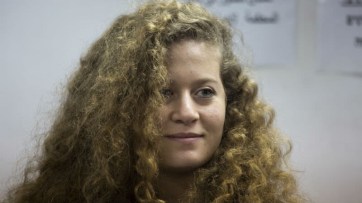
The Israeli military was forced to give in and drop eight of the 12 charges against 17-year-old Palestinian girl Ahed Tamimi (below) as part of a plea bargain, in which Ahed recognized in court the fact that she slapped the soldier and called for protests.

In return, Ahed will get the minimum sentence of 8 months instead of spending at least 3 years in prison based on what the military prosecutor was initially seeking. Lawyers at Ofer Military Court told us we would be lucky if they offered a 2 year plea bargain.

But now, Ahed will be out in July — early enough to go to her first year in college. For the next 4 months in prison, Ahed will focus on her studies and take her final year exams.

Ahed’s mother, Nariman, will also be released at the same time.

The fact that a child will be jailed for 8 months for slapping a soldier whose troops just shot her 15 year old cousin in the face is extreme, but in the context of the 99% conviction rate in the Israeli military court system and right-wing incitement against Ahed, this compromise by the Israeli military shows they have decided to back down in the face of growing pressure to release Ahed.

In fact, they were begging Ahed’s lawyer, Gaby Lasky, to accept the plea bargain. Below are the 3 main reasons why the Israeli military was forced to back down, and give Ahed the minimum possible sentence:ahed sentenced

(1) Ahed refused to be coerced so there wasn’t enough evidence to convict her. Israel subjected Ahed Tamimi to intense military interrogations led by a member of Israel’s military intelligence. The interrogation tactics were meant to coerce her into admitting guilt on the 12 charges brought against her.

Detained children, who are often beaten, disoriented, and afraid, end up saying anything the interrogator wants them to — but Ahed courageously maintained her right to remain silent throughout the entire interrogation.

Unable to break Ahed, the Israeli military arrested 10 other Palestinians from Nabi Saleh, 8 of them children. These children also remained steadfast and refused to allow the military to coerce them into giving false testimony to indict Ahed.

Hence, the prosecutor did not have enough evidence to indict Ahed, which made it difficult to complete here trial, especially while it was garnering significant international attention.

(2) Ahed’s case created massive global uproar from citizens to diplomats: millions around the world watched in shock as a 16 year old girl was terrorized, and Israel failed to spin the story.

After a massive right-wing Israeli campaign calling for the arrest, and sometimes even murder, of Ahed, which was followed by her arrest, Ahed quickly became a symbol of Palestinian children. Dozens of media networks flocked to cover her story, and in so doing shed a spotlight on the detention of Palestinian children in Israeli military courts.

Over 1.75 million people around the world took action with Avaaz and demanded that Ahed and Palestinian children be released. Amnesty and Human Rights Watchjoined her campaign — and news networks from the BBC to Xinhua, and from CNN to Al Jazeera reported her story.

In an effort to spin the story in Israel’s favor, former Israeli Ambassador to the United States, Michael Oren, claimed that the ‘Tamimi family were actors’, which journalists did not buy. Oren further claimed that the Knesset had a committee investigating the “authenticity” of the family, which was quietly ridiculed in diplomatic circles as a sign of Israel’s paranoia and its inability to humanize Palestinians.

In a last ditch effort to defame the Tamimi family, 15 year old Mohammad Tamimi, whose skull was shattered when a soldier shot him in his face, was arrested. Ahed slapped the soldier because she heard her cousin Mohammad was shot and in critical condition — and that story intensified global support for her case. The Israeli military interrogated Mohammad and successfully coerced him into saying he got his head injury (a third of his skull was missing and he needed surgery to replace it) from falling off of a bicycle. Major General Yoav Mordecai posted Mohammad’s “confession” on his Facebook page.

However, the Tamimi family quickly released x-rays, footage, and hospital records that proved without a doubt that Mohammad was shot, forcing the military to retract.

Diplomatically, many nations that were already worried about the ill-treatment of Palestinian children in Israeli military prisons spoke up. The EU said it was “deeply concerned” about the arrest of minors. Diplomats from around the world were mobilised to watch Ahed’s hearing, with representatives from Germany, France, Belgium, Spain, and many others attending her trial.

(3) Ahed’s arrest was supposed to deter Palestinian youth but instead it inspired them to organise

The Israeli military hoped that the arrest of Ahed would deter the youth of Nabi Saleh (Ahed’s village) and Palestinians across the region from protesting. What happened was the opposite: The youth were inspired by Ahed’s agency, and protests in Nabi Saleh and elsewhere became larger and more intense.

Youth from the villages around Nabi Saleh also joined its protests. And Palestinian students began the process of organising a #March_for_our_freedom. Fearing further upheaval, and unwilling to make Ahed a bigger hero, the Israeli military was forced to give in and drop 8 of the charges against Ahed. Instead of spending over 3 years in prison based on what they had initially pursued, she will now be out in July — early enough to go to her first year in college. The only thing she was booked for were the things in the video — slapping a soldier and calling for protests.

They dropped the charge of inciting to bombings and stabbings for her and her mother, and the charge of stone throwing. For the next 4 months in prison, Ahed will focus on her studies and take her final year exam.

It is essential that we tell Ahed’s story as it is, one of steadfastness in prison and a failure by the military to break her. In court, Ahed said: “There is no justice under occupation.”

She’s right, and that’s why this plea deal, as unfair as it is, was the best she could hope for and the biggest possible compromise the Israeli military, under pressure, could give. There are 356 children, all like Ahed, still in military confinement. Every year over 750 children are arrested. Let’s continue to take action until they are all free.
Check out the HUGE campaign to free Ahed and all Palestinian children

Look here: https://secure.avaaz.org/campaign/en/free_ahed_global_loc/

How does closing schools for 500,000 children help anti-radicalisation?

Chris Gunness from the UNRWA, the United Nations organisation that looks after Palestinian refugees, gave this briefing in London recently on the effect of Trump’s cuts in UNRWA funding

Our biggest single state donor is the US. Last year we received $365 million and we had
CHRIS-GUNNESSbeen led to believe by the American administration that we would get exactly that amount this year. In the second week of January we got a cheque for 60 million and we were quite surprised. When we made repeated enquiries to our interlocutors in Washington it became clear that that is all we could expect for this year. So our budget which is $1.2 billion was suddenly reduced by at least $300 million.

Now let me talk about the potential impact of that. 525 thousand students in UNWRA schools in the Arab states and territories around Israel may not get an education. Nine million patient visits which is what our 140 primary health clinics give to Palestine refugees every year may stop functioning. 1.7 million food-insecure Palestine refugees may not receive food. That is in places like Syria where we have 400,000 at least Palestine refugees wholly dependent on UNWRA for food. In Gaza alone there are one million food-insecure refugees and by the way as a matter of political choice, that figure has gone from about 80,000 people in the year 2000, to nearly one million today,  so as a matter of political choice the international community has taken the decision to make one million people food insecure in an economy where there is over 60 per cent unemployment.

We hear a lot about radicalisation: one hears it from western politicians, one hears it from American politicians, one hears it from British politicians and European politicians. Can I ask rhetorically of them but also of you, how can it be in the interests of the anti-radicalisation narrative, to have over half a million children on the streets of the Middle East, at a time when extremist groups are in full recruitment mode?

How can it be in the interests of an anti-radicalisation narrative to have a million hungry, angry, increasingly ill-educated children in UNWRA schools become non- functioning. How can that be in anyone’s interest?

And on the subject of radicalisation allow me to make a slightly more profound thought: whatis Gaza? It is essentially a closed Palestinian community where there are appalling human rights abuses that take place on a daily basis, where political horizons and where personal horizons are deprived of a people who are naturally entrepreneurial and who want nothing more than to be free from the indignity of aid dependence. What is Yarmouk? Yarmouk is a refugee camp on the southern reaches of Damascus which was taken over by Isis in 2014. It is an enclosed Palestinian community with a ring of steel around it where there is an enormous and appalling denial of human rights on an industrial scale where there are no political or personal horizons, What is  Ein El Hilweh in Lebanon? It is an  enclosed Palestinian society where there are appalling human rights abuses where people have no political or personal horizons. What is Al Walaja in the West Bank? The list goes on.

And the point I am trying to make is that what defines Palestinian identity  increasingly is this experience of confinement, of rights abuses, of the deprivation of personal and political horizons and that is why I wholeheartedly agree with what our ambassador has said that there has to be a political solution. That alone will solve UNWRA’s economic crisis and that indeed will solve the political crisis confronting the scattered communities around the Middle East.

I want to end by telling you a story and I think it speaks to the anti-radicalisation argument. When after the 2014 war our schools gathered together at the beginning of the academic year the first thing that happened is that there was a roll call. There was a roll call because our school kids had to learn who had been killed in the war. They had to learn which of their classmates had been so badly maimed they could not get to school. Now imagine your children going to school and starting the academic year and having to begin by trying to get their heads around their classmates who had been killed. UNWRA’s work in that situation was to employ  a socio-economic adviser/practitioner in each of our schools and they worked tirelessly to work through the traumas. Our doctors, last time I was in Gaza in November, said to me: There is an epidemic of psycho-social problems. There are tens of thousands of children in Gaza who simply have no sense of a future, who are deeply disturbed by three wars within the last nine years. I say to you thank you. Behind all these macro-economic statistics there are individuals whose dignity and individuality must be respected. So thank you for supporting us.


Ask your MP to write a letter to UNICEF

Please send this letter from Military Court Watch to your MP:

Dear ……….

March 6 marked 5 years since UNICEF published the report – “Children in Israeli Military Detention”. As you know the report concluded that the ill-treatment of children who come in contact with the military detention system appears to be “widespread, systematic and institutionalised”.

During the intervening years UNICEF issued 2 updates to its report in October 2013 and February 2015. While acknowledging that there have been some positive developments UNICEF ultimately concluded that the levels of alleged abuse have not significantly decreased.

To mark the anniversary MCW has issued a short statement – https://is.gd/JkxqUY

One issue we highlight in the statement is that UNICEF has now gone silent – no updates to the report for 3 years. UNICEF has not publicly stated why they have gone quiet but we do know that they have come under sustained pressure.

Can you please write a letter to the head of UNICEF in Jerusalem, thanking the organisation for its important work, and urging the organisation to release a 3rd update soon. The head of UNICEF here is Genevieve Boutin – gboutin@unicef.org
Please send a copy to me and to Military Court Watch at: gerard@militarycourtwatch.org

Why social workers are demanding release of Palestinian rights defender

Travel2Palestine has been shown round the Aida refugee camp in Bethlehem by Munther Amira, director of the Aida youth centre, who was arrested by Israeli authorities in December, as reported here in The Guardian

By Filipe Duarte

The arrest and detention of Munther Amira, a 48-year-old Palestinian social worker and human rights defender, has provoked an outcry in the international social work community.
Amira was arrested by Israeli soldiers in Palestine on 27 December 2017 while peacefully participating in a rally in Bethlehem in the West Bank. He was protesting against the detention and alleged mistreatment of Palestinian child political prisoners, including 17-year-old Ahed Tamimi (aged 16 when arrested) who was detained a few days before.
Amira lives and works at the Aida refugee camp in the West Bank, and is the director of the Aida Youth Centre. Amira is also the head of the Popular Struggle Coordination Committee, a grassroots resistance movement formed in 2008. He previously served as secretary-general of the Palestinian Union of Social Workers and Psychologists.
I haven’t met Amira, but his values, dignity and legacy to defend the human rights of Palestinian children are renowned in the international social work community. In a statement released by the British Association of Social Workers(BASW), Amira is described as “a highly esteemed and respected colleague well-known to a number of BASW members”.
On 4 January 2018, when Raed Amira, human rights representative of the International Federation of Social Workers (IFSW) in Palestine, shared on social media the news about Amira’s arrest, I immediately felt that I needed to take action on his behalf. I launched a change.org petition demanding his immediate and unconditional release on behalf of social work core values, and of the thousands of social workers worldwide who are committed to end injustice, oppression and the violation of human rights.
On 7 January, the IFSW issued a statement demanding Amira’s release. This statement has been echoed by several national social work associations in Britain, New Zealand, Palestine, Turkey, the Latin America region and Ireland.
The international campaign to free Amira is growing rapidly. The petition has been signed by more than 13,000 social workers and supporters worldwide and has been sent to the prime minister of Israel, Benjamin Netanyahu. On 15 January, the IFSW also sent letters to relevant agencies at the United Nations, urging them to use their respected offices to support the global movement of social workers and human rights defenders, like Amnesty International.
Amira has had six court hearings since his arrest, and the Israeli military prosecution has extended his detention several times. His trial began on 21 February, and he is being indicted with 13 charges for participating in five separate rallies/protests, such as “participating in a march without a permit” and “throwing stones at Israeli forces”. The military court system in the West Bank has a 99% conviction rate towards Palestinians.
Social workers worldwide must continue to raise awareness about Munther Amira and stand in solidarity with all social workers who protect and defend the rights of children and refugees on a daily basis. Social workers are human rights defenders, they believe in peace and social justice.

Filipe Duarte is a social work scholar and activist

Read this in The Guardian

MPs can put recognition of Palestine back on the parliamentary agenda

mahmoudabbasHopes for a resumption of the peace process are at a particularly low ebb in Palestine.  President Abbas (right)  is refusing to meet Trump’s ‘peace’ envoys Jared Kushner and Jason Greenblatt because he believes Trump cannot act as ‘honest broker’ between the Israelis and Palestinians.

And who can blame him when the American vice-president Mike Pence is on record as saying “we don’t want to be a broker. A broker doesn’t take sides, but America is on the side of Israel.”

The Palestinians believe Trump threw away their most important negotiating chip when he recognised Jerusalem as Israel’s capital.

The refusal of all countries (including the US since George Bush Snr) to recognise Jerusalem and move their embassies from Tel Aviv to Jerusalem has been the one act of international solidarity putting pressure on the Israelis to reach a settlement.

Now Trump is asking the world to wait for his peace plan. Palestinians can be forgiven for asking why should they hang about for a US peace plan when it’s already obvious he is playing them for fools? It’s just yet another delaying tactic, in their view, to give the Israelis time to steal more of their land and build more “facts on the ground”.

With so much scepticism about America’s good faith we have to conclude that America cannot – at least in the short term – resolve the Israel-Palestine conflict for the very reason that Pence gave.  The responsibility falls to European countries such as the UK or France to take the lead.

William Hague started to square up to the task when he said in 2011 that the UK accepts the case for recognition of Palestine and will announce it at a time when it “when it can best help bring about peace”.

Many believe there has been an unacknowledged change of policy. Some trace it back to an angry showdown in 2012 between William Hague and MPs from Conservative Friends of Israel who accused him of being part of a ‘bigoted’ Foreign Office plot against Israel (Simon Walters, Mail on Sunday Political Editor 4 March 2012). Some say that Downing Street blocked the Foreign Office’s recognition plan.

But now, seven years later, Boris Johnson is still saying the UK will recognise Palestine and he’s still waiting for the right time to “play his card”. The analogy with a card game is seen by many as insensitive – while others point out that even in a game of cards you can hold on to a trump for too long.

The fact is there have been many opportunities to recognise Palestine “when it can best help bring about peace” and they have all been missed. They are missing one now. There has never been a better time for the UK to ‘play its card’. The situation cries out for a European initiative.

That is not going to come from the EU itself – as it would require a unanimous vote by all 28 members. So it must come from individual states. France said it would recognise, but Macron now feels he would be too exposed on his own. Many smaller European states – Ireland, Belgium, Luxembourg, Slovenia – are lining up to recognise Palestine as soon as one of the major powers leads the way.  In view of the UK’s history as the country that issued the Balfour Declaration and ruled over Palestine for 26 years, the responsibility falls to us.

Nearly two-thirds of LFI MPs supported the recognition of Palestine

In October 2014 the House of Commons voted 274-12 in favour of recognition. Opinion polls show overwhelming public support among those that have an opinion. The only voices against are coming from the Friends of Israel groups in Parliament or from the Prime Minister.

Little is known about the membership of Conservative Friends of Israel. They used to claim to have 80% of Conservative MP on their books. It may be less now, but not much less. There were only 40 Conservatives among the MPs who voted in favour of recognition.

The House of Commons vote was a catalyst for Labour Friends of Israel.  They did not change their policy, but they rebranded their image.  After years in which they had never used the P-word except in reference to “Palestinian terrorists”, they launched a campaign with the slogan “For Israel, For Palestine, For Peace”.

This helped them in a recruitment drive which saw their numbers increase from 29 to 77.  But it came at the expense of accepting a lot of MPs whose views were very different from the Israeli government and indeed from their sister party in Israel, the Israeli Labour Party.

Of the 77 MPs now listed on the LFI website as ‘supporters’ more than half (39) voted in favour of Palestinian recognition in the last House of Commons vote on the subject in October 2014.  Many of the remainder were not actually MPs at the time of the vote, so in fact nearly two thirds of LFI members who were able to vote (39 out of 61) voted in favour of recognising Palestine.

There is no reason why LFI should not join in a campaign for recognition. But Labour Friends of Israel has never pretended to be a democratic organisation.  An executive committee lays down the policy line.
Recognition will remove a roadblock on the way to peace negotiations
It may seem like an uphill struggle to campaign for recognition when the Government and the majority of Conservative MPs are still apparently opposed, but it is a hill that has to be climbed.

Recognition is the simplest achievable goal, entirely within the powers of the UK government, involving no consultation with other states, costing no money, promised many times in the past.

No one pretends that a UK decision to recognise Palestine will make any immediate difference to the lives of Palestinians in the West Bank or Gaza, but it will remove a major roadblock on the road to peace.

Once Palestine is recognised as a state, legally on the same footing as Israel, it will be so much harder for a British government to justify UK trade with illegal Israeli settlements, to allow UK companies to build the walls, to arm the soldiers, to supply security equipment for the Israeli army of occupation.

On the other hand if we fail to win the battle for recognition, it is difficult to see how we can make progress in any other area. It is a small step, but it will open the gate. That is why the Israelis are trying so hard to prevent it. But we recognised Israel in 1950. It’s now 2018.


End of the masquerade – Trump officially pronounces two-state solution dead

For the last three years the Ha’aretz columnist Gideon Levy has given the address at the ‘counter-AIPAC’ which takes place in Washington before – and in opposition to – the annual conference of the most powerful lobby in the United States, the America-Israel Public Affairs Committee. 

Videos of his 2015 speech went viral with over 400,000 hits on social media. Since then they have invited him back every year to make – as he keeps reminding his audience – essentially the same speech.

It’s a long speech, best heard on the video-link below or read in the full text version, but for those with limited time please at least read the bullet-point version in the seven paragraphs below. 

Gideon Levy in seven paragraphs

1. The military occupation in the occupied territory is today one of the brutal, cruel tyrannies on earth. How dare someone call Israel the only democracy in the Middle East when in its backyard there is one of the most cruel, brutal tyrgideon levyannies in the world. How can you do it? Can you be half pregnant? Can you be half democratic? Can you be a democracy in the front and a tyranny in your backyard?
2. It is not temporary and it will not be temporary if it depends on Israel. There was never an Israeli statesman in an important position and in an influential position, prime minister or so, who really meant to put an end to the occupation – none of them. Some of them wanted to gain time in order to strengthen the occupation. Some others wanted to gain time by getting all kind of interim agreements just for gaining time. Some others wanted to be perceived by the world, to be hugged by the world as people of peace. But none of them had the intention to put an end to the occupation. How do I know it? I don’t know what is in their hearts. I know only one thing. Israel had never stopped building settlements. Anyone who builds one house in the occupied territories has no intention whatsoever to put an end to the occupation, and those bluffs should be called.
3. The hopes for change from within the Israeli society are really, really very minimal. Again, with all due respect to those groups who are fighting; who are not giving up, who are struggling; who are going to demonstrate every Friday in another village against the fence, against the occupation, against all those things – wonderful people including many, many young people – but finally it is a small group and delegitimized. Therefore, people like me, my only hope is from people like you. This is right now the only hope.
4. They are moving now the American Embassy to Jerusalem, big victory for Israel, big victory for the occupation. By the end of the day, what does it mean? It means that United States has declared officially the death of the two-state solution. It means that the United States had declared officially what we knew for many, many years that the United States is not and cannot be a fair mediator. It declared that the United States is officially the friend of the occupation and only of the occupation. It declared officially that the funeral of the two-state solution and the funeral of America as a mediator in the Middle East went to its way already.
5. For the long run I see it as an achievement. End of the masquerade. End of the masquerade and of the lip services. I’m very grateful – you’ll be surprised – to Donald Trump who brought us there.
6. I don’t know how many of you are familiar to the very dramatic fact that today, already today, between the Jordan River and the Mediterranean they are exactly 50-50, 6 million Palestinians and 6 million Jews. If you count 2.5 million in the West Bank, two in Gaza and two in Israel, you get over 6 million Palestinians and there are 6 million Jews roughly speaking.
7. So if someone thinks that one people can dominate another people, the basic of Zionism is that there is one people which is privileged over the other. That’s the core. This cannot go on. If it goes on, it has only one name. Here we call it apartheid.

Gideon Levy on video: http://www.informationclearinghouse.info/48916.htm

Gideon Levy in full
The hope for change within Israeli society is so limited. It’s nonexistent. When the United States is so still, so crucial, people like you really can make the difference. People like you can really be a game changer, and I mean it. It was never before that Israel and the United States share the same values like in those days. The only place on earth that Donald Trump is beloved, admired, adored, and appreciated is Israel. The only place that Benjamin Netanyahu is admired, adored, beloved is the United States. If this is not shared values, what is shared values?
Some of my ex-best friends are on their way now to the real thing, to the AIPAC conference which will start on this weekend – politicians, journalists, to what I call as the annual drug dealer’s conference. They will discuss how many more drugs will they send to the Israel occupation-addicted state, how much more friendship will they express, and how much more money and weapons will they supply. I can tell you in the United States, as an Israeli, we don’t have a bigger enemy than the Jewish lobby. We don’t have a bigger enemy for justice, for peace, for equality than those who think that if you supply the drug addict with more drugs you are his friend; that if you support him blindly and automatically whatever he does, you are a friend. No, my friends, those are not friends. Those are enemies. I can’t tell how happy and proud I am to be here today and not there tomorrow. Thank you.
The title of my lecture speaks about Zionism, and Zionism is one of the two religions of Israel. As religion, as any religion, you can’t question it. The second religion is obviously the religion of security. So between Zionism and security, anyone in Israel who dares to raise any kind of question mark is immediately perceived as a traitor. It’s impossible to describe to you what does it mean to say that you have some questions about Zionism. Imagine yourself if you question today the other religion, if you claim that the Israeli idea of the Israeli Defense Forces are not the most moral army in the world – let’s say they are the second moral army in the world – how dare you.
We are getting it with the milk of our mothers. Even though my mother was not such a Zionist I think. But it’s very hard to understand from the outside how an ideology became part of the DNA, how an ideology became something which must be taken for granted and there is no room for any question mark. I know it about myself. I know how I grew up. I know what I thought about those very, very, very few who claim that they are not Zionist or, god forbid, anti-Zionists. They were the Satan even though they were Jews and Israelis.
I don’t recall one example on earth in which an ideology is so totalitarian, is so saint, is so holy that you have no right to put any kind of doubts or question marks – nothing. Not about the past, not about the future, not about the present – nothing. It’s unbelievable when you live in a state in which, if you declare that you don’t accept this ideology, you are not part of the place. You are not part of society. You have no place there. Go to Gaza. Go to the Damascus. Don’t stay here.
This leads me to the title. Because when it comes to Zionism – and friends, we have to face reality – when it comes to Zionism, there is no difference in Israel between left and right. When it comes to the occupation which is part and parcel of Zionism, there is no meaningful difference between left and right in Israel. What I mean left and right, I mean this so-called Zionistic left, labor and others, and the right-wingers. The difference is only by rhetoric. So those of you – and I know some of my Israeli friends who bought already some champagne bottles – ready to open them the moment that Benjamin Netanyahu will be impeached or even go to jail and they will celebrate how Israel is coming from darkness to light, how freedom and peace is around the corner because we got rid of the tyrant, the right-winger, the fascist and after this the light is around the corner, it’s usually I have bad news for you. Because by the end of the day, when you judge the real policy – not the rhetoric – yes, labor and left are having much more sympathetic rhetoric between other sins that I committed.
One of my sins was working for Shimon Peres for four years. He didn’t stop talking about putting an end to the occupation. He didn’t stop talking about it’s not democratic and not justice that one people governs another people. Beautiful ideas that Benjamin Netanyahu and those right-wingers would have never say. But by the end of the day, Nobel Prize winner Shimon Peres is the founding father of the settlements project. So what do we get out of this nice rhetoric except showing a nice face of Israel and doing the very, very, very same crimes.
I’m here not to spread optimism as you might know me by now. But when it comes to the basic, Israel is really united. I still remember, Grant, those days in which the joke was that three Israelis shared — sorry, I spoiled it. That two Israelis shares three views. Today three Israelis share hardly one view and it will be not only Zionist, not pro-occupation. As you might know, occupation is off the table in Israel. Nobody talks about it. Nobody discuss it. Nobody’s concerned about the occupation. It is like one of those things – like the rain, like the sun – force majeure. Some like it. Some like it less. But nobody thinks that anything can be done about it. It doesn’t bother us so much, that’s the truth. It’s only half an hour away from our homes, but who hears about it and who cares about it?
The crimes are on a daily basis, but really daily basis. The media hardly covers them. If they cover them, it will be always according to the Zionistic narrative. A terrorist of 12, a girl of 14 with scissors in her hands as an existential threat to the state of Israel. A girl who is slapping a soldier is someone who deserves life sentence, not less than this. A girl that one hour before, her cousin was shot in his head 50 meters away from her home. So now the Israeli army claims that this was fabricated. I mean even the Israeli propaganda lost its shame. When Israel dares – dares – to claim that this child, Mohammed Tamimi whom I met few days he was injured, he lost half of his brain, that he fabricated his injury, then you see that Israel is really desperate. If Israel needs this kind of level of propaganda, if Israel is getting so low in denying shooting in the head of a child of 15 and claiming that he fall from the bicycles, then you know that things are getting worse. Maybe it’s a hope for a new beginning, but right now look how low does it get there.
All those are passing Israel society as if nothing is happening. No question marks, very little moral doubts if at all, a cover up, living in denial like never before. I cannot think about one society which lives in such denial like the Israeli society. Again, it includes left and right, except of the very devoted extreme left activists. Let’s remember them. But they are really small in figures and totally, totally delegitimized. So when I speak about left, I mean labor; Yeshuati, the new promise of Israeli politics; maybe the next prime minister, Yair Lapid, and all the rest. In many ways they’re worse than the right-wingers because they feel so good about themselves, because they are so sure that they are so human and universal and moral. While the right-wingers at least don’t cover up, they say, yes, we are fascists. So what’s wrong about it? We are Jews and we have the right to be fascists. Because we are the chosen people, we have the right and nobody’s going to tell us what to do.
When it comes to the central left as it’s called – I can hardly pronounce it, centre left – what do those people have to do is left. But when it comes to the centre left, it a rare combination, you feel so good about yourself. You are not one of those fascists. You are not one of those nationalist racists, you are a liberal. But the occupation must go on, and the child – Ahed Tamimi – must stay in jail forever, and the crimes must continue because we have no other choice, which brings me to the set of values which I see as the core of Israeli society nowadays, three or four sets of values which explain everything in my view.
The first very deep-rooted value, let’s face it, is the value that we are the chosen people. Secularists and religious will claim so. Even if they don’t admit it, they feel so. The implementation is very simple. If we are the chosen people, who are you to tell us what to do? Who are you? Who is the international community to tell Israel what to do? International law, wonderful thing, it doesn’t apply on us. It applies on any other place on earth, but not on Israel because we are the chosen people. Don’t you understand it?
Asylum seekers, 88 percent of Eritreians are recognized as refugees in Europe. You know how many of them in Israel? Less than 1 percent – less than 1 percent – why so? Because we are a special case, you don’t expect us to absorb 40,000 asylum seekers. How can you expect us? We can’t. We can’t. We are the chosen people and we don’t need to prove it.
The second very deep-rooted value is obviously the value of “we the victims,” not only the biggest victims, but the only victims around. I know many occupations which were longer than Israeli occupation somewhere, even more brutal even though it’s getting harder and harder to be more brutal than the Israeli occupation. I don’t recall one occupation in which they occupier and presents himself as the victim, not only the victim, the only victim. If to phrase here, if to quote here the late Golda Meir whom I quoted also last time I know, but it is so unforgettable I have to use it again. She once said that we will never forgive the Arabs for forcing us to kill their children. We are the victims. We are forced to kill their children – poor us. As the victim and the only victim in history, again, it enabled us the rights to do whatever we want and nobody is going to tell us what to do because we are the only victims.
To this there’s a third very deep-rooted value, and this is the very deep belief. Again, everyone will deny it. But if you scratch under the skin of almost every Israeli, you’ll find it there. The Palestinians are not equal human beings like us. They are not like us. They don’t love their children like us. They don’t love life like us. They were born to kill. They are cruel. They are sadists. They have no values. No manners. Look how they kill us.
This is very, very deep-rooted in Israel society, and maybe that’s the key issue because as long as this continues, nothing will move. As long as most of Israelis don’t perceive the Palestinians as equal human beings — we are so much better than them, we are so much developed than them, and we are so much human than them. As long as this is the case, all our dreams – and we have some dreams and I’ll get to them – all our dreams will never become true as long as this core issue will not change. So you have a society with a deep conviction in its justice, in its right way with very, very few question marks. Anyone who dares to raise a question mark in a systematic way is immediately erased, demolished. It’s unbelievable how this machinery works in Israel.
We are talking here about how efficient is the Jewish lobby here. Look at the Jewish lobby, so-called in Israel Breaking the Silence. For years we were dreaming about the day that soldiers will stand up and say the truth, not Gideon Levy, the liar, the traitor who tells us all kind of stories about the Israeli crimes. No. Soldiers who have committed those crimes will just come and testify about what they have been doing, and here it came.
Over 1,000 testimonies of soldiers who in a very brave way gave their testimonies about what they have been doing in occupied territories throughout the years. This should have been earth-quaking in any healthy society. It’s our sons. But what happened? Nothing – Breaking the Silence was immediately delegitimized by the establishment with typical collaboration with the Israeli media. I’m afraid to say that Breaking the Silence is crushed today. This is just one example.
Israel’s society, especially in the last years, has a very clear intention to crush any kind of criticism from within and from outside. This is going through legislation, through campaigns, through the media. It’s just in its beginning. In this way, I must say there might be a slight difference between so-called left and right in Israel because the Israeli’s left has some kind of commitment at least for the democracy for the Jews because, as you might know, Israel is maybe the only place on earth with three regimes.
We are having three regimes. One is the so-called liberal democracy for Jewish citizens, which have many cracks now but it is still functioning. I have total freedom in Israel, this must be mentioned here. I write whatever I want. I appear on TV. I can’t claim that someone is shutting my mouth except those people in the street who wouldn’t like to see me or spitting at me or was threatening me. But by the end of the day this freedom which I don’t take for granted and might not last for long, this freedom is there. So that’s the first regime in the front.
Then comes the second regime, a very discriminative regime towards the Israeli Palestinians. The Palestinians of ‘48; the Israeli citizens who are Palestinians, 20 percent of the population, they are discriminated in any possible aspect of life but they gain formal equal civil rights. They vote. They elect. They could be voted. They can be elected. That’s the second regime.
Obviously the third regime which Israel is hiding is the military occupation, is the military regime in the occupied territories. Here I allow myself to say with no doubt that this is today one of the most brutal, cruel tyrannies on earth. Not less than this. I repeat it – the military occupation in the occupied territory is today one of the brutal, cruel tyrannies on earth. How dare can someone call Israel the only democracy in the Middle East when in its backyard there is one of the most cruel, brutal tyrannies in the world. How can you do it? Can you be half pregnant? Can you be half democratic? Can you be a democracy in the front and a tyranny in your backyard?

Here comes the next lie that we should fight. The claim that it is all temporary, no, my friends, it was never meant to be temporary. It is not temporary and it will not be temporary if it depends on Israel. There was never an Israeli statesman in an important position and in an influential position, prime minister or so, who really meant to put an end to the occupation – none of them. Some of them wanted to gain time in order to strengthen the occupation. Some others wanted to gain time by getting all kind of interim agreements just for gaining time. Some others wanted to be perceived by the world, to be hugged by the world as people of peace. But none of them had the intention to put an end to the occupation. How do I know it? I don’t know what is in their hearts. I know only one thing. Israel had never stopped building settlements. Anyone who builds one house in the occupied territories have no intention whatsoever to put an end to the occupation, and those bluffs should be called.

So to expect a change from within this society, when restaurants are packed, when life is beautiful, when there is hardly terror in Israel, I mean what they call terror with those exploding buses and all those things. The only violent attacks are mainly now in the occupied territories. Not in Tel Aviv. Tel Aviv is living a very, very peaceful secure life. So, to expect this society to stand up and to say no more out of [indiscernible], what incentive, so as long as this balance is that Israel is either gaining out of the occupation or not paying anything for it, as long as any kind of any Israeli doesn’t feel that the occupation is something you should think about, why should he be bothered? He doesn’t pay. He’s not punished. And even if he’s paying, he does not make the linkage. Because even if there were those years of the second intifada which were really, really bloody with exploding buses and suicide bombers, nobody made the linkage to the occupation. If you dare to make the linkage, you will be immediately accused as a traitor because how dare you, because you justify terror. So they explode buses because they were born to kill. It has nothing to do with the occupation. So there was no progress or change even after the violence.

Here I come to you all. I’m very, very skeptical about change from within the Israeli society because life in Israel is far too good and brainwash system is far too efficient. To have a dialogue today with most of Israelis is even, for me, almost an impossible job. Really, it’s in many times I find myself together with Kathryn where we meet ordinary Israelis, good people, they would volunteer anywhere. But when you start to talk with them about the occupation, after two minutes you want just tear your hairs. I mean you don’t know what to do. You don’t know where to start. Brainwash is so deep and the denial is so deep. The ignorance, the ignorance, they know nothing. Anyone in this hall knows so much more about the occupation than any average Israeli, including those who serve there in the army. They know nothing. What they know is wrong.
So if life is so good, there’s really no reason to go for change. Therefore, the hopes for change from within the Israeli society are really, really very minimal. Again, with all due respect to those groups who are fighting; who are not giving up, who are struggling; who are going to demonstrate every Friday in another village against the fence, against the occupation, against all those things – wonderful people including many, many young people – but finally it is a small group and delegitimized. Therefore, people like me, my only hope is from people like you. This is right now the only hope.
We are hearing here today all day, including from Grant’s very, very knowledgeable lecture, figures that are depressing even to me. The Jewish lobby is so strong, yet. But by the end of the day, let’s see it in a more realistic way. They are moving now the American Embassy to Jerusalem, big victory for Israel, big victory for the occupation. By the end of the day, what does it mean? It means that United States has declared officially the death of the two-state solution. It means that the United States had declared officially what we knew for many, many years that the United States is not and cannot be a fair mediator. It declared that the United States is officially the friend of the occupation and only of the occupation. It declared officially that the funeral of the two-state solution and the funeral of America as a mediator in the Middle East went to its way already.
For the long run I see it as an achievement. End of the masquerade. End of the masquerade and of the lip services. I’m very grateful – you’ll be surprised – to Donald Trump who brought us there. Now I just feel sorry for one person, but you know this is not so much. I really feel so much sympathy, empathy and sorrow for Ambassador David Friedman. He will have to move from Herzliya by the sea, from this lovely villa, to Jerusalem. Believe me, he deserves it.
The ambassador of the settlements was the costume of the American ambassador. He’s even not the ambassador of Israeli. He’s ambassador of the settlements project. Not of all settlements, just the extreme ones, if there is a difference, will have to move to Jerusalem. What is a bigger gift for all of us than to see him among the orthodox, among the tensions, among the board of police every corner with all the violence and the tension and the occupation in every step you step in Jerusalem. What will be more of a gift for us than to see him there rather than to see him in front of the sea of Herzliya. So we shouldn’t give up.
If I may, with all my modesty, my ideas for what you should do, whom I am to tell you? I hardly know what to tell myself what to do. But still I saw it in three main issues right now. One must be to fight this unbelievable process of criminalization, of criticizing Israel. This must stop and we shouldn’t give up. We heard today that it’s not only about BDS anymore. Now it’s about any critic about Israel. The fact that someone who raises his voice for justice is criminalized is first of all a domestic problem. What kind of society is this? What kind of society is this that criminalized those who support justices and praises those who supports the violations of international law, the crimes?
So this should be one of our goals, not to give up. When they call you anti-Semites, here it’s easier, in Europe they get paralyzed. If you call someone anti-Semite in Europe, he’s paralyzed. And they take advantage of it in a very manipulative way. Don’t let them. You should be proud in raising your voice. BDS right now is the only game in town. BDS is a legitimate tool. Israel is using it by calling the world to boycott Hamas, to boycott Iran. You have the full right not to buy products from sweatshops in South Asia. You have the full right not to buy products from a shop which sells meat. You have the full right not to buy products from a country or from an area that you feel that something is wrong there. What does it mean that you should apologize for boycotting something that deserves boycott?
BDS, one can claim that it had not yet reported about real success, economical successes may be. But we have one proof why BDS is the right thing to do. Look how Israel gets nervous about BDS. If they get so nervous about it, you can know that’s the right way. Grant, if you’ll invite me next year again or in two years, I’m not sure I will be able to say those sentences because those sentences very soon will become a violation of the Israeli law. You are not allowed to call people to boycott Israel, but let’s challenge them.
The second challenge that I see for you is to try to tear, especially in this country, the lie that Israel is the only democracy in the Middle East. We need it desperately. It’s all about the truth. It’s all about telling the people the truth. As I say it before, a state which possesses one of the most brutal tyrannies on earth cannot be called a democracy – period.
The last lie that you have to fight, or I allow myself to suggest to you to fight, is the lie that all these is temporary. After 50 years of occupation – why would we say after 50 years – after the 100 year of occupation or after 70 years of occupation? Because 48 never stopped, let’s remember it. It’s the same policy. Those are the same methods, same lies, same brainwash, same explanations and excuses. As long as this continues, nobody can claim that this is temporary. The occupation is there to stay and we should call the bluff and say this colonialistic project has no intention to come to its end. Even though here and there are some statements of politicians who claim so. No, you never had an intention to put an end to it and you don’t have it.
As it say zero, zero, zero in my timer, is it an appreciation for my talk, Grant, three zeroes? In any case, my last sentence would be what should be the solution. It was mentioned here; therefore, I’m not getting into elaborating on it. But I just feel committed to say so. For many years I was a great supporter of the two-state solution. I saw that the two-state solution is a reasonable and achievable solution. Total justice will never be achieved in this part of the world, but I saw that this will be a relatively fair and just solution even though a lot of injustice is about.
Above all, we are dealing about 22 percent to the Palestinians and 78 percent to the Jews. While we are facing today, I don’t know how many of you are familiar to the very dramatic fact that today, already today, between the Jordan River and the Mediterranean they are exactly 50-50, 6 million Palestinians and 6 million Jews. If you count 2.5 million in the West Bank, two in Gaza and two in Israel, you get over 6 million Palestinians and there are 6 million Jews roughly speaking. Maybe I’m wrong in some figures, but it is roughly half and half. Two peoples equal right now.
So if someone thinks that one people can dominate another people, and let’s get back to Zionism and to the title of this talk, the basic of Zionism is that there is one people which is privileged over the other. That’s the core. This cannot go on. If it goes on, it has only one name. Here we call it apartheid.
So I totally join your analysis today, which I learned a lot of, and others. Even if it sounds now like a utopia, even if it sounds now like something unthinkable, it’s time for us to change the discourse. It’s time for us to talk about equal rights; about one person, one vote. And let’s challenge Israel. Israel will say no. Then we can officially declare Israel as an apartheid state because there is no other way. If you deny equal rights, you are not a democracy officially. It’s not a question of point of view, of opinion. It’s a matter of fact. Israel obviously will say no. But we shouldn’t give up because by the end of the day I truly believe that Palestinians and Israelis, Palestinian Jews, can live together. We tried it in the past. It is being tried today in all kind of small frameworks. We can really live together, believe me.
I’d rather have a Palestinian prime minister than Yair Lapid or Benjamin Netanyahu. So by the end of the day we should be clear about the hope, about the vision. We should understand that the road is still very, very long to go. We’re just in the beginning. But unlikely, at least for me, unlikely in the last years in which I continue to say almost out of my sleep two-state, two-state solution, two-state solution knowing that it will never happen, knowing that no one is going to evacuate 700,000 settlers, knowing that nobody meant to do it and knowing that it will not solve the basic problem. So we have a vision, we have meanwhile some goals. There’s so much work to do for you and for us, so let’s not waste more time on talking. Thank you very much.
Design a site like this with WordPress.com
Get started