Foreign Office Questions

TUESDAY 8 APRIL 2014
Oral Questions to the Secretary of State for Foreign and Commonwealth Affairs
Ann McKechin (Glasgow North) (Lab): What recent assessment he has made of progress in peace negotiations between Israel and Palestine.
William Hague: In the past few days, I have discussed progress with Secretary Kerry and President Abbas, and I will speak to my Israeli counterparts in the coming days. Secretary Kerry’s tireless efforts provide an unparalleled opportunity to achieve a two-state solution. I urge both parties to show the bold leadership needed to resolve this conflict once and for all.
Ann McKechin: The Foreign Secretary will be aware of press stories that the latest report by the European heads of mission in East Jerusalem states that Israeli policies in Jerusalem are aimed at “cementing its unilateral and illegal annexation of East Jerusalem”, with an unprecedented surge in settlement activity. Does the Foreign Secretary concur with that view and, if so, what is he doing to ensure the future of Jerusalem as a shared capital as part of the negotiations?
Mr Hague: Jerusalem, as a shared capital, is part of what we believe is a characteristic of achieving a two-state solution, along with a solution based on 1967 borders, with agreed land swaps and with a just, fair and agreed settlement for refugees. It is vital that that possibility is kept open. That is why so many of us on all sides of the House have voiced such strong disapproval of settlements on occupied land, which are illegal. We make that point regularly to the Israelis—indeed, I will do so to an Israeli Minister this afternoon—and we urge them to take the opportunity of peace.
Dr Matthew Offord (Hendon) (Con): Last December, the Foreign Secretary said that the British Government have been “clear to the Palestinians that there is no alternative to negotiations” and that “we oppose unilateral measures”. What representation has he made to the Palestinian Authority following its return to unilateral actions last week, in violation of its commitment to abstain for the duration of direct peace talks?
Mr Hague: I called President Abbas last Thursday to repeat our view that the only chance of achieving a viable and sovereign Palestinian state is through negotiations. President Abbas assured me that he remains committed to negotiations, so we will continue to encourage him and Israeli leaders to make a success—even at this stage—of this opportunity.
Mrs Louise Ellman (Liverpool, Riverside) (Lab/Co-op): It is essential that both sides return to negotiations and that they recognise that they will both have to make great compromises to secure a negotiated peace. Does the Foreign Secretary believe that the Palestinian leadership has been preparing the Palestinians for peace when terrorists freed by Israel have been welcomed in the Palestinian Authority as heroes? A broadcast by Palestinian Authority TV has honoured Dalal Mughrabi, who was responsible for a hijacking in which 37 Israeli citizens, including 12 children, were killed.
Mr Hague: Prisoner releases are always controversial in a peace process, as we know well in our own country, but I absolutely regard President Abbas, the leader of the Palestinians, as a man of peace, and I pay tribute to the bold leadership that he has shown on these issues in recent months. As she has just heard, I have urged him to continue with that, and we must focus on that point.
Ian Lucas (Wrexham) (Lab): What is Government policy on Palestine applying as a state to be a member of international political or cultural organisations?
Mr Hague: Last week, President Abbas signed and submitted letters of accession to 15 conventions, including the fourth Geneva convention. No decision is imminent or necessary at the moment on these things, and given that our focus is on urging both Palestinians and Israelis to make a success of the negotiations, I do not believe that it would be wise for us or other countries to pass judgment on those applications now.

Free Marwan Barghouti meeting

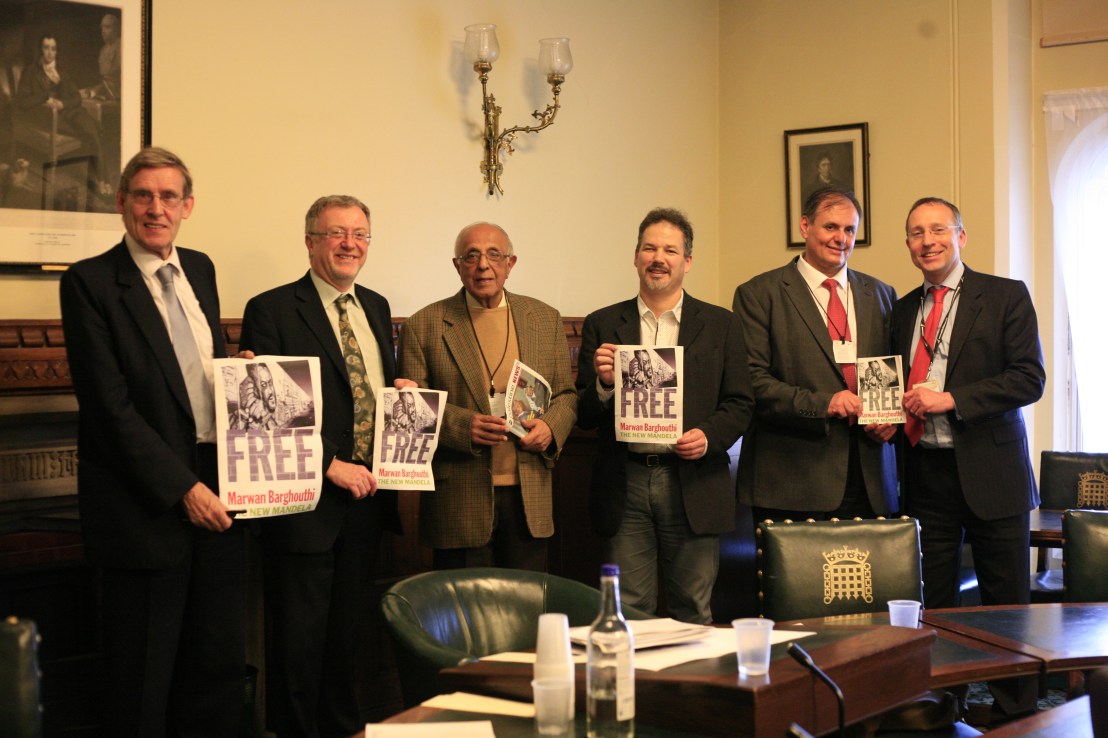
On Tuesday 1st April Ahmed Kathrada came to speak at the House of Commons. He called on members of the All Party Parliamentary Britain-Palestine group and the invited guests to join the campaign to free Marwan Barghouti, Palestine’s most significant political prisoner.

Martin Linton, Richard Burden, Ahmed Kathrada, Dan Judelson, Fadel Takrouri and Andy Slaughter MP Copyright held by PalestineBriefing. Not to be used without permission.
Martin Linton, Richard Burden, Ahmed Kathrada, Dan Judelson, Fadel Takrouri and Andy Slaughter MP. Copyright held by Martin Linton of Palestine Briefing. Picture not to be used without permission.


The meeting was organised by the All Party Parliamentary Britain-Palestine group and Palestine Briefing, timed just after the expected release of the fourth group of Palestine’s political prisoners from Israeli prisons.

Ahmed Kathrada – like the man he was there to talk about – is of huge symbolic importance for Palestine solidarity.  The man who began the first campaign – in the 1960s – to free Nelson Mandela, a man regarded by the majority of the western world as a terrorist at the time – only to be jailed himself for many years. Ahmed Kathrada has shown huge personal, political and physical courage over his long life and heading up the campaign to free Marwan Barghouti.

He spoke about when Mandela was released from prison and was advised to break ties with the Palestine Liberation Organisation and few other liberation groups. Mandela refused, saying “when we came to you for help you disowned us as terrorists. It would be ungrateful of us to disown them now.”

Mr Kathrada told us of how he took Fadwa Barghouti, Marwan’s wife and Fateh Council member, to the cell in Robben Island that Nelson Mandela had occupied.

Ahmed Kathrada said he very much hoped the campaign to free Marwan Barghouti “will take on the proportions of the Free Nelson Mandela campaign.”

Mr Kathrada recounted how in 1985 Mandela was taken away and isolated by the Apartheid South African authorities. But during this time Mandela took the bold step of starting to talk to the Government.  He told them that negotiations would be impossible until they:

  • released the political prisoners

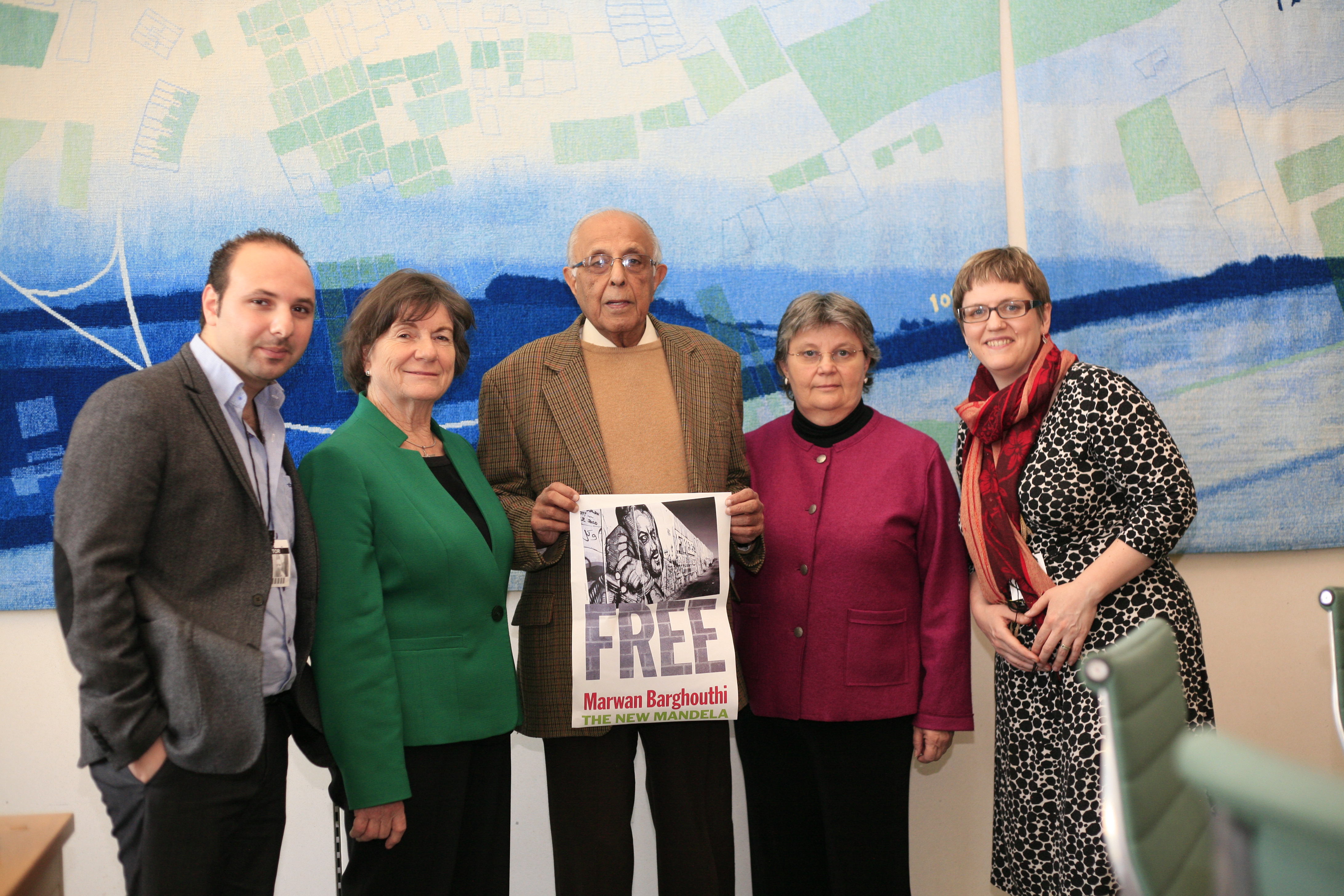
    Raed Debiy, Baroness Jenny Tonge, Ahmed Kathrada, Barbara Hogan, Sara Apps
    Raed Debiy, Baroness Jenny Tonge, Ahmed Kathrada, Barbara Hogan, Sara Apps
  • removed the ban on political organization
  • allowed exiles to return

It took time but eventually the authorities acceded to all those demands.

Palestinian Ambassador, Professor Manuel Hassassian, delivered a powerful speech, thanking Ahmed Kathrada for his presence. He pointed out that in fact pre-Oslo prisoners were meant to be released as part of the Oslo process, so in fact Israel has now failed to honour its commitment to free them several times.  This prisoner release was not part of the Kerry plan, but was in fact agreed before that: the Palestinian leadership agreed not to go to the UN bodies and the ICC in exchange for the release of the prisoners.

The Ambassador said it was right that Marwan should be the symbol for the struggle to release the Palestinian prisoners because of his outstanding popularity and he is the uncontested symbol of the Palestinian prisoners.

The invited audience included many notable individuals including: Afif Safieh from Fateh’s  council, Betty Hunter Honorary President of Palestine Solidarity Campaign, Ziad El Aloul from Palestinian Forum of Britain, Aimee Shalan from Medical Aid for Palestinians.

Afif Safieh talked about the moving first meeting between Yasser Arafat and Nelson Mandela, and how Mandela had said the liberation of South Africa was incomplete without the Palestinians.

It was notable what a strong presence of Palestinians there was in the audience, which is perhaps not surprising as Marwan Barghouti polls as the most popular Palestinian politician within the West Bank and Gaza. But Marwan Barghouti has been explicit himself that this is a campaign for all the political prisoners, of which he is a symbol.

Free Marwan Barghouti!

Sara Apps

Guardian CIF on Marwan Barghouti

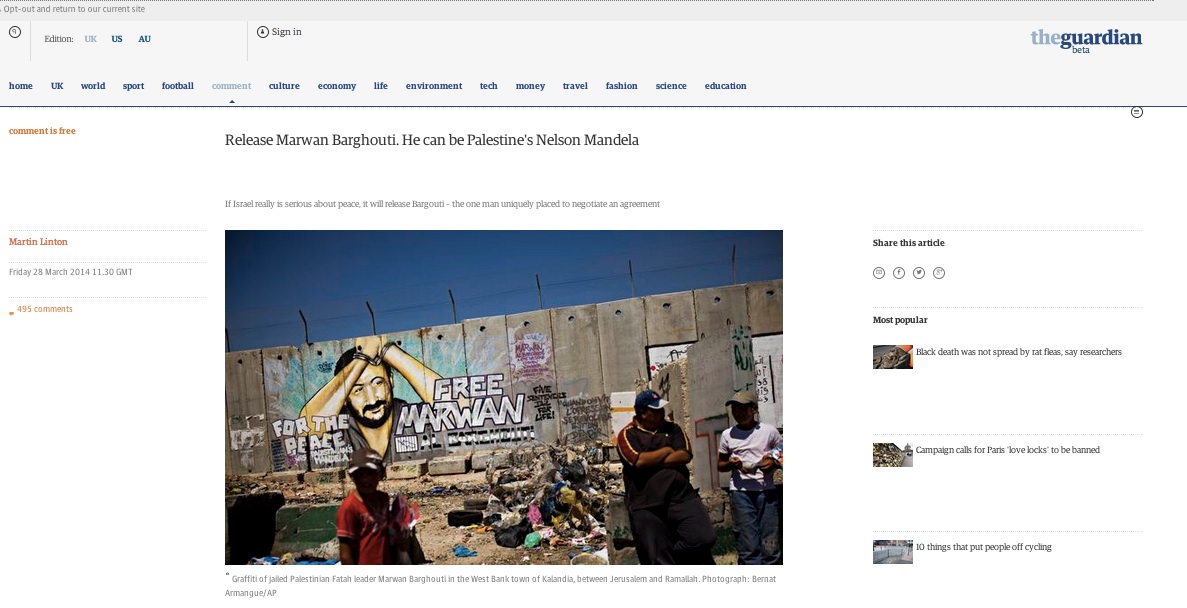
The Guardian published the following article by Martin Linton, on why Israel should release Marwan Barghouti for the future of the peace talks.

Read the Guardian article>

guardian marwan

Free Marwan Barghouti: the New Mandela

Read our new Free Marwan Barghouthi pamphlet, calling for the release of the best known Palestinian political Free Marwan Barghouthi for web prisoner. 

The campaign was launched by the veteran South African ANC politician Ahmed Kathrada. Back in the 1960s Kathrada founded the first Free Marwan Barghouti pamphlet fp imagecampaign to Release Mandela and was then jailed himself and spent many years on Robben Island.  He returned to Mandela’s cell on Robben Island to launch the campaign to Free Marwan Barghouthi with Fadwa Barghouti, Marwan’s wife.

Momentum is now growing behind the campaign which is supported by all the Palestinian political parties and human rights organisations and by the overwhelming majority of Palestinians as well as a constellation of former prime ministers and Nobel prize winners.

To coincide with what should have seen the release of the fourth group of prisoners as part of the Kerry talks,  we are launching a new pamphlet calling for the release of Marwan Barghouthi as part of the peace process.

In brief the pamphlet says:

The death of Nelson Mandela reminds us that often the first step towards the resolution of a conflict is the release from prison of a national leader who has the authority to unite, to negotiate and to resolve.

Mahatma Gandhi, Jawaharlal Nehru and Jomo Kenyatta are all examples of national leaders who were released by the British so that they could negotiate their countries’ independence.  The pattern was repeated in South Africa when Mandela went from a prison cell to the presidents’ palace in just four years.

It will be twelve years on April 15th since Israeli security agents, posing as ambulance workers, seized Barghouthi and took him to an Israeli prison. 

But even after 12 years in an Israeli jail Barghouthi remains one of Palestine’s most popular politicians – capable, according to the polls, of beating any other candidate for the presidency. Many believe he could come out of prison, stand for election, win the presidency, unite the Palestinian factions, negotiate a settlement, put it to his people, win their support and then preside over a process of “truth and reconciliation” in a newly-independent country.

Timeline of event

March 28: Publication of pamphlet entitled “Free Marwan Barghouthi” by Palestine Briefing.  Copies will be available at the meeting or from info@palestinebriefing.org

March 29: Israel due to release final group of pre-1992 Palestinian prisoners as part of agreement with US Secretary of State John Kerry

March 30: Palestinian Land Day

April 1: Ahmed Kathrada visiting the UK, supporting the Free Marwan Barghouti Campaign

April 8: Foreign & Commonwealth Office questions

April 15: 12th anniversary of Marwan Barghouthi’s imprisonment

April 29: Final day of Israeli-Palestinian peace talks brokered by US Secretary of State John Kerry

Read the Free Marwan Barghouthi pamphlet now

Palestinian Bedouin clearances

The Israeli government has postponed the Prawer-Begin Bill that would have forcibly relocated 40,000 Bedouin Arabs from their ancestral lands in the Negev to government-designated towns. But this is only a temporary delay for consultations. Demolitions of Bedouin homes are also continuing in Khan Al Ahmar and other areas in the Judean desert to the east of Jerusalem.

Read a mini-briefing on Bedouin clearances>


child detainees update

The Britain-Palestine All Party Parliamentary Group welcomed a recent announcement that Israel will establish a pilot scheme to issue summonses to Palestinian children suspected of crimes, instead of using night time arrests. The cross-party group of MPs and peers called on the international community to ensure this happens as part of a complete overhaul of the system. The aim is to ensure that all child detainees are treated according to international law.

A recent report by Military Court Watch, supported by UNICEF, found that over half of children held in military custody had been arrested at night.

Details of the pilot programme to reduce night-time arrests– including who is supervising implementation, and the extent of the pilot’s reach, timeframe and monitoring and assessment –  are not yet clear.   The BPAPPG are therefore calling for Israel to provide further detail on the proposal, and implement the programme as swiftly as possible.

It is at the point of arrest and the subsequent 24 hours when Palestinian children suffer the most traumatic experiences. The evidence shows that Palestinian minors when released from detention suffer from many types of trauma related conditions, including bed-wetting, aggression, lack of motivation, loss of concentration, anxiety and obsessive compulsive behaviour.

According to the UNICEF report of 2013:

“Many children are arrested in the middle of the night, awakened at their homes by heavily armed soldiers. Some children are arrested in the streets near their homes, near bypass roads used by Israeli settlers or at army checkpoints inside the West Bank. Many of the children arrested at home wake up to the frightening sound of soldiers banging loudly on their front door and shouting instructions for the family to leave the house. For some of the children, what follows is a chaotic and frightening scene, in which furniture and windows are sometimes broken, accusations and verbal threats are shouted, and family members are forced to stand outside in their night clothes as the accused child is forcibly removed from the home and taken away with vague explanations such as “he is coming with us and we will return him later”, or simply that the child is “wanted”. Few children or parents are informed as to where the child is being taken, why or for how long.”

The BPAPPG and Caabu have taken 12 Parliamentary delegations to the Israeli military court at Ofer. Both have pushed for an end to the use of night time arrests except in exceptional cases. In 2013, the issue of pilot programmes was raised with the Israeli authorities, who stated that the idea was under consideration.  The BPAPPG state that an end to night time arrests must be part of a broader overhaul of the whole detention process that includes full audio-visual recordings of interviews, consulting a lawyer before interrogation and the presence of a parent throughout.

Richard Burden MP, Chair of the BPAPPG said:

“The treatment of Palestinian children in Israeli custody remains an outrage. What we, as MPs, have seen in these courts and heard from Palestinian detainees and their lawyers, shows just how important it is that proper legal processes and protections are implemented.” We will now be seeking answers on how this pilot scheme will ensure that the human rights for all children in Israel and the Occupied Palestine Territories are finally upheld.”

Read a mini-briefing on child detainees>


Unemployment briefing

The unemployment rate in Gaza Strip increased from 32.5% in the 3rd quarter 2013 to 38.5% in the 4th quarter 2013 while in the West bank it was 18.2% in the same period, according to the Palestinian Central Board for Statistics.

This is not surprising given that the Israelis impose a near-total ban on exports from Gaza, leaving all but a handful of Gaza’s many factories mothballed. In the week ending March 28th there were only 6 lorryloads of exports allowed out, compared with a weekly average of 240 before the blockade according to UN figures.

The Israelis also restrict imports to about a third of their pre-blockade level. In the same week 521 lorry loads were imported compared with a weekly average of 2,807 before the blockade.

The unemployment rate for males was 23.1% compared with 33.5% for females.

The highest unemployment rate in the 4th quarter 2013 was 43.9% among youth aged    20-24 years. For years of schooling, the unemployment rate among females with 13 years of schooling or more was 46.1%.

The highest unemployment rates in the West Bank governorates was in Hebron with 25.3%. In Gaza Strip, the highest unemployment rate was in Rafah with 48.1%.

UN OCHA figures>

Palestinian Central Bureau of Statistics (PCBS)>

Special conference speech: Martin Linton

Martin Linton spoke at Labour’s Special Conference 2014, a conference to debate and decide on the reforms that Ed Miliband called to make Labour more deeply rooted in the lives of working people and their communities. Here is his speech:

I’ve got 3 minutes to tell you two stories which I hope will show you why this reform is needed and why it should have been done years ago.

I’ve always found it ludicrous that we have 3,000,000 affiliated trade union members of the Labour Party, but we’re not allowed to know their names and addresses.

Their affiliation fees are very welcome, but if we have 3 million trade union members it means we have on average 4,600 per constituency and their names and addresses would be gold dust to any MP, candidate or organiser, as would their participation in the local party.

When I was an MP I used to ask my union, the GMB, sometimes to mail their levy-paying members on our behalf, which they did.

But we could never come face to face with them because we don’t have any large work places, or even work places where the majority of employees live in the constituency,

In the end we asked the unions to invite members with postcodes in our constituency to a reception.

And at this reception, for the first time, we met lots of working-class Labour voters who were affiliated members, paid money to the Labour Party, voted in Labour leadership elections, the very people who are missing from our membership.

Secondly, in the 1980s I wrote a Fabian pamphlet in which I described the way trade unions affiliated to the Swedish Social Democrats – whole branches affiliated and all the members of the branch became members of the local constituency party – except for those who were opted out.

I got a phone call from a newly-elected MP who invited me to lunch at the Commons to talk about changing the system of trade union affiliation. He was really keen on it.

Now this MP – I don’t think I need to tell you his name – he did a lot of things I agree with, a few I don’t agree with – particularly on the Middle East, but he never got round to changing the affiliation system.

So I think it’s to the credit of Ed Miliband and Paul Kenny and the other union leaders that they have done what Tony Blair failed to do.

Of course we won’t keep all of our affiliated members. But the unions will still have political funds and they will still have an interest in getting a Labour government elected.

That’s the glue that holds us together. It’s in the interests of the Labour Party to win trade unionists’ votes and it’s in the interests of the unions to get a Labour government elected.  We don’t need the belt and braces of an antiquated system.

Children Of The Occupation

Read Harriet Sherwood’s article about children growing up in occupied Palestine

“Around four million Palestinians have known nothing but an existence defined by checkpoints, demands for identity papers, night raids, detentions, house demolitions, displacement, verbal abuse, intimidation, physical attacks, imprisonment and violent death. It is a cruel mosaic: countless seemingly unrelated fragments that, when put together, build a picture of power and powerlessness.”

Read article>

Highlights from House of Commons Gaza debate 5th Feb 2014

Gaza (Humanitarian Situation)
Sir Tony Baldry (Banbury) (Con): I initiated this debate because during the last International Development questions I was struck by the comments of the International Development Minister who made a stark prediction: “Come the autumn, Gaza could be without food, without power and without clean water. One UN report predicts that it could become an unliveable place, meaning that it risks becoming unfit for human habitation.”—[Official Report, 22 January 2014; Vol. 574, c. 279.]
When I chaired the Select Committee on International Development, I saw many terrible tragedies. What distinguished Gaza and struck me was the total sense of hopelessness among ordinary people there. After my second visit, I recall returning home and telling my children that I had no fear of death and I had been to hell, or rather that I could not imagine a state of existence or purgatory of such total hopelessness as being trapped in Gaza.
Mr Andrew Smith (Oxford East) (Lab): Why does he think the international community has proved so ineffective at putting effective pressure on Israel to relax the horrific stranglehold on Gaza? What steps does he think could be taken now?
Alex Cunningham (Stockton North) (Lab): The multitude of problems make the lives of Palestinians intolerable. Struggling sewerage facilities and difficulties with the provision of clean water are further undermined by the lack of power affecting health and medical facilities. Does he see any way forward, or are we banging our heads against a brick wall?
Sir Tony Baldry: On 27 July 2010, the Prime Minister observed: “The situation in Gaza has to change. Humanitarian goods and people must flow in both directions. Gaza cannot and must not be allowed to remain a prison camp.”
Sadly, the situation there has not changed and the humanitarian position has deteriorated significantly. Gaza today is still a prison camp with 1.7 million inmates. The Prime Minister said that he spoke “as someone who is a friend of Israel, who desperately wants a secure and safe and stable Israel after the two-state solution has come about”. That is also my position and, I suspect, that of almost every Member of this House.
There is an increasing concern among donors, NGOs and the international community that constantly applying sticking-plaster solutions to the humanitarian situation in Gaza does not address the root causes of its problems.
The simple fact is that the humanitarian situation in Gaza is getting worse, however much money the international community puts into it.
The occupation must end. Gazan business should be allowed to export to Israel, and through Israel to the West Bank. It may be possible to export Gazan strawberries for a couple of months a year to the Netherlands, but sustainable exports from Gaza are entirely to Israel and the West Bank. There appears to be a total ban on exports from Gaza to either Israel or the West Bank, however, which is resulting in mounting unemployment and grinding poverty.
Israel, the occupying power, does not seem prepared to allow people or exports to leave Gaza, and it seems equally unwilling to allow construction materials into Gaza. Construction was one of the only industries in Gaza that used to be growing, and it once employed 20,000 people, but now practically no construction is taking place.
People appear not to be getting permits to travel to hospital. For the past two years there have been serious shortages of medical supplies and drugs, and the UN estimates that 30% to 50% of drugs are at zero stock.
Fisherman are allowed to fish up to 6 nautical miles from Gaza’s coastline, but the main fish stocks are 8 nautical miles from the shore and fishing in nearer waters provides no livelihoods. There have been cases of fisherman being shot or their boats being confiscated.
Farmers face the difficulty that there is no clarity about the width of the buffer zone between Gaza and the Israeli border. Officially, it would seem to be 100 metres, but Palestinians have been shot up to 300 metres from the border, and I am even told that one was shot 1 km from the border.
There is considerable natural gas in the Gaza marine field. Instead of having to rely on diesel, Gaza could run its energy and water systems on natural gas. Unsurprisingly, the natural gas discussions between Israel and the Palestinians have been complex and appear to be getting nowhere.
It cannot be right, in the 21st century, that people are suffering as they are. As the UN General Assembly mission concluded, under international law “collective punishment of the civilian population in Gaza is not lawful in any circumstances.”
Occupation clearly harms those who are occupied, but I would also suggest that long-term occupation is not in the best interests of the occupiers. Israel cannot continue to be both a Jewish state and a democracy if it denies rights to 2.5 million Palestinians indefinitely. It would appear that we have months rather than years to resolve the issue.
Mr James Clappison (Hertsmere) (Con):  What signs has he seen from Hamas, the political power in Gaza, of willingness to participate in a peaceful settlement?
Sir Tony Baldry: The chair of Conservative Friends of Israel is of course right to bring Hamas’s role to the attention of the House. However, so long as he and other supporters of the state of Israel—of which I am one—remain deaf to the clear advice that has been given about the illegitimacy of the collective punishment of the people of Gaza for the actions of a few, we are never going to see a resolution of the tragedy that is affecting so many people in Gaza.
Sarah Teather (Brent Central) (LD): Is the right Member as worried as I am about the number of people who are affected by burns because of things that they are trying desperately to do to create their own generators in order to get around the lack of power?
Mr David Winnick (Walsall North) (Lab): Is not one of the worst aspects of the situation the fact that 90% of the water in Gaza is undrinkable?
Mr Andrew Love (Edmonton) (Lab/Co-op):  What does he suggest we can do to highlight the situation and put pressure on the Israelis to relent?
Jeremy Corbyn (Islington North) (Lab):  Does he agree that an environmental catastrophe is fast approaching, and that if it is not addressed, goodness knows what will happen to the people of Gaza?
Stephen Phillips (Sleaford and North Hykeham) (Con):  Does he agree that we are talking in terms of months not years in order to get matters right, not only for Israel but for the people of Palestine?
Sir Gerald Kaufman (Manchester, Gorton) (Lab):  Again and again, Israel seeks to justify the vile injustices that it imposes on the people of Gaza and the West Bank on the grounds of the holocaust. It is totally unacceptable that the Israelis should behave in such a way, but they do not care.Go to Tel Aviv, as I did not long ago, and watch them sitting complacently outside their pavement cafés. They do not give a damn about their fellow human beings perhaps half an hour away.
The Member quoted the Prime Minister as saying that Gaza is a prison camp. It is all very well for him to say that, as he did, but what is he doing about it? Nothing, nothing, nothing!
The time when we could condemn and think that that was enough has long passed. The Israelis do not care about condemnation. They are self-righteous and complacent. We must now take action against them. We must impose sanctions. If the spineless Obama will not do it, we must do it—even unilaterally. We must press the European community for it to be done.
These people cannot be persuaded. We cannot appeal to their better nature when they do not have one. It is all very well saying, “Wicked, wicked Hamas.” Hamas is dreadful. I have met people from Hamas, but nothing it has done justifies punishing children, women and the sick as the Israelis are doing now. They must be stopped.
I do not want a war. I do not want violent action, but the action that the international community takes must be imposed, otherwise hell will break loose.
Mr James Clappison (Hertsmere) (Con): I do not believe, and will not be persuaded, that the state of Israel has any interest in imposing the present conditions on the people of Gaza for the sake of it.
Yasmin Qureshi (Bolton South East) (Lab): Come off it!
Mr Clappison: Israel withdrew unilaterally from Gaza in 2005 under the leadership of Ariel Sharon, and it was hoped that that would bring about a solution to Israel’s immediate problems. It did not. Since then—and he touched on the point—there have been about 8,000 rocket attacks on Israel. There have been many thousands, certainly.
Mr Andy Slaughter (Hammersmith) (Lab): I am afraid that the Member is trotting out the usual Israeli propaganda. I went to Gaza three weeks after Operation Cast Lead, where 1,400 Palestinians and 13 Israelis were killed. That was the ratio—100 Palestinian deaths to one Israeli death.
Mr Clappison: I regret all deaths on both sides, but the Member must face the fact that it was Palestinian—Hamas or Islamic Jihad, whatever it was—rocket attacks that began it. In each case that is what has begun the problems.
Israel has no interest per se in doing such things to Gaza. Hamas has set its face against a peaceful solution in its charter. At the moment they have set their face against peace, and they are the problem.
Yasmin Qureshi (Bolton South East) (Lab): I want to praise the people in Israel and the Jewish people in this country who campaign actively for the rights of Palestinians. Like the Member for Manchester, Gorton, I am sure that they are criticised by other Jewish people perhaps for trying to betray the state of Israel. However, the issue is not about a state of Israel, of Jews or of religion; it is about the millions of people who used to live in the state of Israel, who have been made homeless and who have sought refuge in various parts of the world and have not been able to return to their country. Particularly inhumane actions are being carried out in Gaza, causing the suffering that we see.
Whether we are talking about the West Bank or Gaza, the policy pursued by the state of Israel is not helping to lead to a two-state solution. All it is doing is making Palestinians even more depressed and anxious. They think, “What hope is there for us?”, and they rightly ask, “What is the international community doing about this?” Let us face it: if what is happening to Gaza, done by Israel, were happening to any other nation, the whole world would be up in arms, and rightly so. So why are we not getting the same in Palestine?
Sir Edward Leigh (Gainsborough) (Con): Everyone accepts that Hamas is an appalling organisation and that the rocket attacks are appalling. However, I want to focus on humanity….. [but] despite the horrors of Hamas and the rocket attacks, we cannot punish the many because of the sins of a few.
We have heard about the fishermen. How can anyone fish just 6 miles out in filthy water? How can anyone live in a place where 90% of the water is undrinkable? How can farmers be shot just for going within a mile of an electric fence while going about their business? Would that be tolerated in any other part of the world? Would our Prime Minister, the Leader of the Opposition and the UN not be stopping it?
Yes, this is only a little debate in Westminster Hall and we are only Back-Benchers, but we must do our bit to articulate a sense of outrage that our fellow human beings are being treated like this.
By all means, if someone is attacked, they should reply strongly in military terms, but not punish a whole people and reduce them to utter poverty and destitution. I say this as a strong supporter of the state of Israel, but there is a real danger that more and more people in the world believe that a people who were formerly oppressed are now becoming the oppressors, and that the state of Israel is thereby losing its soul. What is its soul? It is the soul of an oppressed people who have made a great and wonderful nation. But there are other nations in this world and they must be treated fairly and must have an equal right to health, dignity and freedom.
Jeremy Corbyn (Islington North) (Lab):  I have been to Gaza on a number of occasions. I was struck by two things. One was the hope, determination and inspiration of many of the people who were trying to provide services and food against appalling odds, using their ingenuity to do so.
Secondly, by the random nature of bombardments and attacks. In Operation Cast Lead, illegal weapons were used and the most appalling abuse was meted out against people. The abuse has not stopped. Random bombings and air attacks still take place.
In Gaza, I visited the crater made by a bomb that had fallen not long before. I talked to the one survivor of a family whose house had been hit. I went into its remains and it was as if the world had stopped at a certain moment. Remember those old movies where the clock has stopped at a certain moment? It was exactly like that. The house was covered in dust, there was a bomb crater outside and almost everyone inside the house was dead. That family had done nothing—they were just the victims of yet another random attack by an F-16 jet from a first world power, which had been supplied by another first world power, against people living in desperate poverty and under siege the whole time.
It is totally the responsibility of the power that is encircling Gaza and has brought this situation about. It is time that something was done about the situation, and rapidly.
Sandra Osborne (Ayr, Carrick and Cumnock) (Lab): Will the UK Government insist that Kerem Shalom be opened for exports as well as imports? Will they push for Erez to be reopened for imports and exports, and if necessary fund more security scanners if there is a real need for them? Will they push Israel to organise a “land bridge” between Gaza and the West Bank, so that exports can reach West Bank markets? A lorry convoy system could be instituted immediately for that purpose.
Will the Government push for the activation of the EU border assistance mission, which was agreed in 2005, to oversee the 2005 access and movement agreement and to address Israel’s security concerns independently? The arrangements should be immediately reinstated and a similar mission put in place at Erez and Kerem Shalom. Will the UK Government push for the fishing limit to be extended to 12 or 15 nautical miles?
Mr Andy Slaughter (Hammersmith) (Lab): I first visited Gaza shortly after Operation Cast Lead. It was a totally harrowing experience that is completely fresh in my mind five years on. It was the complete evisceration of a society, with the systematic and organised destruction of industry and villages. It was what can only be called murder, including the murder of whole families. There was shelling of hospitals, which was done knowingly, and white phosphorus was used. These were war crimes, just as the occupation itself is a crime against international law. To say that these are not deliberate and knowing acts by the Israeli Government is naivety or worse.
30% to 35% of all the correspondence to the Foreign Office is about Israel-Palestine. Why cannot our Government, whether through their influence on the United States or their role in the EU, or unilaterally, do more to support the people of Gaza? That issue is clearly uppermost in the minds of the people of this country.
This week, we had the pleasure of a briefing from Sir Vincent Fean, a distinguished diplomat who was retiring after 40 years, having spent his last three years as consul-general in Jerusalem and therefore being responsible for Gaza. He told us about the incredible suffering—the lack of power, the polluted water, the lack of jobs, the complete blockade—and how intolerable it was.
Mr Philip Hollobone (Kettering) (Con): Yes, the humanitarian situation is dire. But there will be no solution to the problem of the Gaza strip unless, first, the security situation is sorted out and, secondly, proper economic links are restored both with the state of Israel and with the state of Egypt.
All of us want the humanitarian situation in the Gaza strip sorted out, but we simply will not make any progress if all the condemnation is against Israel.