US, Israel to punish Palestine for exercising right to join UN |
| Free Palestine won’t need aid – DfID |
Briefings on Palestine
Category: Palestine briefing
US, Israel to punish Palestine for exercising right to join UN |
| Free Palestine won’t need aid – DfID |
WEDNESDAY 9 APRIL 2014 Oral Questions to the Secretary of State for International Development
Sir Peter Luff (Mid Worcestershire) (Con): What assessment she has made of the effectiveness of her Department’s support for the Palestinian Authority.
Aid Minister Alan Duncan: The UK is providing effective support for the Palestinian Authority in very challenging circumstances. The Palestinian Authority has developed institutions to the point where the international community has recognised it as technically ready for statehood, and it has made impressive progress in delivering improved outcomes in health and education.
Sir Peter Luff: Having just returned from a Select Committee visit to the Palestinian occupied territories and seen the excellent work being done there by the Department, may I ask whether the Minister agrees that its work to support the private sector would be much more effective if Israel lifted many of its restrictions, which can have nothing to do with its essential security, on the freedom of Palestinian business people to develop their economy in areas such as the banking sector, water supply, and even 3G telephone networks?
Mr Duncan: I am grateful to him for his appreciation of DFID’s work in the occupied Palestinian territories and glad that he and the Committee had such a useful visit. Israeli restrictions do tremendous damage to the economy and to the living standards of ordinary Palestinians. The simple truth is that they are not allowed to develop their banking or information and communications technology sectors, or to build even their basic infrastructure. Were these restrictions to be lifted, not only would DFID’s work to support the private sector be much more effective, but within a relatively short space of time the Palestinians would probably not need our aid at all.
Richard Burden (Birmingham, Northfield) (Lab): Is the Minister aware that the World Bank has said that Area C of the West Bank, particularly the Jordan valley, is vital to the future economic viability of a Palestinian state? Presumably that is why the Department is looking to fund infrastructure projects there. What is his view of the fact that illegal Israeli planning restrictions are stopping those infrastructure projects being built, and for how long will the Government allow Israel to have a veto over economic development in the West Bank?
Mr Duncan: I fully understand what he says. I think the Select Committee saw a direct example of the destruction of olive groves when it was there. It is essential that area C is able, through planning arrangements, to develop its economy; otherwise there can be no sensible or useful economic future in the Palestinian territories.
Sir Malcolm Bruce (Gordon) (LD): May I confirm what the Minister says—that without access to area C there is no future for a two-state solution or for an economically viable Palestine? The Palestinian Authority pleaded with us to put all possible pressure on Israel to allow access. We met someone from a company who is saying that the cost of land in areas A and B is prohibitive and that without access to area C he cannot develop his business.
Mr Duncan: I fully concur with him. I hope that a full understanding of this can be included in the peace talks that we hope are continuing towards a productive and useful conclusion.
Mark Lazarowicz (Edinburgh North and Leith) (Lab/Co-op): What recent representations have the Government made to the Israeli authorities about the continued forcible removal of populations, and property demolition, in the occupied territories? Yesterday the Foreign Secretary met the Israeli Minister for International Relations: was this issue raised with him?
Mr Duncan: I was also at that meeting, and I can assure the Member that we raise such matters regularly. It is essential that some kind of normal activity can be permitted in the occupied Palestinian territories; otherwise, as Sir Malcolm Bruce said, there will not be a two-state solution and there is a danger of permanent conflict and tension.
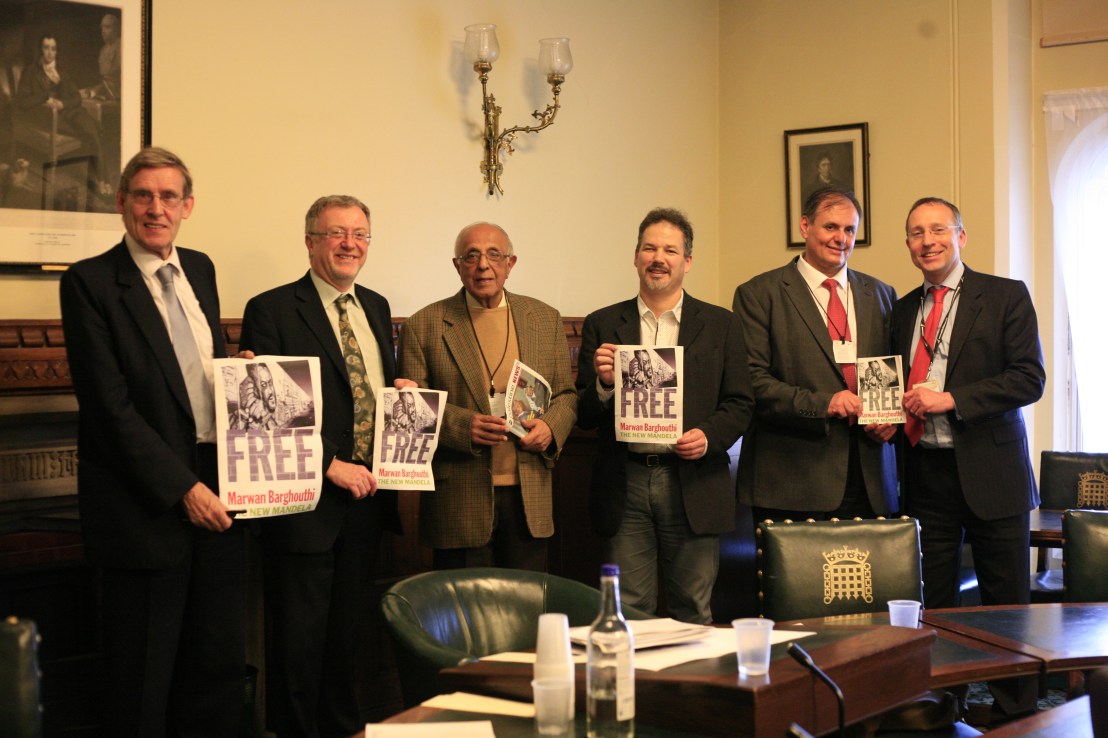
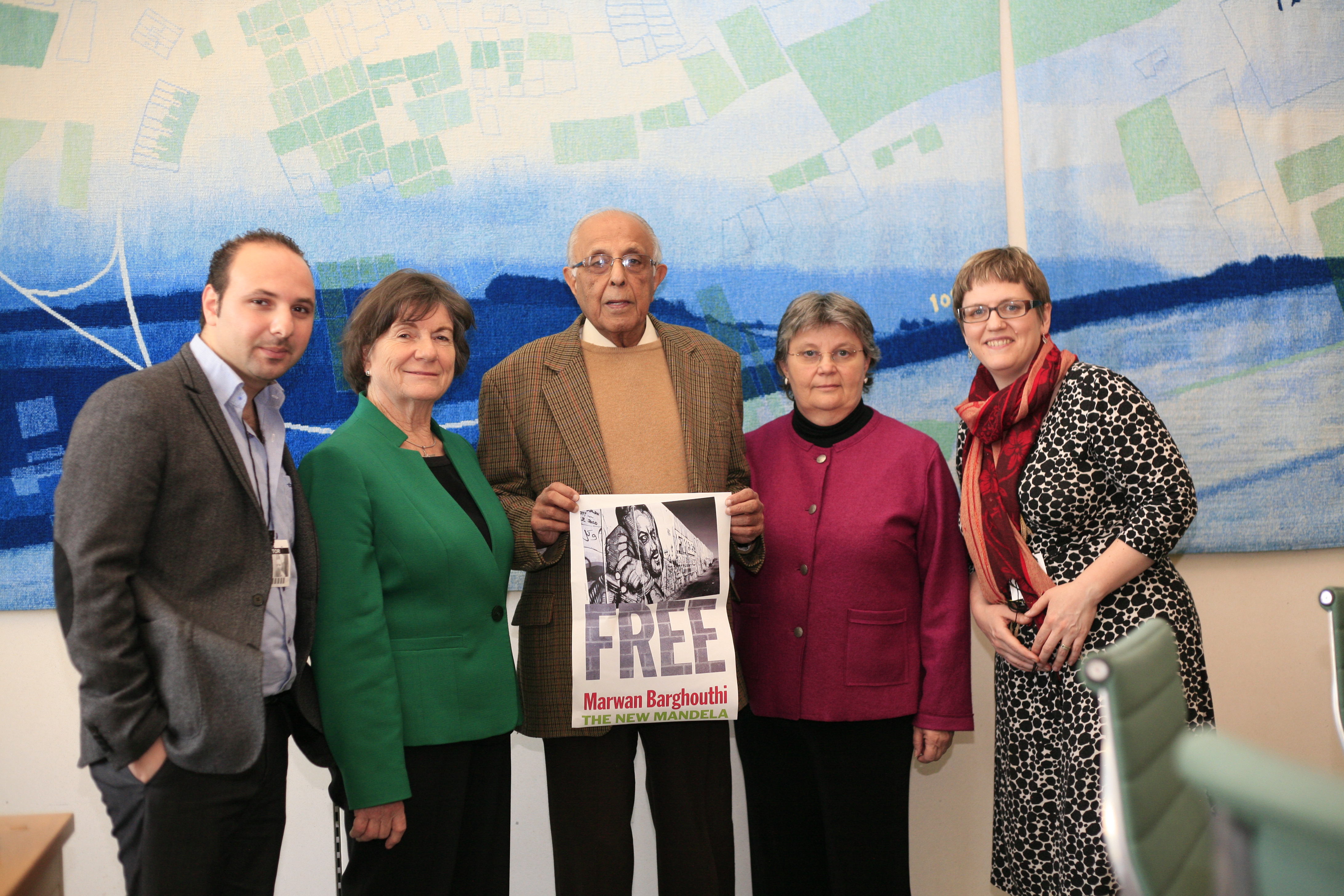
On Tuesday 1st April Ahmed Kathrada came to speak at the House of Commons. He called on members of the All Party Parliamentary Britain-Palestine group and the invited guests to join the campaign to free Marwan Barghouti, Palestine’s most significant political prisoner.

The meeting was organised by the All Party Parliamentary Britain-Palestine group and Palestine Briefing, timed just after the expected release of the fourth group of Palestine’s political prisoners from Israeli prisons.
Ahmed Kathrada – like the man he was there to talk about – is of huge symbolic importance for Palestine solidarity. The man who began the first campaign – in the 1960s – to free Nelson Mandela, a man regarded by the majority of the western world as a terrorist at the time – only to be jailed himself for many years. Ahmed Kathrada has shown huge personal, political and physical courage over his long life and heading up the campaign to free Marwan Barghouti.
He spoke about when Mandela was released from prison and was advised to break ties with the Palestine Liberation Organisation and few other liberation groups. Mandela refused, saying “when we came to you for help you disowned us as terrorists. It would be ungrateful of us to disown them now.”
Mr Kathrada told us of how he took Fadwa Barghouti, Marwan’s wife and Fateh Council member, to the cell in Robben Island that Nelson Mandela had occupied.
Ahmed Kathrada said he very much hoped the campaign to free Marwan Barghouti “will take on the proportions of the Free Nelson Mandela campaign.”
Mr Kathrada recounted how in 1985 Mandela was taken away and isolated by the Apartheid South African authorities. But during this time Mandela took the bold step of starting to talk to the Government. He told them that negotiations would be impossible until they:

It took time but eventually the authorities acceded to all those demands.
Palestinian Ambassador, Professor Manuel Hassassian, delivered a powerful speech, thanking Ahmed Kathrada for his presence. He pointed out that in fact pre-Oslo prisoners were meant to be released as part of the Oslo process, so in fact Israel has now failed to honour its commitment to free them several times. This prisoner release was not part of the Kerry plan, but was in fact agreed before that: the Palestinian leadership agreed not to go to the UN bodies and the ICC in exchange for the release of the prisoners.
The Ambassador said it was right that Marwan should be the symbol for the struggle to release the Palestinian prisoners because of his outstanding popularity and he is the uncontested symbol of the Palestinian prisoners.
The invited audience included many notable individuals including: Afif Safieh from Fateh’s council, Betty Hunter Honorary President of Palestine Solidarity Campaign, Ziad El Aloul from Palestinian Forum of Britain, Aimee Shalan from Medical Aid for Palestinians.
Afif Safieh talked about the moving first meeting between Yasser Arafat and Nelson Mandela, and how Mandela had said the liberation of South Africa was incomplete without the Palestinians.
It was notable what a strong presence of Palestinians there was in the audience, which is perhaps not surprising as Marwan Barghouti polls as the most popular Palestinian politician within the West Bank and Gaza. But Marwan Barghouti has been explicit himself that this is a campaign for all the political prisoners, of which he is a symbol.
Free Marwan Barghouti!
Sara Apps
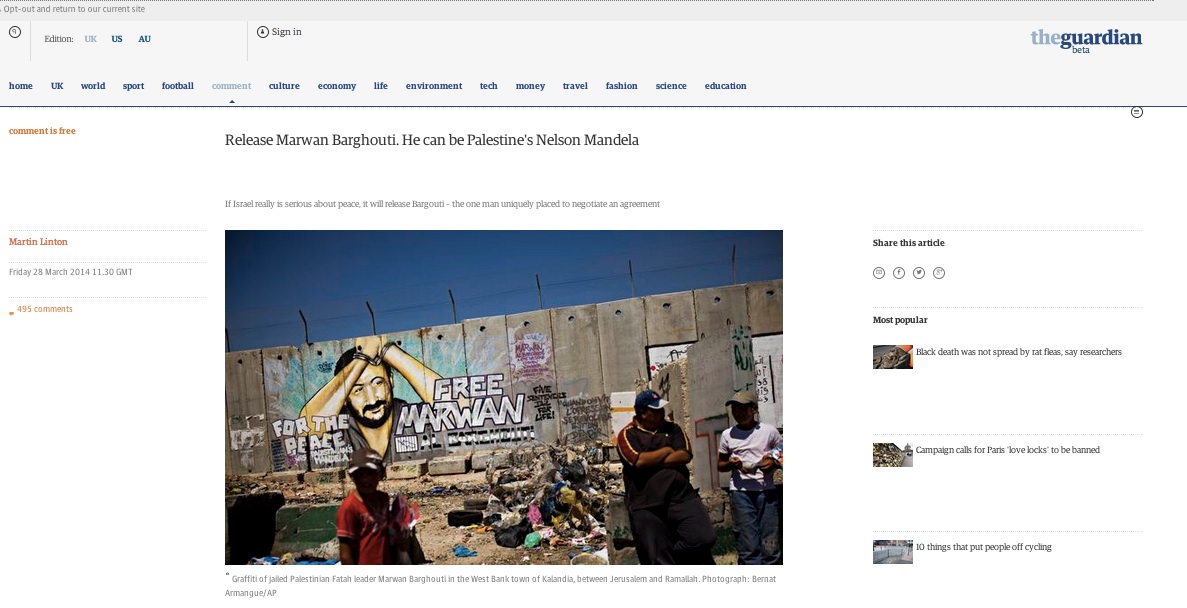
The Guardian published the following article by Martin Linton, on why Israel should release Marwan Barghouti for the future of the peace talks.
Read our new Free Marwan Barghouthi pamphlet, calling for the release of the best known Palestinian political Free Marwan Barghouthi for web prisoner.
The campaign was launched by the veteran South African ANC politician Ahmed Kathrada. Back in the 1960s Kathrada founded the first
campaign to Release Mandela and was then jailed himself and spent many years on Robben Island. He returned to Mandela’s cell on Robben Island to launch the campaign to Free Marwan Barghouthi with Fadwa Barghouti, Marwan’s wife.
Momentum is now growing behind the campaign which is supported by all the Palestinian political parties and human rights organisations and by the overwhelming majority of Palestinians as well as a constellation of former prime ministers and Nobel prize winners.
To coincide with what should have seen the release of the fourth group of prisoners as part of the Kerry talks, we are launching a new pamphlet calling for the release of Marwan Barghouthi as part of the peace process.
In brief the pamphlet says:
The death of Nelson Mandela reminds us that often the first step towards the resolution of a conflict is the release from prison of a national leader who has the authority to unite, to negotiate and to resolve.
Mahatma Gandhi, Jawaharlal Nehru and Jomo Kenyatta are all examples of national leaders who were released by the British so that they could negotiate their countries’ independence. The pattern was repeated in South Africa when Mandela went from a prison cell to the presidents’ palace in just four years.
It will be twelve years on April 15th since Israeli security agents, posing as ambulance workers, seized Barghouthi and took him to an Israeli prison.
But even after 12 years in an Israeli jail Barghouthi remains one of Palestine’s most popular politicians – capable, according to the polls, of beating any other candidate for the presidency. Many believe he could come out of prison, stand for election, win the presidency, unite the Palestinian factions, negotiate a settlement, put it to his people, win their support and then preside over a process of “truth and reconciliation” in a newly-independent country.
Timeline of event
March 28: Publication of pamphlet entitled “Free Marwan Barghouthi” by Palestine Briefing. Copies will be available at the meeting or from info@palestinebriefing.org
March 29: Israel due to release final group of pre-1992 Palestinian prisoners as part of agreement with US Secretary of State John Kerry
March 30: Palestinian Land Day
April 1: Ahmed Kathrada visiting the UK, supporting the Free Marwan Barghouti Campaign
April 8: Foreign & Commonwealth Office questions
April 15: 12th anniversary of Marwan Barghouthi’s imprisonment
April 29: Final day of Israeli-Palestinian peace talks brokered by US Secretary of State John Kerry
Read the Free Marwan Barghouthi pamphlet now
The Israeli government has postponed the Prawer-Begin Bill that would have forcibly relocated 40,000 Bedouin Arabs from their ancestral lands in the Negev to government-designated towns. But this is only a temporary delay for consultations. Demolitions of Bedouin homes are also continuing in Khan Al Ahmar and other areas in the Judean desert to the east of Jerusalem.
Read a mini-briefing on Bedouin clearances>
The Britain-Palestine All Party Parliamentary Group welcomed a recent announcement that Israel will establish a pilot scheme to issue summonses to Palestinian children suspected of crimes, instead of using night time arrests. The cross-party group of MPs and peers called on the international community to ensure this happens as part of a complete overhaul of the system. The aim is to ensure that all child detainees are treated according to international law.
A recent report by Military Court Watch, supported by UNICEF, found that over half of children held in military custody had been arrested at night.
Details of the pilot programme to reduce night-time arrests– including who is supervising implementation, and the extent of the pilot’s reach, timeframe and monitoring and assessment – are not yet clear. The BPAPPG are therefore calling for Israel to provide further detail on the proposal, and implement the programme as swiftly as possible.
It is at the point of arrest and the subsequent 24 hours when Palestinian children suffer the most traumatic experiences. The evidence shows that Palestinian minors when released from detention suffer from many types of trauma related conditions, including bed-wetting, aggression, lack of motivation, loss of concentration, anxiety and obsessive compulsive behaviour.
According to the UNICEF report of 2013:
“Many children are arrested in the middle of the night, awakened at their homes by heavily armed soldiers. Some children are arrested in the streets near their homes, near bypass roads used by Israeli settlers or at army checkpoints inside the West Bank. Many of the children arrested at home wake up to the frightening sound of soldiers banging loudly on their front door and shouting instructions for the family to leave the house. For some of the children, what follows is a chaotic and frightening scene, in which furniture and windows are sometimes broken, accusations and verbal threats are shouted, and family members are forced to stand outside in their night clothes as the accused child is forcibly removed from the home and taken away with vague explanations such as “he is coming with us and we will return him later”, or simply that the child is “wanted”. Few children or parents are informed as to where the child is being taken, why or for how long.”
The BPAPPG and Caabu have taken 12 Parliamentary delegations to the Israeli military court at Ofer. Both have pushed for an end to the use of night time arrests except in exceptional cases. In 2013, the issue of pilot programmes was raised with the Israeli authorities, who stated that the idea was under consideration. The BPAPPG state that an end to night time arrests must be part of a broader overhaul of the whole detention process that includes full audio-visual recordings of interviews, consulting a lawyer before interrogation and the presence of a parent throughout.
Richard Burden MP, Chair of the BPAPPG said:
“The treatment of Palestinian children in Israeli custody remains an outrage. What we, as MPs, have seen in these courts and heard from Palestinian detainees and their lawyers, shows just how important it is that proper legal processes and protections are implemented.” We will now be seeking answers on how this pilot scheme will ensure that the human rights for all children in Israel and the Occupied Palestine Territories are finally upheld.”
Read a mini-briefing on child detainees>
The unemployment rate in Gaza Strip increased from 32.5% in the 3rd quarter 2013 to 38.5% in the 4th quarter 2013 while in the West bank it was 18.2% in the same period, according to the Palestinian Central Board for Statistics.
This is not surprising given that the Israelis impose a near-total ban on exports from Gaza, leaving all but a handful of Gaza’s many factories mothballed. In the week ending March 28th there were only 6 lorryloads of exports allowed out, compared with a weekly average of 240 before the blockade according to UN figures.
The Israelis also restrict imports to about a third of their pre-blockade level. In the same week 521 lorry loads were imported compared with a weekly average of 2,807 before the blockade.
The unemployment rate for males was 23.1% compared with 33.5% for females.
The highest unemployment rate in the 4th quarter 2013 was 43.9% among youth aged 20-24 years. For years of schooling, the unemployment rate among females with 13 years of schooling or more was 46.1%.
The highest unemployment rates in the West Bank governorates was in Hebron with 25.3%. In Gaza Strip, the highest unemployment rate was in Rafah with 48.1%.