Category: blog and news

Minister promises EU measures ‘to discourage settlements’

Written questions from Grahame Morris MP

Question: To ask the Secretary of State for Foreign and Commonwealth Affairs, if he will support proposals in the EU to impose sanctions on the Israeli government if it goes ahead with tenders and construction of Israeli settlements at Givat Hamatos in East Jerusalem.

Answer: Mr Tobias Ellwood We are strongly opposed to any attempts to change the facts on the ground in East Jerusalem by increasing the number of settlers living there. Such acts raise tensions and undermine prospects for peace. During my visit to Israel and the Occupied Palestinian Territories between 5-8 October, I discussed my strong concerns about the issue of settlements and land expropriation with the Israeli Justice Minister on 6 October. Discussions are continuing in Brussels on how the EU can best discourage settlement expansion, and the UK is working closely with other Member States to that end.

Question: To ask the Secretary of State for Foreign and Commonwealth Affairs, if he will support proposals in the EU to apply sanctions on the Israeli government if it goes ahead with plans to relocate 12,000 Bedouins in a new town in the Jordan Valley without their consent.

Answer: Mr Tobias Ellwood During my recent visit to Israel and the Occupied Palestinian Territories, I visited the E1 area and met members of the Bedouin community living there who face relocation by the Israeli authorities. They told me that they had no wish to leave, and expressed their fears of being forcibly transferred to make way for the construction of Israeli settlements. Such a move would seriously threaten the possibility of a contiguous Palestinian state, and according to the UN would be contrary to international humanitarian law. Discussions are continuing in Brussels on how the EU can best discourage settlement expansion, and the UK is working closely with other Member States to that end.


British Army trains Israeli soldiers to operate drones

 UK urges transfer of Area C to Palestine

 Written questions

Mr Tom Watson (West Bromwich East) To ask the Secretary of State for Defence, for which periods officers in the armed forces have been trained on the operation and use of drone technology in Israel and the Occupied Palestinian Territories in the last two years.

Mr Mark Francois Answered on: 19 November 2014 In the last two years training on the unarmed HERMES 450 Unmanned Aircraft System has been conducted by Army personnel in Israel on a regular basis. The last training took place in July 2014. This training was a mixture of individual and pre-deployment training for HERMES operators, and technical training for support personnel. Over this period, more than 270 personnel received training by the civilian contractor in Israel. No training has been conducted within the Occupied Palestinian territories.


Chi Onwurah (Newcastle upon Tyne Central) To ask the Secretary of State for Foreign and Commonwealth Affairs, what assessment he has made of the effect on the peace process of differences in how the application of planning regulations apply to settlers and Palestinians in the West Bank.

Mr Tobias Ellwood Answered on: 17 November 2014 The British Government regularly raises concerns regarding the Israeli building and planning regime in Area C with the Israeli Government. The UK has also called publicly on Israel to take steps towards the transfer of authority over Area C to the Palestinian Authority. Palestinian development in Area C is essential for a sustainable Palestinian economy, yet only 1% of Area C is zoned for Palestinian construction and a large portion of this land is already built-up. The UK will therefore continue to press Israel to ease the current restrictive permitting regime and to transfer control of Area C to the Palestinian Authority as per the Oslo accords. The Israeli Non-Governmental Organisation Peace Now has identified the building and demolition decisions in Area C. Between 2000 and 2007 the Israeli Civil Administration approved only 91 of 1,624 Palestinian applications. During the same period Israeli settlers built over 18,000 homes in the same area. We assess that this does not help efforts towards peace.

Paul Flynn (Newport West) Asked on: 29 August 2014: To ask the Secretary of State for the Home Department, what estimate he has made of the number of (a) British citizens, (b) British residents holding dual passports and (c) British residents holding foreign passports who left the UK in 2014 to fight for the (i) Israeli Defence Force in Gaza.

James Brokenshire Answered on: 20 November 2014 We do not hold data on British nationals fighting with the Israeli Defence Force: many foreign nationals (including British nationals) serve in the IDF, and also hold dual (Israeli) nationality.

Mr George Galloway (Bradford West) To ask the Secretary of State for Foreign and Commonwealth Affairs, if he will make representations to the Israeli government condemning its (a) closure of the al-Aqsa mosque and other parts of the al-Sharif site in Jerusalem and (b) plan to build 1,000 housing units in illegal settlements in occupied East Jerusalem.

Mr Tobias Ellwood Answered on: 11 November 2014 Our Ambassador to Tel Aviv delivered a clear message to the Israeli Cabinet Secretary on 30 October, advocating reopening of the mosque. The mosque re-opened on 31 October for men over 50 and for women. I issued a statement on 29 October condemning the announcement of plans for 1,060 new housing units in East Jerusalem. Officials from our Embassy in Tel Aviv have raised this issue with the Israeli National Security Adviser, the Ministry of Foreign Affairs Political-Military Adviser, senior contacts at the National Security Council and the Cabinet Office.

Chris Williamson (Derby North) Asked on: 10 November 2014 To ask the Secretary of State for International Development, what support her Department has provided for trained psychosocial counsellors to help children in Gaza.

Mr Desmond Swayne Answered on: 20 November 2014 DFID is funding a range of mental health and psychosocial support initiatives in Gaza, including psychosocial care for 3000 children and 1500 mothers, psychological training for 120 child carers, and psychotherapy for 900 severely traumatised children. The UK is also one of the largest donors to the UN Relief and Works Agency, which is providing psychosocial support and activities for children through its extensive network of schools.

Chris Williamson (Derby North) Asked on: 10 November 2014 To ask the Secretary of State for International Development, what estimate she has made of the cost of the reconstruction of Gaza.

Mr Desmond Swayne Answered on: 20 November 2014 Assessments led by the Palestinian Authority, and carried out in conjunction with the United Nations and other partners, estimate the total cost of relief, recovery and reconstruction to be around $4 billion.

Chris Williamson (Derby North) Asked on: 10 November 2014 To ask the Secretary of State for International Development, what assistance her Department has provided for British physicians and nurses working on short missions in Gaza.

Mr Desmond Swayne Answered on: 20 November 2014 DFID provided support for an initial medical assessment in Gaza carried out by a team of British medical staff in August, and further support to take forward their recommendation for a small team of British specialists with trauma, orthopaedic and reconstructive skills to make follow-up visits to Gaza. We are also providing support for specialists in orthopaedic trauma, neurology, burns and amputation, drawn from the UK’s International Emergency Trauma Register, to provide highly specialised training, equipment and supervision for rehabilitation in Gaza.

Chris Williamson (Derby North) Asked on: 10 November 2014 To ask the Secretary of State for International Development, what assessment she has made of the extent of damage to basic infrastructure and housing in Gaza arising from the recent conflict.

Mr Desmond Swayne The UN has estimated that 18,000 housing units were destroyed or severely damaged in the conflict and that 44,300 other housing units sustained some damage. The UN estimates that 20-30% of the water and sewage network was damaged, and reports extensive damage to the Gaza Power Plant and internal electricity grid, telecommunications and internet infrastructure, as well as factories and commercial buildings.

Chris Williamson (Derby North) Asked on: 10 November 2014 To ask the Secretary of State for International Development, what emergency aid her Department is providing for Gazans whose homes have been destroyed in the recent conflict.

Mr Desmond Swayne Answered on: 20 November 2014 The UK was one of the biggest donors to Gaza this summer, providing more than £17 million in emergency assistance to deliver lifesaving food, clean water, shelter and medical assistance to tens of thousands of people affected by the fighting. We have also pledged £20 million in early recovery assistance, which includes support for shelter and basic services, short-term employment to help with reconstruction, clearance of explosive remnants of war, and funding for the UN mechanism to import construction materials.

Mr David Burrowes (Enfield, Southgate) To ask the Secretary of State for Foreign and Commonwealth Affairs, what support his Department provides to ensure Hamas does not acquire construction materials for terror purposes.

Mr Tobias Ellwood Answered on: 18 November 2014 The UK, as a donor, follows very carefully the course of internationally provided construction materials into Gaza, and we are confident in the effectiveness of the new UN agreed monitoring mechanism. Imports of construction materials, including concrete, are currently only permitted for UN-led humanitarian projects with strict controls mitigating the risk of transfer of materials for use other than that intended. There remains a clear need for further legitimate construction work in Gaza.

Mr Mark Williams (Ceredigion) Asked on: 10 November 2014 To ask the Secretary of State for Foreign and Commonwealth Affairs, if he will raise with his Israeli counterpart the death of Bahaa Samir Badir in Beit Liqiya on 16 October 2014.

Mr Tobias Ellwood Answered on: 18 November 2014 The Government has repeatedly expressed concerns to Israel about the appropriate use of force, including the use of live ammunition, by the Israel Defence Force and Police, as well as the need for Israel to implement the recommendations of the Turkel Commission on improving how the Israeli authorities investigate alleged violations of international humanitarian law. We will continue to do so as long as this remains an issue of concern.

Mr Mark Williams (Ceredigion) Asked on: 10 November 2014 To ask the Secretary of State for Foreign and Commonwealth Affairs, what reports he has received on attacks by the Israeli Ground Force and Navy on farmers and fishermen in Gaza in October 2014; and if he will raise this matter with his Israeli counterpart.

Mr Tobias Ellwood Answered on: 18 November 2014 The IDF has demarcated a 6-mile radius at the western nautical border. The demarcation of the northern border is not as clear to fishermen and this border area is the site of many incidents. During Operation Protective Edge, we raised our concern with the IDF several times over incidents in which fishermen were reportedly shot. The IDF maintained that the Israeli Navy fired only warning shots into the air when the fishermen ventured over the nautical border. We have received unconfirmed reports from the British Consulate General in Jerusalem on attacks in October. We have not raised the October incidents with the Israeli authorities, but continue to monitor developments closely.

Dr Matthew Offord (Hendon) To ask the Secretary of State for Foreign and Commonwealth Affairs, what assessment his Department has made of reports of bomb attacks against Fatah officials in the Gaza strip.

Mr Tobias Ellwood Answered on: 18 November 2014 The Foreign and Commonwealth Office was concerned by reports of bomb attacks targeting Fatah officials in Gaza on 7 November. Investigations have been launched in Gaza into who was responsible.

Mr George Galloway (Bradford West) To ask the Secretary of State for Foreign and Commonwealth Affairs, if he will make representations to the Israeli government condemning its (a) closure of the al-Aqsa mosque and other parts of the al-Sharif site in Jerusalem and (b) plan to build 1,000 housing units in illegal settlements in occupied East Jerusalem.

Mr Tobias Ellwood Answered on: 11 November 2014 Our Ambassador to Tel Aviv delivered a clear message to the Israeli Cabinet Secretary on 30 October, advocating reopening of the mosque. The mosque re-opened on 31 October for men over 50 and for women. I issued a statement on 29 October condemning the announcement of plans for 1,060 new housing units in East Jerusalem. Officials from our Embassy in Tel Aviv have raised this issue with the Israeli National Security Adviser, the Ministry of Foreign Affairs Political-Military Adviser, senior contacts at the National Security Council and the Cabinet Office.

Baroness Tonge To ask Her Majesty’s Government what discussions they have held with the government of Israel concerning its alleged weapons testing, including of dense inert metal explosives, during Operation Protective Edge. [HL2634]

Baroness Anelay (Con): While we have not raised this issue with the Israeli authorities, there must be a robust process of accountability given the heavy civilian death toll in Gaza. Israel has confirmed plans to form their own investigative committee which we understand will be mandated to investigate the proportionality of Israel Defence Forces actions. To be credible, the committee must be independent, transparent and rigorous, and must draw on lessons from the past to examine how Israel can in future exercise its right to self-defence without such heavy civilian loss of life.


EDM 521 – MEDICS WORKING IN GAZA DURING AND SINCE OPERATION PROTECTIVE EDGE IN GAZA

Tabled on 18.11.14 by Jeremy Corbyn MP

That this House applauds the exemplary work of all health professionals in Gaza, be they medics, social workers, occupational therapists, ambulance teams and others who continue to look after the 12,000 injured, including 3,374 children, long after the media have taken their cameras away from the one vantage point permitted them during Israel’s Operation Protective Edge attack on Gaza in August and September 2014; notes the death toll of 2,200 Palestinians, 1,500 civilians including 500 children, and 71 Israelis, five civilians; further notes that many of the injured are now permanently disabled and will require a lifetime of physical and psychological rehabilitation; commends all those who have donated their services to looking after the people of Gaza; deplores in particular the conduct of the Israeli authorities in refusing entry to Gaza of medical personnel from abroad including the indefatigable and determined Norwegian surgeon Dr Mads Gilbert who repeatedly works in Gaza whilst it is under attack, and who is the latest victim of such unjust treatment; and calls on the Government to press the Israeli government to respect international law and allow humanitarian aid into Gaza and to lift the siege on Gaza.

Settlement-building ‘intended to undermine peace’ – Hammond

Settlements ‘can be demolished’

Foreign Secretary Philip Hammond has finallly said what no government minister has dared say before – that Israel’s settlement-building programme is not only undermining the peace process but “is intended to undermine the prospects of the peace process”.

This strips away the pretence that the Government believes Israeli prenier Benyamin Netanyahu is sincere when he says he supports the two-state solution and wants peace.

If building settlements is intended to undermine the peace process – and Netanyahu has approved three new settlement expansions in East Jerusalem since the end of the 50-day War in August – then it is clear that Netanyahu does not prioritise peace.

In an unexpected intervention during Foreign Office questions Mr Hammond said new settlement building “will not be allowed to define” the final border between Israel and Palestine and pointed out that buildings “can .. be demolished” if they are on the wrong side of the line.

He adopted a stronger tone than his junior minister Tobias Ellwood who earlier tried to downplay the issue, saying merely that the Government “discourages” further settlement building because it “makes it more difficult for Israel’s friends to defend it” and added that “we do not want people to be distracted by the settlements.”

Labour MP Huw Irranca-Davies asked the junior minister to reconsider his comment that settlement-building was “a distraction” and Liberal Democrat MP David Ward asked him how many illegal settlements would have to be built before the Government took action.

At that point the Foreign Secretary intervened to say that he knew exactly what his junior minister had been trying to say earlier on. “The settlements are illegal and building them is intended to undermine the prospects of the peace process. We must not allow that to happen.

“These are buildings; buildings can be transferred and demolished. Where these buildings are built must not be allowed to define where the final settlement line can go. We must be very clear about that.”

Even after this intervention Mr Ellwood insisted that: “We do not want the settlement issue to hog the wicket here. We need to focus on the humanitarian efforts. We do not want to be distracted by the settlement issue.”

He preferred to dwell on the reconstruction conference in Cairo, which he had attended, and the £20 million the UK had pledged to help kick-start Gaza’s recovery after the 50-day War.

But Mr Hammond’s plain speaking puts the settlement issue back at the heart of the dispute between the UK and Israel – and also questions the integrity of the Israeli prime minister.

This parallels the line taken by the US State Department who recently refused to meet the notoriously hawkish Israeli defence minister while he was in Washington and have repeatedly condemned the latest settlement-building announcements. State department spokeswoman Jen Psaki has not ruled out countermeasures.

The Government issued revised guidance last December that they would “no longer encourage or support” UK businesses trading with illegal Israeli settlements, but the Foreign Secretary’s comments suggest that tougher measures may finally be on the way.

They are unlikely to go far enough for former Conservative aid minister Sir Alan Duncan who suggested last week that British politicians should treat any Israeli MP who supports settlements – which is practically all of them – as an extremist.

“Anyone who supports illegal Israeli settlements on Palestinian land is an extremist who puts themself outside the boundaries of democratic standards.  They are not fit to stand for election or sit in a democratic parliament and they should be condemned outright by the international community and treated accordingly.”

Nothing changes, but everything changes after recognition vote

recognisepalestine

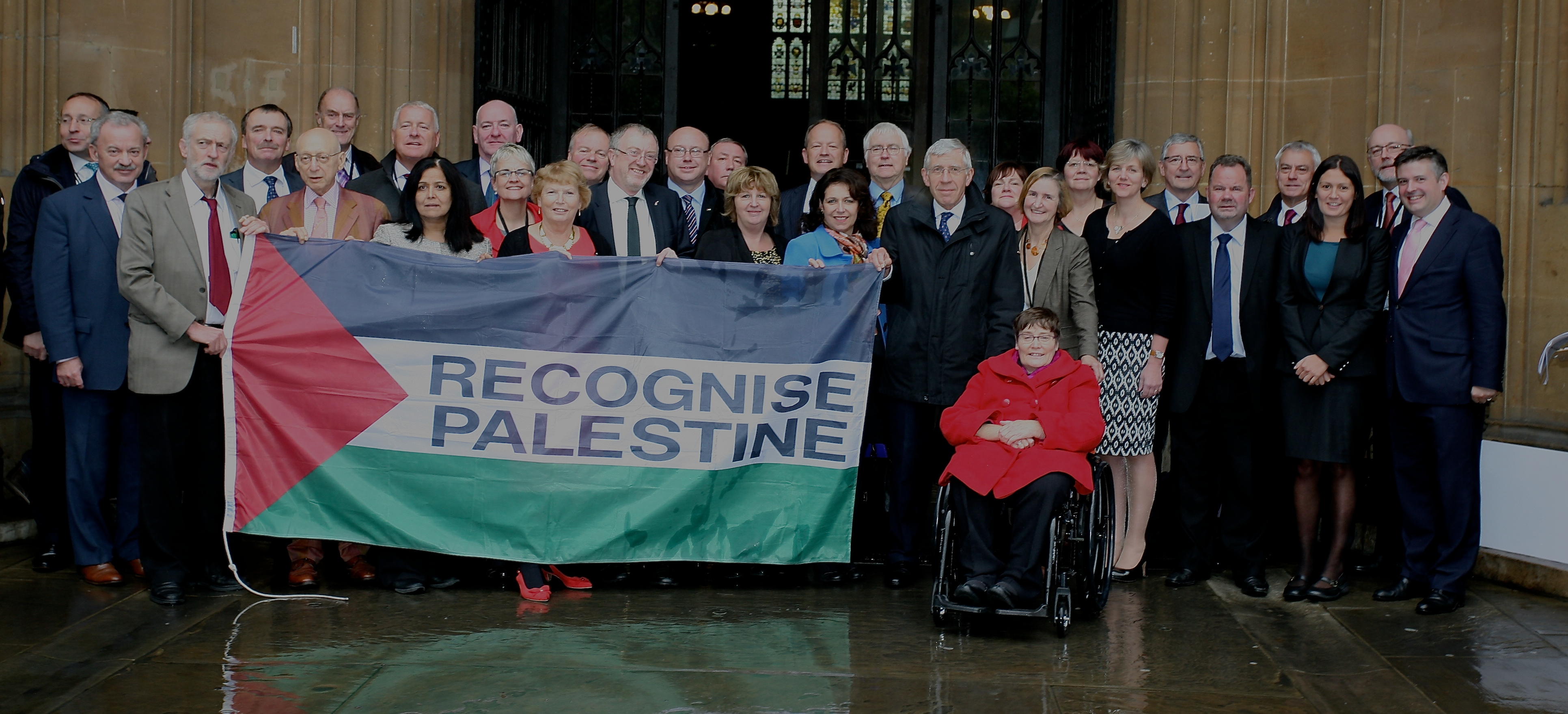
MPs voted in favour of the UK recognising Palestine by an unexpectedly large majority of 262 after a five-hour Commons debate called by Easington MP Grahame Morris. Commentators were quick to dismiss it as “merely an expression of Parliament’s view” that will not commit the Government because it was “only” a backbench debate.

But although the vote is not binding on the Government, it is clear that MPs have changed their views and it is only a matter of time before the Government will have to change its policies. And, although recognition is a minor issue and will not directly affect the lives of Palestinians, there is a good chance that this decisive vote will lead to stronger steps that will begin to put real pressure on the Israelis. The 274-12 vote came about because of a deep underlying shift in MPs’ attitudes to Israel, caused by their shock at the brutality of the Gaza war and their huge postbags of letters from constituents demanding action.

It emerges from the vote that:

  • Half the MPs listed as supporters of Labour Friends of Israel voted in favour of recognising Palestine despite last-minute pleas from senior Israeli politicians to vote against.
  • 40 Conservative MPs – including some members of Conservative Friends of Israel – backed the recognition motion and the Conservative Home website reported that ‘support for Israel is slipping away’.

Ed Miliband put a ‘one-line whip’ on the vote – meaning that MPs could either vote for the motion or abstain – but 80% of his MPs and 21 of 26 members of his Shadow Cabinet voted for the motion. MPs received a huge number of emails – 57,808 through the Palestine Solidarity Campaign website alone – from their own constituents urging them to attend the debate and vote for recognition. This represents a sea-change in both parties.

Conservative Friends of Israel, who are strongly opposed to the recognition of Palestine, claim to have 80% of Tory MPs on their books (242 of 303), but in the event only six Conservatives voted against. Part of the reason may have been that CFI, realising they were going to lose, encouraged their supporters to stay away from the vote – in the hope that the motion would be approved without a physical division where MPs are counted through the voting lobbies. That would mean that the motion would be declared ‘carried’ but no one would know exactly how many or which MPs had voted for or against the motion.

This plot was foiled by two MP who supported recognition but shouted ‘no’ when the Speaker called for ‘ayes’ and ‘noes’ and acted as tellers for the ‘noes’ – without which the Speaker would have been obliged to call off the division. Labour MP Jeremy Corbyn rose on a point of order after the division to explain that he and Batley & Spen MP Mike Wood volunteered as tellers “to ensure that democracy could take place and that Members could record their vote, because those who were opposed to the motion declined to put up tellers”.

If the two ‘no’ tellers are included there were 195 Labour MPs voting for recognition – more than twice the current total of MPs who support Labour Friends of Palestine & the Middle East. While it has been Labour Party policy since 2011 to support the recognition of Palestine, first by the UN and now by the UK, there was no obligation on MPs to turn up for a backbench debate and the numbers were another indication of the rapid fall-off in uncritical support for Israel on the Labour benches. Coalition ministers were told to abstain, but Conservative and Liberal-Democrat MPs were free to vote as they liked.

Although only 40 Conservatives voted for the motion, this was a big increase from the 10 or 15 known to support the Palestinian case in the past.

The real surprise was the number of Conservatives who abstained because they were disillusioned by recent actions of the Israeli government. Typical was the distinguished chair of the Foreign Affairs Committee Sir Richard Ottaway who told the Commons that he had stood by Israel through thick and thin for 20 years but was outraged by the recent Israei annexation of Palestinian land and “such is my anger over Israel’s behaviour in recent months that I will not oppose the motion”.

It was the highest ever attendance at a backbench debate (other than the European referendum debate which was whipped) and out of a total of 43 speeches, only six were from opponents of recognition, with the result that Conservative MPs who have previously been reluctant to express their support for the Palestinian case spoke with passion and eloquence, as though a gag had been removed.

In the event there were 195 Labour MPs supporting the motion, 40 Conservatives, 28 Liberal Democrats, nine Scottish and Welsh nationalists and four Northern Irish (2 SDLP, 1 Independent, 1 Alliance). The noes were six Conservatives, five Ulster Unionists and one Liberal Democrat. Other than the 140 MPs on the “payroll” vote of ministers and ministerial aides who are expected to abstain in backbench debates, the number of MPs who abstained or were absent was 220.  Even if they had all voted ‘no’ (and a number have said they would have voted ‘yes’ but could not be there) opponents of recognition would still have had only 232 votes against the 278 votes in favour of recognition.

Baroness Warsi, who resigned from the Government in August in protest at the strongly pro-Israeli policy, said at the time that many of her ministerial colleagues and most of the officials in the Foreign Office agreed with her, but policy came from a small group at the top. There was a natural majority not only in the country, but also in Parliament and in the Foreign Office for the recognition of Palestine, but “you’ve a small group of politicians who are keeping a close grip on this and who are not allowing public opinion, ministerial views, parliamentary views and the views of the people who work in this system.”

Call it what it is – theft, apartheid, extremism 

We should not use euphemisms to describe what is happening in Palestine. We should use words like ‘theft’, ‘apartheid’, ‘criminal’, ‘extremist’. That’s the view expressed by Conservative MP and former minister Sir Alan Duncan in a speech to the Royal United Services Institute on Tuesday 14 October 2014.

“Illegal construction and habitation is theft, it is annexation, it is a land grab – it is any expression that accurately describes the encroachment which takes from someone else something that is not rightfully owned by the taker. As such, it should be called what it is, and not by some euphemistic soft alternative.

“Settlements are illegal colonies built in someone else’s country. They are an act of theft, and what is more something which is both initiated and supported by the state of Israel.

“It is no exaggeration to say that many settlers are state-supported militia, defying international law, driving out the rightful inhabitants from their land, and creating an illegal economy at the expense of those who have been cruelly displaced.

“No settlement endorser should be considered fit to stand for election, remain a member of a mainstream political party, or sit in a Parliament. How can we accept lawmakers in our country, or any country, when they support lawbreakers in another?  They are extremists, and they should be treated as such.”

Read more>

Cameron rejects Commons’ vote

David Cameron lost little time in pouring cold water on Monday’s vote in the Commons, telling Liberal Democrat MP David Ward during Prime Minister’s questions, that Palestine will not be recognised until “negotiations that bring about a two-state solution”.

This is precisely what the House of Commons rejected by voting by 274-12 on Monday that Britain should recognise Palestine without any preconditions and without waiting for peace talks – because, as Grahame Morris said in his introduction, there were no peace talks and no prospect of peace talks, so this would give the Israelis a veto on UK policy and recognition should be a matter for the UK alone.

Negotiations broke up on April 29th after nine months of fruitless of talks when the Israelis announcement yet another illegal settlement in Palestinian East Jerusalem and there is no likelihood of talks restarting at any point in the near future.

David Ward (Bradford East) (LD):

The Palestinian ambassador, Mr Hassassian, has described Monday’s vote on the recognition of the Palestinian state as “a momentous vote”. Indeed it was. He has also said:“Now is the time for the UK government to listen to its democratically elected parliament and to take decisive political action by recognising the State of Palestine and upholding its historical, moral and legal responsibility towards Palestine”.Does the Prime Minister agree?

The Prime Minister:

Of course, I look forward to the day when Britain will recognise the state of Palestine, but it should be part of the negotiations that bring about a two-state solution. That is what we all want to see—a state of Israel living happily and peacefully alongside a state of Palestine—and that is when we should do the recognition.

Although the parliamentary motion is not binding on government, the hope is that it will encourage other European countries to announce recognition of Palestine – France and Ireland are known to be considering it – to create a bandwaggon effect after the announcement by the new Swedish government earlier this month that they will recognise Palestine.

Already 135 countries (out of 193) recognise Palestine, including many EU states, and the main exceptions are the major West European and North American countries.  Even without the support of the British government, the British Parliament may inspire other countries to follow suit.

But the more important effect of Monday’s vote is that many MPs have voted in support of Palestine for the first time and this may embolden them to go on to give their support to the Palestinians on other issues, such as discouraging or banning trade with the illegal settlement or putting economic pressure on Israel to stop building more settlements.

For Palestinians recognition will make no visible difference – except that a small well-fortified building in East Jerusalem will take down a sign saying “British Consulate-General” and put up a new sign saying “British Embassy to Palestine”.

For the first time the House of Commons has demonstrated its support for the Palestinians’ case and the Palestinians’ hope – and the Israelis’ fear – will be that they will do so again on an issue which will have more than a symbolic effect on the long-running conflict.

Highlights of Debate on Motion to recognise Palestine as a State

A Backbench debate on Monday 13 October 2014 was secured by Grahame Morris MP  “That this House believes that the Government should recognise the state of Palestine alongside the state of Israel. An amendment was proposed by Jack Straw to add ‘as a contribution to securing a negotiated two state solution.’ This amendment was accepted.
The amended motion was carried 274 votes for, 12 against.
Highlights from the debate 
Grahame M. Morris: As the originator of the Balfour declaration and holder of the mandate for Palestine, Britain has a unique historical connection and, arguably, a moral responsibility to the people of both Israel and Palestine. In 1920, we undertook a sacred trust—a commitment to guide Palestinians to statehood and independence. That was nearly a century ago, and the Palestinian people are still to have their national rights recognised. This sacred trust has been neglected for far too long. As the Lady has just said, we have an historic opportunity to atone for that neglect, and take this small but symbolically important step.
Sir Edward Leigh (Gainsborough) (Con): I understand the Government’s position, but they should listen to the voice of this House. Virtually everybody who has spoken—not just lefties waving placards in Trafalgar square, but virtually every Conservative MP—has said that now is the time to recognise the justice of the Palestinians’ case.
I have nothing but respect and support for the state of Israel. I think that all of us are very philo-Semitic. But the [Israelis] have to open their hearts. They have to start relaxing controls in and out of Gaza. They have to start relaxing controls at the Bethlehem checkpoint and they have to stop the settlements. There has to be some way forward. We have to recognise, however naive this may sound, that we are part of a common humanity.
Mr Andy Slaughter (Hammersmith) (Lab): this country has a special duty here. It is easy to try to duck that duty. We are the authors of the Balfour declaration and we were the occupying power. Anybody who goes to the Middle East knows—I am sure that the Minister would agree with me on this—that the views taken by the British Government and the British people run powerfully in the region. We should set an example. Yes, 135 countries have recognised Palestine and yes, we are behind the curve in this matter, but it is not too late for us to set an example to Europe and the rest of the world and show that we believe in equality and fairness in international statecraft as much as we believe in our own country.
Sir Nicholas Soames (Mid Sussex) (Con): What entitles the United Kingdom to withhold a recognition that is the birthright—the long overdue birthright—of each and every Palestinian child? It would be shameful not to take the step of recognition now, when it would make a real difference.
The United Kingdom was a midwife at the birth of Israel and is a permanent member of the UN Security Council. That means an aspiration to take a lead in world affairs. We should take that lead now on this vital issue through a decisive vote of the British House of Commons.
Sir Gerald Kaufman (Manchester, Gorton) (Lab): There The recognition of Palestine by the British House of Commons would affect the international situation. It would be a game changer. I call on both sides of the House to give the Palestinians their rights and show the Israelis that they cannot suppress another people all the time. It is not Jewish to do that. They are harming the image of Judaism, and terrible outbreaks of anti-Semitism are taking place. I want to see an end to anti-Semitism, and I want to see a Palestinian state.
Mr Jack Straw (Blackburn) (Lab): Their illegal occupation of land is condemned by this Government in strong terms, but no action follows. The Israelis sell produce from these illegal settlements in Palestine as if they were made or grown in Israel, but no action follows. The Israeli Government will go on doing this as long as they pay no price for their obduracy.
Richard Burden (Birmingham, Northfield) (Lab): I received an e-mail today from a Palestinian living in East Jerusalem. He described some of his life under occupation in East Jerusalem and he asked me to say this tonight: “I want to see light at the end of the tunnel, but I really want to see light at the end of the tunnel; I don’t want to see a train coming at me from the other end.”
Sir Richard Ottaway (Croydon South) (Con): I have stood by Israel through thick and thin, through the good years and the bad. I have sat down with Ministers and senior Israeli politicians …. and I thought that they were listening. But I realise now, in truth, looking back over the past 20 years, that Israel has been slowly drifting away from world public opinion.
The annexation of the 950 acres of the West Bank just a few months ago has outraged me more than anything else in my political life, mainly because it makes me look a fool, and that is something that I resent.
Under normal circumstances, I would oppose the motion tonight; but such is my anger over Israel’s behaviour in recent months that I will not oppose the motion.
I have to say to the Government of Israel that if they are losing people like me, they will be losing a lot of people.
Sir Alan Duncan (Rutland and Melton) (Con): Recognition of statehood is not a reward for anything; it is a right. The notion that it would put an end to negotiations, or somehow pre-empt or destroy them, is patently absurd; Palestine would still be occupied, and negotiations would need to continue, both to end that occupation and to agree land swaps and borders. Refusing Palestinian recognition is tantamount to giving Israel the right of veto.
A lot of people feel intimidated when it comes to standing up for this issue. It is time we did stand up for it, because almost the majority of Palestinians are not yet in their 20s. They will grow up stateless. If we do not give them hope, dignity and belief in themselves, it will be a recipe for permanent conflict, none of which is in Israel’s interests. Today, the House should do its historic duty.
Mike Wood (Batley and Spen) (Lab): We will be voting tonight for the recognition of a Palestinian state. That is not just about recognising the inalienable right of Palestinians to freedom and self-determination but about Israel’s need to be saved from itself. What Israel is looking at in a one-state solution is a continuation, year after year, of war and violence such as we have seen building in the past 20 years. The Israelis have just finished a third incursion into Gaza in 10 years. Are we suggesting that every two years another 1,500 people should be killed and another 100,000 people rendered homeless as a continuation of the process of driving everybody who is not Jewish out of what is considered to be greater Israel?
Mr David Ward (Bradford East) (LD): What I do not understand is why the Palestinians should have had to pay such a terrible price for the creation of the state of Israel, where it was believed that security could be created, or why the Israelis believed that the brutal expulsion and continued suppression of the Palestinians would ever lead to the sense of security that they seek.
Anas Sarwar (Glasgow Central) (Lab): There are moments when the eyes of the world are on this place, and I believe that this is one of those moments.
Mr Andrew Love (Edmonton) (Lab/Co-op): , three years ago at the United Nations, the then Foreign Secretary said that Palestine met the conditions and was ready for statehood. How long do they have to wait?
Mr Tobias Ellwood, Middle East minister: The UK will bilaterally recognise a Palestinian state when we judge that that can best help bring about peace. The UK will recognise a Palestinian state at a time most helpful to the peace process, because a negotiated end to the occupation is the most effective way for Palestinian aspirations of statehood to be met on the ground.
The UN estimates that it could take 18 years to rebuild Gaza without major change. It says that Gaza could become unliveable by 2020. If the underlying causes are not addressed, it risks becoming an incubator for extremism in the region.
Ian Lucas (Wrexham) (Lab), shadow Middle East minister:  The Labour party supported Palestinian recognition at the UN and we support the principle of recognition today, because we believe it will strengthen the moderate voices among the Palestinians who want to pursue the path of politics, not the path of violence.
It is crucial, at this time when help is needed, that President Abbas receives support for the political path he has chosen. We need to support President Abbas to follow the path of peace and not the path the terrorists of Hamas inflict on the people of Israel, Labour believes that, amid the despair today, we need to take a dramatic step.
Labour urges the Government to listen to the House of Commons—listen to the voices on the Conservative Benches, the Liberal Democrat Benches, the Labour Benches, all the Benches—and give Palestinians what they have as a right: statehood. This it not an alternative to negotiations; it is a bridge for beginning them.
Julie Elliott (Sunderland Central) (Lab): This year’s conflict in Gaza shows how unequal the two sides are. There were some 1,462 civilians killed on the Palestinian side and seven on the Israeli side. All of those are a personal disaster for the victims’ families and are regrettable, but we can see from the numbers the scale of the imbalance in this situation.
Given the imbalance, Palestinian statehood would not harm Israel in any way, but it would give some support to the Palestinian people.
Mr Peter Lilley (Hitchin and Harpenden) (Con): In line with our traditional policy, we should recognise the Palestinian state as a reality. We would not be granting it anything; we would simply be recognising a fact.
Andy McDonald (Middlesbrough) (Lab): Every day that the establishment of the Palestinian state is postponed merely guarantees the continuation of the conflict, with more innocent people losing their lives. We owe it to all those who have lost their lives on both sides, and those whose lives are constantly at risk, to bring this tragedy to an end by recognising the Palestinian state without further delay.
Andrew Stephenson (Pendle) (Con): I believe that time has come. We need to support the vast majority of Palestinians who believe in peaceful coexistence with Israel, and face down the violent minority by showing them that non-violence and a willingness to negotiate can help get them somewhere.
Mr Andy Slaughter (Hammersmith) (Lab): It is the British people who have taken up this cause, with more than 50,000 e-mails sent to MPs over the past two or three weeks. The Labour movement [has been on a journey] from being very sympathetic to Israel as a country that was trying to achieve democracy and was embattled, to seeing it now as a bully and a regional superpower. That is not something I say with any pleasure, but since the triumph of military Zionism and the Likud-run Governments we have seen a new barbarism in that country.
The motion is a positive step, but my constituents wish to see more. They would like us to stop supplying arms to the Israelis when those arms are being used for the occupation and to kill people in Gaza. They would like us to stop importing goods from illegal settlements—illegal under international law. They cannot understand why, if the settlements are illegal, the goods should not be illegal as well.
Sarah Champion (Rotherham) (Lab): In the recent referendum in Scotland. … we did not ask the people of England, Wales or Northern Ireland whether they wish Scotland to stay. We accepted that it was the right of the Scottish people to decide. The same principle should be applied to Palestine. This is not an issue for the Israelis to decide, even if they want to. It is not an issue for negotiations. It is an issue for the Palestinian people and the Palestinian people alone.
Stewart Hosie (Dundee East) (SNP): If we are serious about a two-state solution, 65 years is too long to wait for recognition of Palestine. Even if only to provide parity of dignity—the basic dignity of having one’s nation state recognised—we should recognise it. The time for excuses is over; we should recognise Palestine today.
Andrew Griffiths (Burton) (Con): According to the UN, during this summer’s conflict, a total of 2,131 Palestinians were killed. Of those, at least 1,473 were civilians—young, innocent civilians, in many cases. On the Israel side, 66 Israeli defence force soldiers were killed, and five Israeli civilians. I do not believe that that response is proportionate. Israel has lost the moral high ground in the way it acted.
We should demand the same standards of Israel as we do of any democratic state Some of the acts committed by Israel were clearly unacceptable. Why was it necessary to blow up Gaza’s only power station, leaving already stretched hospitals to rely on generators? Why was it necessary to bomb hospitals and schools, when, as we saw, the threat of loss of life to Israeli civilians was small in comparison? By adding to the suffering of the Gazan people, the Israeli Government have lost the support of the House, and it should cause them great concern.
It is important that moderates in the debate such as me should speak out if we are turning against support for Israel.
Lyn Brown (West Ham) (Lab): Over the past weeks my in-box has been flooded with hundreds of letters from my constituents. Their strength of feeling is undeniable, their arguments are heartfelt, and their conviction is deep-seated—and for good reason. I share those arguments and that conviction.
Jonathan Ashworth (Leicester South) (Lab): This House has a duty to support Palestinian statehood. The Palestinian claim to statehood is not in the gift of a neighbour—it is an inalienable right of the Palestinians, and tonight we should speak up on their behalf. There are times when this House has to send a message—when this House has to speak. I believe that the will of the British people is now to support Palestinian statehood
Martin Horwood (Cheltenham) (LD): if we are to tell Arabs across the region to reject extremism, rockets, bombs and massacres that are deliberately aimed at killing defenceless civilians, we must also do more to support the moderate, democratic, pluralist leaders, such as Mahmoud Abbas, who have painstakingly pursued the diplomatic path towards peace and self-determination.
Palestinians face sanctions for going to United Nations

US, Israel to punish Palestine for exercising right to join UN

Free Palestine won’t need aid – DfID
Is it a crime to go to the United Nations? Is it a crime for a country to sign up to UN conventions and join UN agencies?
Yes, according to the Americans.
The US ambassador to the UN, Samantha Power, warned last week that America “will oppose any attempt to upgrade the status of the Palestinians everywhere in the UN”.
Yes, according to Israel.
Israel’s prime minister Binyamin Netanyahu imposed sanctions on the Palestinian Authority for signing up to UN conventions this week by ordering his ministers not to speak to Palestinian ministers or their civil servants.
We’d rather you didn’t do it, says the FCO.
The Middle East minister told David Winnick MP that, while the UK would “ultimately” like to see a Palestinian state sign up to UN conventions, “at this stage” it believed the “only route” to ending the occupation was through negotiations and it should focus on that.
This was the bizarre reaction to Palestinian President Mahmoud Abbas’s decision last week to sign letters of accession to 15 UN treaties and conventions – exercising a right he has had since November 2012 when the UN voted by 138 to nine to recognise Palestine as a state.
The Palestinians agreed last summer not to exercise this right during the nine months of the peace talks provided the Israelis released 106 prisoners who have been in Israeli jails for more than 22 years.
The Israelis failed to release the last batch of 26 prisoners on Saturday March 29th and as a result President Abbas felt free to sign the letters on Tuesday April 1st.
However, he made it clear he would suspend action on the applications to the UN if and when the prisoners were released and he was willing to continue the talks until the final day of the nine months, April 29th.
If they are not released, he will in due course apply to join all 63 UN bodies – including the one the Israelis fear most, the International Criminal Court.  Once Palestine is a member of the ICC, Israeli generals can be tried for war crimes in the occupied West Bank and Gaza.
At Foreign Office questions this week William Hague did his best to convince himself that the talks will continue – even though John Kerry has now washed his hands of them and blamed the Israelis for causing the collapse.http://mondoweiss.net/2014/04/blames-israel-breakdown.html
In the Lords Lord Turnberg urged him to start thinking of a Plan B.
At DfID questions in the Commons Aid Minister Alan Duncan said Israeli restrictions did tremendous damage to the Palestinian economy and to the living standards of ordinary Palestinians.
“The simple truth is that they are not allowed to develop their banking or information and communications technology sectors, or to build even their basic infrastructure.
“Were these restrictions to be lifted … within a relatively short space of time the Palestinians would probably not need our aid at all.”
During the so-called ‘peace talks’ there have been 56 Palestinians killed, 146 houses demolished, 550 attacks by settlers, 897 Palestinians injured, 3,061 arrested, 3,767 military raids and 10,509 new homes built in illegal settlements – enough to house 52,000 new settlers. 
 
Is any more proof needed that the Israelis use ‘peace talks’ as a cover for the accelerated take-over of the West Bank?


International Development Questions

WEDNESDAY 9 APRIL 2014 Oral Questions to the Secretary of State for International Development

Sir Peter Luff (Mid Worcestershire) (Con): What assessment she has made of the effectiveness of her Department’s support for the Palestinian Authority.

Aid Minister Alan Duncan: The UK is providing effective support for the Palestinian Authority in very challenging circumstances. The Palestinian Authority has developed institutions to the point where the international community has recognised it as technically ready for statehood, and it has made impressive progress in delivering improved outcomes in health and education.

Sir Peter Luff: Having just returned from a Select Committee visit to the Palestinian occupied territories and seen the excellent work being done there by the Department, may I ask whether the Minister agrees that its work to support the private sector would be much more effective if Israel lifted many of its restrictions, which can have nothing to do with its essential security, on the freedom of Palestinian business people to develop their economy in areas such as the banking sector, water supply, and even 3G telephone networks?

Mr Duncan: I am grateful to him for his appreciation of DFID’s work in the occupied Palestinian territories and glad that he and the Committee had such a useful visit. Israeli restrictions do tremendous damage to the economy and to the living standards of ordinary Palestinians. The simple truth is that they are not allowed to develop their banking or information and communications technology sectors, or to build even their basic infrastructure. Were these restrictions to be lifted, not only would DFID’s work to support the private sector be much more effective, but within a relatively short space of time the Palestinians would probably not need our aid at all.

Richard Burden (Birmingham, Northfield) (Lab): Is the Minister aware that the World Bank has said that Area C of the West Bank, particularly the Jordan valley, is vital to the future economic viability of a Palestinian state? Presumably that is why the Department is looking to fund infrastructure projects there. What is his view of the fact that illegal Israeli planning restrictions are stopping those infrastructure projects being built, and for how long will the Government allow Israel to have a veto over economic development in the West Bank?

Mr Duncan: I fully understand what he says. I think the Select Committee saw a direct example of the destruction of olive groves when it was there. It is essential that area C is able, through planning arrangements, to develop its economy; otherwise there can be no sensible or useful economic future in the Palestinian territories.

Sir Malcolm Bruce (Gordon) (LD): May I confirm what the Minister says—that without access to area C there is no future for a two-state solution or for an economically viable Palestine? The Palestinian Authority pleaded with us to put all possible pressure on Israel to allow access. We met someone from a company who is saying that the cost of land in areas A and B is prohibitive and that without access to area C he cannot develop his business.

Mr Duncan: I fully concur with him. I hope that a full understanding of this can be included in the peace talks that we hope are continuing towards a productive and useful conclusion.

Mark Lazarowicz (Edinburgh North and Leith) (Lab/Co-op): What recent representations have the Government made to the Israeli authorities about the continued forcible removal of populations, and property demolition, in the occupied territories? Yesterday the Foreign Secretary met the Israeli Minister for International Relations: was this issue raised with him?

Mr Duncan: I was also at that meeting, and I can assure the Member that we raise such matters regularly. It is essential that some kind of normal activity can be permitted in the occupied Palestinian territories; otherwise, as Sir Malcolm Bruce said, there will not be a two-state solution and there is a danger of permanent conflict and tension.

Foreign Office Questions

TUESDAY 8 APRIL 2014
Oral Questions to the Secretary of State for Foreign and Commonwealth Affairs
Ann McKechin (Glasgow North) (Lab): What recent assessment he has made of progress in peace negotiations between Israel and Palestine.
William Hague: In the past few days, I have discussed progress with Secretary Kerry and President Abbas, and I will speak to my Israeli counterparts in the coming days. Secretary Kerry’s tireless efforts provide an unparalleled opportunity to achieve a two-state solution. I urge both parties to show the bold leadership needed to resolve this conflict once and for all.
Ann McKechin: The Foreign Secretary will be aware of press stories that the latest report by the European heads of mission in East Jerusalem states that Israeli policies in Jerusalem are aimed at “cementing its unilateral and illegal annexation of East Jerusalem”, with an unprecedented surge in settlement activity. Does the Foreign Secretary concur with that view and, if so, what is he doing to ensure the future of Jerusalem as a shared capital as part of the negotiations?
Mr Hague: Jerusalem, as a shared capital, is part of what we believe is a characteristic of achieving a two-state solution, along with a solution based on 1967 borders, with agreed land swaps and with a just, fair and agreed settlement for refugees. It is vital that that possibility is kept open. That is why so many of us on all sides of the House have voiced such strong disapproval of settlements on occupied land, which are illegal. We make that point regularly to the Israelis—indeed, I will do so to an Israeli Minister this afternoon—and we urge them to take the opportunity of peace.
Dr Matthew Offord (Hendon) (Con): Last December, the Foreign Secretary said that the British Government have been “clear to the Palestinians that there is no alternative to negotiations” and that “we oppose unilateral measures”. What representation has he made to the Palestinian Authority following its return to unilateral actions last week, in violation of its commitment to abstain for the duration of direct peace talks?
Mr Hague: I called President Abbas last Thursday to repeat our view that the only chance of achieving a viable and sovereign Palestinian state is through negotiations. President Abbas assured me that he remains committed to negotiations, so we will continue to encourage him and Israeli leaders to make a success—even at this stage—of this opportunity.
Mrs Louise Ellman (Liverpool, Riverside) (Lab/Co-op): It is essential that both sides return to negotiations and that they recognise that they will both have to make great compromises to secure a negotiated peace. Does the Foreign Secretary believe that the Palestinian leadership has been preparing the Palestinians for peace when terrorists freed by Israel have been welcomed in the Palestinian Authority as heroes? A broadcast by Palestinian Authority TV has honoured Dalal Mughrabi, who was responsible for a hijacking in which 37 Israeli citizens, including 12 children, were killed.
Mr Hague: Prisoner releases are always controversial in a peace process, as we know well in our own country, but I absolutely regard President Abbas, the leader of the Palestinians, as a man of peace, and I pay tribute to the bold leadership that he has shown on these issues in recent months. As she has just heard, I have urged him to continue with that, and we must focus on that point.
Ian Lucas (Wrexham) (Lab): What is Government policy on Palestine applying as a state to be a member of international political or cultural organisations?
Mr Hague: Last week, President Abbas signed and submitted letters of accession to 15 conventions, including the fourth Geneva convention. No decision is imminent or necessary at the moment on these things, and given that our focus is on urging both Palestinians and Israelis to make a success of the negotiations, I do not believe that it would be wise for us or other countries to pass judgment on those applications now.