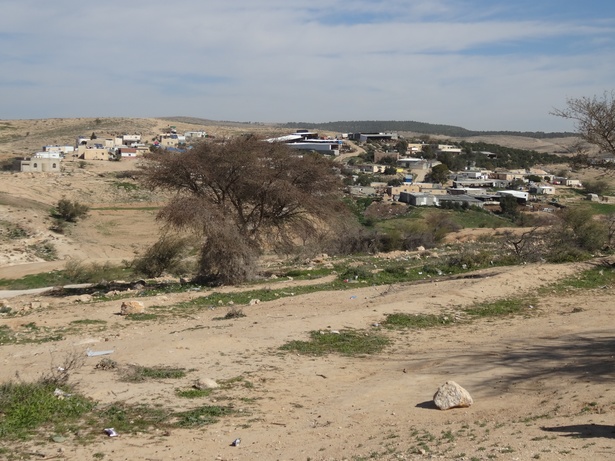
 Emboldened by the election of Donald Trump, the Israeli premier Benjamin Netanyahu was reported to be sending his army’s bulldozers in at dawn today (Tuesday) to demolish this peaceful Bedouin village in Israel.
The Israeli government has long been planning to demolish the village of Umm Al Hiran and evict its inhabitants in order to build a Jewish village with the same name – Hiran – on exactly the same location.
The 500 Arab residents of the village have lived in the village for nearly 60 years and were ordered to move there by the Israeli military commander of the Negev who gave them a lease to build a village, farm the land and graze their sheep.
Villagers say: ‘Why evict us when we can both live here? There’s plenty of space.’
This village is in Israel, not the Palestinian Territories. Its residents are full citizens of Israel. Yet they are treated as though they had no rights, no importance.
Like all the other “unrecognised” villages in the Negev, they were provided with no mains electricity, no paved roads, no water, no sanitation. They had to do their best buying water from tankers and using solar panels for intermittent power.
Six reasons to stop Israel’s illegal settlement project
Everyone who wants to end the Israel-Palestine conflict, from the President of the United States to your local peace campaign, agrees on one thing: the major injustice aggravating this conflict is Israel’s illegal settlement project.
For nearly 50 years now, since the start of the Israeli occupation in 1967, the Palestinians have watched helplessly as armed Israeli settlers, backed by the Israeli army, have built their homes on Palestinian land while Palestinians are denied permits to build on their own land.
Having been left with only 22% of historic Palestine after the creation of the Israeli state, the Palestinians have seen the land they control dwindle further as settlements grow. They could end up with just 8% of historic Palestine even though they are more than 50% of its population.
Crisis
These settlements are regarded as illegal by every country except Israel. A motion calling on Israel to end settlement building was supported by 14 or the 15 countries on the United Nations Security Council in 2011, including the UK, France and Germany. Only the US voted against and that vetoed it.
President Obama now has a window of opportunity in the ten weeks between the US election and his successor’s inauguration on January 20 2017 to lift his veto and allow the international community to move towards a resolution of the conflict.
We are also about to start a year of unhappy anniversaries: March 2017 is the 10th anniversary of the Israeli blockade of Gaza, June 2017 is the 50th anniversary of the start of the Israeli occupation of the West Bank and November 2017 is the centenary of the Balfour Declaration, the letter written by British foreign secretary Arthur Balfour promising “to view with favour the establishment in Palestine of a national home for the Jewish people”.
Balfour
Trade
We think of the conflict as insoluble, but it will be easy to resolve if the international community is working together. Settlements equate to just over ½% of Israel’s trade with the outside world and Israel is a small country heavily dependent on its major trading partners, the EU and the US. Only a hint of concerted international action will be enough to persuade most Israeli voters that they are better off without the settlements.
That is why all the major organisations campaigning for justice for the Palestinians have made their major policy objective over the next year to stop settlement building and settlement trade.
MPs have a crucial role to play in this. They can put this issue on the agenda and make sure the international community takes this opportunity. Or they can look the other way and let the Israeli government get away with the gradual takeover of the West Bank, sowing the seeds for another century of conflict.
1. Settlements are illegal
The Israel government always disputes this, but international law states quite clearly that an occupying country “shall not … transfer parts of its own civilian population into the territory it occupies” and the International Court of Justice confirmed in 2004 that Israel was breaching its obligations under international law by establishing settlements in the West Bank. Even the US has always opposed settlements on the grounds they are illegal, though they prefer the word “illegitimate”.
2. Settlements are growing fast
Many people’s image of a settlement is just a cluster of houses on the top of a hill. In fact, the largest settlement now has a population of 60,000. Five are over 40,000. The last official number for the total number of settlers was 547,000 but that was in 2013. The settlers themselves say it is now nearly 800,000 among a Palestinian population of 2.9 million.
3. Settlements are eating up the West Bank
The Israeli government will tell you settlements cover only 3% of the West Bank. This is misleading. Settler councils control 42.7% of the land area. The Israel army is in administrative control of 62% of the West Bank, known as Area C. Settlements are constantly expanding. Palestinians are refused building permits with almost no exceptions. One of the parties in the Israeli coalition government want Area C annexed to Israel, leaving the Palestinians in control of isolated pockets of land amounting to just 8% of historic Palestine.
4. Settlements are strangling the Palestinian economy
The Israeli government wants you to believe settlers are more successful because they are better at business. No, it’s because they take 80% of the water and all of Palestine’s natural resources to which they have no legal right. Palestinians’ freedom of movement is restricted by 490 roadblocks in the West Bank and the blockade of Gaza. A report by the World Bank in 2013 calculated that the restrictions in Area C cost the Palestinian economy £3.4 billion a year or 35% of its national income. A Palestinian report in 2010 calculated that the Israeli-imposed restrictions on Palestine cost them 85% of nominal GDP.
5. Settlements are bad for Israel as well as Palestine
The settlements have cost an estimated £15 billion to build and cost £500 million a year to subsidise, which many Israelis think is a huge waste of money. But their government continues to offer subsidies to house prices and rents to persuade new immigrants to move there. Spending per citizen is double what it is in Israel, treble in isolated settlements. Religious settlers will never willingly move, but the majority are economic settlers, often locked in by negative equity on houses they cannot sell, and would willingly be bought out to live in Israel, where there is plenty of space. Exports from settlements do not benefit from lower tariffs under EU law and must be labelled as coming from settlements, not Israel.
6. Settlements are the main obstacle to the peace process
The Israeli prime minister says he is willing to enter ‘unconditional’ talks with the Palestinians. What he means is that he is willing to enter talks on condition that he can continue building settlements while talks are going on. The Palestinians are wise to this one. During the 20 years of Oslo talks, no progress was made towards peace but the number of settlers trebled. “It’s like negotiating shares of a pizza with a man who is eating the pizza as you negotiate so your share is always getting smaller,” they say. Obviously, settlement building has to stop before peace talks can resume.
Palestine statement from Owen Smith
Thank you to Owen Smith’s team for forwarding us this response from the Labour Leadership team to Grahame Morris MP, chair of Labour Friends of Palestine and the Middle East. We hope this will be helpful for those Labour Party members deciding how to vote.
Owen Smith writes:
“I am proud to be a member of Labour Friends of Palestine and the Middle East and I strongly support a viable peace process based on internationally recognised (1967) borders.
“I continue to unequivocally support a two-state solution to the Israeli-Palestinian conflict and the recognition of a viable Palestinian State alongside a safe and viable Israel. The terms of a peace deal are well known and I support them completely: two sovereign states living side by side in peace and security.
“The right to self-determination is an inalienable right for the peoples of both Palestine and Israel. I believe that the state of Palestine should be recognised,within the UN and by the UK, and I voted to recognise a Palestinian state in 2014 as an essential step towards to realising a two-state solution. I recognise that, ultimately, this can only be achieved by both sides sitting down together, with equal status, negotiating in good faith and making some difficult compromises.Peace is not something that can be imposed on either the Israelis or Palestinians by force or diktat.
“I am opposed to violations of international human rights law, including the UN Convention on the Rights of the Child, and the construction of the separation wall on Palestinian land. I consider the settlements in the occupied Palestinian territories to be illegal, unjustifiable and detrimental to the prospects of achieving a two-state solution. I also agree that the blockade on Gaza should be lifted and that rocket attacks and terrorism against Israelis must stop.
“I am not convinced that a boycott of goods from Israel would help to achieve a negotiated peace settlement. In order to support the peace process we must build bridges between all those who support peace in the region. My time working in Northern Ireland as part of the peace process showed me that, beyond negotiations, peace only really comes when each side moves towards reconciliation.
As friends of the people of Israel and Palestine, our most important task is to help foster cooperation and coexistence between both sides and I believe the work of Labour Friends of Palestine and the Middle East makes an important contribution to that understanding.”
Members will already be familiar with Jeremy Corbyn’s views on all these issues. To recap, during the 2015 leadership election Labour Friends of Palestine asked the candidates for their views on six issues: Are settlements illegal? UK recognise Palestine? Lift the blockade of Gaza? Stop settlement trade? Suspend tariff reductions? Stop arms sales? Jeremy Corbyn answered yes to all of them.
UN figures: 800 Palestinians evicted in first quarter of 2016
| 2015 | 2016 so far* | annual rate | |
| Buildings demolished | 531 | 586 | + 383% |
| People evicted | 688 | 800 | + 403% |
| *Jan 1 – Apr 18 |
Has your MP signed the motion on demolitions?
Is it finally time to recognise Palestine?
Minister urges Israel: give Palestinians building permits


Foreign Secretary in talks with French on new peace initiative
Former Middle East minister Ben Bradshaw among MPs urging support
Foreign Secretary Philip Hammond has held talks with the French to explore the idea of a peace conference in Paris this summer to start serious discussion on a solution to the Israel-Palestine conflict.
Former Middle East minister Ben Bradshaw (right) and Tom Sheppard and Paul Monaghan of the SNP are among the MPs who have pressed him to consider supporting the initiative of the French foreign minister Jean-Marc Ayrault.
Ben Bradshaw wrote to the Foreign Secretary and was told: “We are discussing with the French to explore their idea, which is still at an early stage…. We will continue to engage with the French as they develop their plans.”
Mr Hammond met the French special envoy for the initiative, Pierre Vimont, to discuss how the idea would work in practice.
MPs have an opportunity to urge Mr Hammond to give the UK’s full support to a Franco-British peace initiative at Foreign Office questions on Tuesday April 12th.
The French Foreign Minister hopes to call a gathering of supportive countries in Paris to lay the groundwork for a peace conference in the summer.
This is supported by the Palestinians, by the EU foreign affairs representative Federica Mogherini and by several European countries including the Spanish and Italians, but will have a far better chance of success with UK support.
The plan was first put forward by the outgoing French foreign minister, Laurent Fabius, who also warned that – if this initiative fails – France will recognise Palestine.
His successor Jean-Marc Ayrault has said recognition will not follow “automatically” if Israel refuses to participate – in order to give the conference a better chance of success.
But if talks don’t take place, or break up, it is difficult to see what logical step remains other than a co-ordinated recognition of Palestine by the UK, France and other European countries such as Italy, Spain, Ireland and Belgium.
The state of Palestine is already recognised by 136 countries (out of 193), inclding ten in the EU, and a joint move by the UK, France and others would send a clear message without in any way changing the UK’s formal relationship with Israel, which it has recognised since 1950. It would also impose responsibilities on the Palestinians.
This is the time for British MPs of all parties to make the case to the Foreign Secretary.
President Obama has made it clear he will make no further moves on the Israel-Palestine in the remainder of his term – though he has hinted he might lift his veto on a Security Council resolution.
The EU Council of Ministers is unlikely to be able to agree an initiative between all 28 countries – there will always be an East European country voting against – so the responsibility falls to the major West European powers.
We all know why Germany will not take the lead, and France has already put forward an initiative, so it is now up to the UK to say whether it will join with the French. There is no longer any excuse for sitting on the fence.
It is important for the UK not only to back the conference this summer but also to support the French position that – if Israel does not engage realistically in the talks – there will be a concerted move to recognise Palestine before the end of the year.
Foreign and Commonwealth Office Questions Tuesday April 12th 11.30 am
- Question 7 David Mowat (Warrington South): What recent assessment he has made of the likelihood of a two-state solution in the Middle East.
- Question 9 Chris Philp (Croydon South): What recent discussions he has had with his counterparts in the EU, Africa and the Middle East on steps to tackle the refugee crisis in the Middle East.
- Question 15 Tommy Sheppard (Edinburgh East): What representations he has made to his Israeli counterpart on the use of administrative detention in that country.
It’s the absence of a solution that causes the violence
MPs who have visited Jerusalem and the West Bank in the last few months will know how dire the situation is and how desperate the Palestinians feel.
It is now six months since the latest wave of violence started. Since October 1st la st year 15,097 Palestinians and 215 Israelis have been injured (a ratio of 70:1) and 202 Palestiniansand 24 Israelis have been killed (a ratio of 8:1). Source: UN protection of civilians database
It’s nearly two years since the last round of talks between Israelis and Palestinians brokered by the US Secretary of State John Kerry (right) collapsed in April 2014 after Israel cancelled a promised release of prisoners and announced new settlement building.
The two facts are related. It is precisely because the West has hung the Palestinians out to dry by failing to follow up the collapse of the talks with any effective pressure on the Israeli government that some Palestinians have turned to violence.
It’s worth remembering that it’s only a tiny minority of young Palestinians who have attempted to kill or injure Israelis – and they have usually been executed on the spot without any serious attempt to arrest them.
The latest video of a young Palestinian being executed by an Israeli soldier as he lay apparently unconscious on the ground tells you a lot about the casual indifference of Israelis – even Israeli ambulance workers – to the lives of Palestinians. See injured Palestinian ignored by ambulance, shot in cold blood
But instead of focusing on the 202 who have been killed, it’s worth thinking about the 15,097 who have been injured. That’s a huge number of (mainly) young people, the great majority of whom have committed no crime but have been treated in hospital for injuries sustained in protests and demonstrations.
They are victims of the Israeli army’s increasing use of excessive force against unarmed and peaceful demonstrations, including live ammunition and rubber-coated bullets. The equivalent in Britain would be for 350,000 young people to have been treated in hospital for injuries sustained in demonstrations in the last six months, 63,000 hit by rubber-coated bullets, 50,000 hit by live ammunition and 15,000 suffering from physical assaults by soldiers or vigilantes (settlers).
The Israelis call it the ‘intifada of individuals’ – an acknowledgment that it is not organised or even incited by outsiders, but the spontaneous and desperate retaliation of a generation of young Palestinians against the everyday hardships and indignities of a brutal occupation now nearly 50 years old.
The absence of any attempt by the Western powers to broker a solution means that moderate politicians are discredited and more people turn to violence. A French or a Franco-British initiative would be an important step in the right direction. But talks alone are not enough. They must be talks with a reasonable chance of success. It’s the absence of a solution that causes the violence.
 Palestine Briefing