Author: director@t2ptravel.com

‘We condemn, but nothing follows’ – Baroness Warsi

House of Lords Debate on Middle East 30 Oct 2014

Lord Risby (Con): There have been no serious moves by the Israeli Government to a two-state solution. Indeed, through the settlement policy, all the moves have been to prevent such a realisation.

There is now a unity Government under Mahmoud Abbas. However imperfect that is, the Israelis are most unlikely to find a more moderate Palestinian leader.

(His) position and credibility is constantly being undermined by the continuing construction of illegal settlements in the West Bank.

Demographic changes in Israel and Palestine point to the necessity of moving .. to a final acceptance of the Palestinian reality. It is, quite simply, in Israel’s interests to pursue this. No country can escape the reality of its own geography.


Baroness Warsi (Con): We condemn the illegal settlements. We say that they threaten the very viability of a two-state solution. But what consequences ever follow from that condemnation?

As Sir Alan Duncan has said, settlements are simply “an act of theft”, initiated and supported by the State of Israel.

The strategic planning, including the announcements on the E1 plan and other building programmes, display an even more dangerous intent. They create enclaves of Palestinians cut off from each other; cut off from their future capital and cut off from a viable existence. It is an organised and planned strangulation of what we call the two-state solution.

We continue to take the position that International Criminal Court (ICC) membership makes negotiations impossible. Why do we say that negotiations would be impossible if the Palestinians went to the ICC? Is it because Israel does not wish to be held accountable for any war crimes that may have been committed; or is it because we, who oppose immunity for such crimes elsewhere, are prepared to make an exception in this particular case?

If we are not prepared to pursue justice for those who are suffering now, how can we be trusted to fulfil our commitment to pursue justice for those who suffered and lost many decades ago? We condemn, but .. no consequences follow.

The Prime Minister said in July 2010  that “Gaza cannot and must not be allowed to remain a prison camp”. What has changed in Gaza since then?

In the light of the parliamentary vote in the Commons and the lack of any negotiations, will the Government move to a position of recognition? If we are not prepared to move to a recognition of Palestine, can we lay out the specific conditions that will need to be met? Will the Government set out a pathway in the interests of transparency?

What consequences have flowed from the strong condemnation by the Foreign Secretary in September and October of this year of the recent settlement announcements?

How have we, since the Gaza conflict, used the so-called influence and capital we built up during that conflict with the Israeli Government to change their position since then?

It was because of the concerns that I have raised today—and not, as some have disturbingly tried to suggest, because I am a Muslim—that, as the then Minister with responsibility for the UN, the ICC and human rights, I concluded that I could no longer defend our policy at that Dispatch Box. Our current position on this issue is morally indefensible.

It is not in Britain’s national interests and it will have a long-term detrimental impact on our reputation, internationally and domestically. It is time for us to start to be on the right side of history.

Lord Mitchell (Lab): I support the state of Israel because history has cruelly demonstrated that, at any time or in any place, Jews live in peril. However I am not saying “Israel, right or wrong”.

The Naqba was a catastrophe for the Palestinian people, and we Jews should admit it. The occupation of the West Bank is a stain. In my view, the building of settlements is wrong. The road blocks, the pass controls and the goading are all intolerable. For me as a supporter of Israel, they are hard to stomach. If history has taught us anything, you humiliate a people at your peril. Many Israelis yearn for a two-state solution but, in truth, some do not. I am sad to say that this includes many members of Israel’s current Government. I certainly support a Palestinian state, but not quite yet. It must be negotiated with both the Palestinians and with Israel.

Baroness Morris of Bolton (Con): We cannot uphold the right of others around the world to stand up for their freedom and self-determination and deny that same right to the Palestinians. Through our shared history, Great Britain has a special responsibility to Palestine, which we should discharge by recognising Palestine as a sovereign state alongside the sovereign state of Israel as an important step to peace.

 Lord Palmer of Childs Hill (LD): What other armed forces in the world would send warnings to civilians living close to military targets that they are about to bomb? Israel does, even at the cost of exposing its own troops to greater danger in the process. The world community’s failure to give Israel credit for that shows just how hard it is for Israel to gain a fair hearing on the stage of international opinion.

What makes me despair is the absence of reporting in the media on the support that Israel has consistently given to the people of Gaza. Some formidable forces are lobbying against Israel in the British public arena. It is perhaps the unrelenting campaigns of such formidable forces that drown out the truth about what Israel is doing to help Gaza, even during hostilities.

I would like to give some examples. On 25 August this year, in the middle of a war in which a bombardment of Hamas missiles was forcing many thousands of Israeli men, women and children to run for cover whenever an air raid siren sounded—even in the middle of such a bombardment—111 trucks entered Gaza through the Kerem Shalom crossing from Israel carrying 2,190 tonnes of food. On that same day, three trucks entered Gaza through the same crossing from Israel, carrying 8 tonnes of humanitarian supplies.

Baroness Deech (CB): A great deal of time has been spent on the recognition of Palestine as a state. The Palestinians could have had a state in 1947 and on many occasions since. I now wonder whether the demands for statehood, as an end to occupation and refugees, are genuine. Is it, as its leaders have stated, designed to be merely one more step in the ultimate goal, in keeping with caliphate ideology, of overrunning Israel—where, conveniently, 6 million Jews are gathered?

Palestine, if recognised now, would be just one more failed state in the area, an area not currently wedded to national states. Its leaders have declared that it would be forbidden for any Jews to live there, and one can well imagine how any religious minority would be treated there. It would be a state with no minorities, no income, no support services and, unbelievably, no citizens or returned expatriates. So what would it be for, other than as a launching pad for attacks on territory and in the ICC?

Lord Cope of Berkeley (Con): We need a dramatic gesture from this country to shake the peace process out of the mothballs. I believe, with Sir Vincent Fean, until recently our consul-general, that recognition would advance the peace process by giving hope to Palestinians and by helping the moderates on both sides: that is, the Palestinians who believe in peace and work for peace in co-operation with Israel; and the Israelis who hate what is done in their name—the separation wall, the house demolitions and the imprisonment of thousands without trial—who think about the long-term future and who do not think it inevitable that they should for ever live behind walls in a permanent state of war with their neighbours.

If we believe, as I do, that the two-state solution can bring lasting peace to the Holy Land, we should act on that basis and recognise Palestine as the second state, just as we recognised Israel all those years ago. Sometimes it seems as if we British are bystanders who can have no influence on what happens. But we helped to create the situation and we have a special responsibility in all this. My father was a soldier in Palestine under General Allenby in 1918. In 1920, we—the British—undertook the mandate to guide Palestine to independence. Recognition is our last duty under the mandate.

Baroness Tonge (Ind LD): The propaganda coming out of the Israeli embassy now is to concentrate on Hamas… Hamas was helped in its creation by Israel, which did not like Fatah, and Hamas won the European Union-monitored election in 2006. Hamas was then refused permission to lead the Government in Palestine. Hamas had its MPs arrested and put in Israeli prisons. Most of them are still there. Yet since 2009, Hamas has been saying—and this is from Khaled Meshaal—that it will recognise the state of Israel in the 1967 borders. No one likes to publicise that.

It is time to be honest and ask what the real reason is. Why do we give this rogue government our support? There are several reasons people will mention: Holocaust guilt—quite right—oil and security. But in my opinion and the opinion of many people who are afraid to say it publicly—but I will—there is none so important as the thing that dare not speak its name. I am talking about the activities of the lobby, in this country and in America. AIPAC in America and BICOM here, plus the groups called Friends of Israel in supporting and cajoling and fundraising and launching websites and letter-writing campaigns and e-mail storms, and not supporting MPs or parties if they refuse to give Israel support. Those of us who challenge the lobby are threatened and disposed of by our leaders as best they can. David Ward, my colleague in the Commons, is currently fighting yet another battle against the lobby as I speak.

All lobbies are dangerous and undemocratic; the pro-Israel lobby is not the only one, but it is particularly dangerous in this context. Money and influence win over truth and justice, and the West sinks lower and lower in the world’s esteem because of it.

The Middle East descends into hell, and we will follow if we do not do something to stop the slide.

Lord Weidenfeld (CB): The Gaza campaign was not a routine punitive expedition. To Israelis, it was an existential necessity to prevent the ever-increasing and increasingly effective rocket campaign from burgeoning into a decisive war, endangering major cities and the country’s one main airport. Those of us who lived through the Second World War know what aerial warfare can mean and what it meant to people living in Coventry, Berlin and Dresden; they will understand what has happened in Gaza.

Baroness Anelay (FCO Minister): We are urging both parties to avoid all actions that undermine the prospect of peace. That is why we were particularly disturbed when Israel brought forward advanced plans for 1,060 new housing units in east Jerusalem. We consider that to be an ill-judged and ill-timed decision, which makes it harder to achieve a two-state solution with Jerusalem as a shared capital. Such announcements make it more difficult for Israel’s friends to defend it against accusations that it is not serious about peace.

The EU sanctions remain in place. We have consistently made it clear through the EU that there will be consequences to further announcements on settlement. Discussions are under way in Brussels at this moment on what further measures the EU could take to discourage any further settlement expansion, including in Givat Hamatos, E1 and Har Homa. The EU is working closely with other member states to that end.

A one-off recognition of the state of Palestine is not something that we wish to pursue at this stage. We are saying clearly that negotiation is the way forward. We want to recognise Palestine, but we want to do so when there has been an agreement with both sides that we end up with two states that can live alongside each other.
Minister promises EU measures ‘to discourage settlements’

Written questions from Grahame Morris MP

Question: To ask the Secretary of State for Foreign and Commonwealth Affairs, if he will support proposals in the EU to impose sanctions on the Israeli government if it goes ahead with tenders and construction of Israeli settlements at Givat Hamatos in East Jerusalem.

Answer: Mr Tobias Ellwood We are strongly opposed to any attempts to change the facts on the ground in East Jerusalem by increasing the number of settlers living there. Such acts raise tensions and undermine prospects for peace. During my visit to Israel and the Occupied Palestinian Territories between 5-8 October, I discussed my strong concerns about the issue of settlements and land expropriation with the Israeli Justice Minister on 6 October. Discussions are continuing in Brussels on how the EU can best discourage settlement expansion, and the UK is working closely with other Member States to that end.

Question: To ask the Secretary of State for Foreign and Commonwealth Affairs, if he will support proposals in the EU to apply sanctions on the Israeli government if it goes ahead with plans to relocate 12,000 Bedouins in a new town in the Jordan Valley without their consent.

Answer: Mr Tobias Ellwood During my recent visit to Israel and the Occupied Palestinian Territories, I visited the E1 area and met members of the Bedouin community living there who face relocation by the Israeli authorities. They told me that they had no wish to leave, and expressed their fears of being forcibly transferred to make way for the construction of Israeli settlements. Such a move would seriously threaten the possibility of a contiguous Palestinian state, and according to the UN would be contrary to international humanitarian law. Discussions are continuing in Brussels on how the EU can best discourage settlement expansion, and the UK is working closely with other Member States to that end.


British Army trains Israeli soldiers to operate drones

 UK urges transfer of Area C to Palestine

 Written questions

Mr Tom Watson (West Bromwich East) To ask the Secretary of State for Defence, for which periods officers in the armed forces have been trained on the operation and use of drone technology in Israel and the Occupied Palestinian Territories in the last two years.

Mr Mark Francois Answered on: 19 November 2014 In the last two years training on the unarmed HERMES 450 Unmanned Aircraft System has been conducted by Army personnel in Israel on a regular basis. The last training took place in July 2014. This training was a mixture of individual and pre-deployment training for HERMES operators, and technical training for support personnel. Over this period, more than 270 personnel received training by the civilian contractor in Israel. No training has been conducted within the Occupied Palestinian territories.


Chi Onwurah (Newcastle upon Tyne Central) To ask the Secretary of State for Foreign and Commonwealth Affairs, what assessment he has made of the effect on the peace process of differences in how the application of planning regulations apply to settlers and Palestinians in the West Bank.

Mr Tobias Ellwood Answered on: 17 November 2014 The British Government regularly raises concerns regarding the Israeli building and planning regime in Area C with the Israeli Government. The UK has also called publicly on Israel to take steps towards the transfer of authority over Area C to the Palestinian Authority. Palestinian development in Area C is essential for a sustainable Palestinian economy, yet only 1% of Area C is zoned for Palestinian construction and a large portion of this land is already built-up. The UK will therefore continue to press Israel to ease the current restrictive permitting regime and to transfer control of Area C to the Palestinian Authority as per the Oslo accords. The Israeli Non-Governmental Organisation Peace Now has identified the building and demolition decisions in Area C. Between 2000 and 2007 the Israeli Civil Administration approved only 91 of 1,624 Palestinian applications. During the same period Israeli settlers built over 18,000 homes in the same area. We assess that this does not help efforts towards peace.

Paul Flynn (Newport West) Asked on: 29 August 2014: To ask the Secretary of State for the Home Department, what estimate he has made of the number of (a) British citizens, (b) British residents holding dual passports and (c) British residents holding foreign passports who left the UK in 2014 to fight for the (i) Israeli Defence Force in Gaza.

James Brokenshire Answered on: 20 November 2014 We do not hold data on British nationals fighting with the Israeli Defence Force: many foreign nationals (including British nationals) serve in the IDF, and also hold dual (Israeli) nationality.

Mr George Galloway (Bradford West) To ask the Secretary of State for Foreign and Commonwealth Affairs, if he will make representations to the Israeli government condemning its (a) closure of the al-Aqsa mosque and other parts of the al-Sharif site in Jerusalem and (b) plan to build 1,000 housing units in illegal settlements in occupied East Jerusalem.

Mr Tobias Ellwood Answered on: 11 November 2014 Our Ambassador to Tel Aviv delivered a clear message to the Israeli Cabinet Secretary on 30 October, advocating reopening of the mosque. The mosque re-opened on 31 October for men over 50 and for women. I issued a statement on 29 October condemning the announcement of plans for 1,060 new housing units in East Jerusalem. Officials from our Embassy in Tel Aviv have raised this issue with the Israeli National Security Adviser, the Ministry of Foreign Affairs Political-Military Adviser, senior contacts at the National Security Council and the Cabinet Office.

Chris Williamson (Derby North) Asked on: 10 November 2014 To ask the Secretary of State for International Development, what support her Department has provided for trained psychosocial counsellors to help children in Gaza.

Mr Desmond Swayne Answered on: 20 November 2014 DFID is funding a range of mental health and psychosocial support initiatives in Gaza, including psychosocial care for 3000 children and 1500 mothers, psychological training for 120 child carers, and psychotherapy for 900 severely traumatised children. The UK is also one of the largest donors to the UN Relief and Works Agency, which is providing psychosocial support and activities for children through its extensive network of schools.

Chris Williamson (Derby North) Asked on: 10 November 2014 To ask the Secretary of State for International Development, what estimate she has made of the cost of the reconstruction of Gaza.

Mr Desmond Swayne Answered on: 20 November 2014 Assessments led by the Palestinian Authority, and carried out in conjunction with the United Nations and other partners, estimate the total cost of relief, recovery and reconstruction to be around $4 billion.

Chris Williamson (Derby North) Asked on: 10 November 2014 To ask the Secretary of State for International Development, what assistance her Department has provided for British physicians and nurses working on short missions in Gaza.

Mr Desmond Swayne Answered on: 20 November 2014 DFID provided support for an initial medical assessment in Gaza carried out by a team of British medical staff in August, and further support to take forward their recommendation for a small team of British specialists with trauma, orthopaedic and reconstructive skills to make follow-up visits to Gaza. We are also providing support for specialists in orthopaedic trauma, neurology, burns and amputation, drawn from the UK’s International Emergency Trauma Register, to provide highly specialised training, equipment and supervision for rehabilitation in Gaza.

Chris Williamson (Derby North) Asked on: 10 November 2014 To ask the Secretary of State for International Development, what assessment she has made of the extent of damage to basic infrastructure and housing in Gaza arising from the recent conflict.

Mr Desmond Swayne The UN has estimated that 18,000 housing units were destroyed or severely damaged in the conflict and that 44,300 other housing units sustained some damage. The UN estimates that 20-30% of the water and sewage network was damaged, and reports extensive damage to the Gaza Power Plant and internal electricity grid, telecommunications and internet infrastructure, as well as factories and commercial buildings.

Chris Williamson (Derby North) Asked on: 10 November 2014 To ask the Secretary of State for International Development, what emergency aid her Department is providing for Gazans whose homes have been destroyed in the recent conflict.

Mr Desmond Swayne Answered on: 20 November 2014 The UK was one of the biggest donors to Gaza this summer, providing more than £17 million in emergency assistance to deliver lifesaving food, clean water, shelter and medical assistance to tens of thousands of people affected by the fighting. We have also pledged £20 million in early recovery assistance, which includes support for shelter and basic services, short-term employment to help with reconstruction, clearance of explosive remnants of war, and funding for the UN mechanism to import construction materials.

Mr David Burrowes (Enfield, Southgate) To ask the Secretary of State for Foreign and Commonwealth Affairs, what support his Department provides to ensure Hamas does not acquire construction materials for terror purposes.

Mr Tobias Ellwood Answered on: 18 November 2014 The UK, as a donor, follows very carefully the course of internationally provided construction materials into Gaza, and we are confident in the effectiveness of the new UN agreed monitoring mechanism. Imports of construction materials, including concrete, are currently only permitted for UN-led humanitarian projects with strict controls mitigating the risk of transfer of materials for use other than that intended. There remains a clear need for further legitimate construction work in Gaza.

Mr Mark Williams (Ceredigion) Asked on: 10 November 2014 To ask the Secretary of State for Foreign and Commonwealth Affairs, if he will raise with his Israeli counterpart the death of Bahaa Samir Badir in Beit Liqiya on 16 October 2014.

Mr Tobias Ellwood Answered on: 18 November 2014 The Government has repeatedly expressed concerns to Israel about the appropriate use of force, including the use of live ammunition, by the Israel Defence Force and Police, as well as the need for Israel to implement the recommendations of the Turkel Commission on improving how the Israeli authorities investigate alleged violations of international humanitarian law. We will continue to do so as long as this remains an issue of concern.

Mr Mark Williams (Ceredigion) Asked on: 10 November 2014 To ask the Secretary of State for Foreign and Commonwealth Affairs, what reports he has received on attacks by the Israeli Ground Force and Navy on farmers and fishermen in Gaza in October 2014; and if he will raise this matter with his Israeli counterpart.

Mr Tobias Ellwood Answered on: 18 November 2014 The IDF has demarcated a 6-mile radius at the western nautical border. The demarcation of the northern border is not as clear to fishermen and this border area is the site of many incidents. During Operation Protective Edge, we raised our concern with the IDF several times over incidents in which fishermen were reportedly shot. The IDF maintained that the Israeli Navy fired only warning shots into the air when the fishermen ventured over the nautical border. We have received unconfirmed reports from the British Consulate General in Jerusalem on attacks in October. We have not raised the October incidents with the Israeli authorities, but continue to monitor developments closely.

Dr Matthew Offord (Hendon) To ask the Secretary of State for Foreign and Commonwealth Affairs, what assessment his Department has made of reports of bomb attacks against Fatah officials in the Gaza strip.

Mr Tobias Ellwood Answered on: 18 November 2014 The Foreign and Commonwealth Office was concerned by reports of bomb attacks targeting Fatah officials in Gaza on 7 November. Investigations have been launched in Gaza into who was responsible.

Mr George Galloway (Bradford West) To ask the Secretary of State for Foreign and Commonwealth Affairs, if he will make representations to the Israeli government condemning its (a) closure of the al-Aqsa mosque and other parts of the al-Sharif site in Jerusalem and (b) plan to build 1,000 housing units in illegal settlements in occupied East Jerusalem.

Mr Tobias Ellwood Answered on: 11 November 2014 Our Ambassador to Tel Aviv delivered a clear message to the Israeli Cabinet Secretary on 30 October, advocating reopening of the mosque. The mosque re-opened on 31 October for men over 50 and for women. I issued a statement on 29 October condemning the announcement of plans for 1,060 new housing units in East Jerusalem. Officials from our Embassy in Tel Aviv have raised this issue with the Israeli National Security Adviser, the Ministry of Foreign Affairs Political-Military Adviser, senior contacts at the National Security Council and the Cabinet Office.

Baroness Tonge To ask Her Majesty’s Government what discussions they have held with the government of Israel concerning its alleged weapons testing, including of dense inert metal explosives, during Operation Protective Edge. [HL2634]

Baroness Anelay (Con): While we have not raised this issue with the Israeli authorities, there must be a robust process of accountability given the heavy civilian death toll in Gaza. Israel has confirmed plans to form their own investigative committee which we understand will be mandated to investigate the proportionality of Israel Defence Forces actions. To be credible, the committee must be independent, transparent and rigorous, and must draw on lessons from the past to examine how Israel can in future exercise its right to self-defence without such heavy civilian loss of life.


EDM 521 – MEDICS WORKING IN GAZA DURING AND SINCE OPERATION PROTECTIVE EDGE IN GAZA

Tabled on 18.11.14 by Jeremy Corbyn MP

That this House applauds the exemplary work of all health professionals in Gaza, be they medics, social workers, occupational therapists, ambulance teams and others who continue to look after the 12,000 injured, including 3,374 children, long after the media have taken their cameras away from the one vantage point permitted them during Israel’s Operation Protective Edge attack on Gaza in August and September 2014; notes the death toll of 2,200 Palestinians, 1,500 civilians including 500 children, and 71 Israelis, five civilians; further notes that many of the injured are now permanently disabled and will require a lifetime of physical and psychological rehabilitation; commends all those who have donated their services to looking after the people of Gaza; deplores in particular the conduct of the Israeli authorities in refusing entry to Gaza of medical personnel from abroad including the indefatigable and determined Norwegian surgeon Dr Mads Gilbert who repeatedly works in Gaza whilst it is under attack, and who is the latest victim of such unjust treatment; and calls on the Government to press the Israeli government to respect international law and allow humanitarian aid into Gaza and to lift the siege on Gaza.

Highlights from Foreign Office questions Tuesday October 28th

Question 5. Andrew Griffiths (Burton) (Con): What recent steps the Government have taken to assist with the reconstruction of Gaza.
Mr Philip Hammond: On 12 October, at the reconstruction conference in Cairo, the UK pledged £20 million to help kick-start Gaza’s recovery. It is essential that both sides take the necessary practical steps to allow reconstruction. Reconstruction of Gaza is necessary and urgent to get the economy back to business, but progress to a political settlement must follow quickly on its heels.
Andrew Griffiths: I thank the Secretary of State for his answer. Many were concerned about the impact on ordinary Palestinians during the 50-day conflict. Of particular concern was the bombing of the hospital in Gaza. Will he advise us what the Government are doing to help rebuild vital medical facilities in Gaza?
Mr Hammond: The Secretary of State for International Development is deeply engaged in that question. As I have said, we have pledged £20 million and we will continue to work with the UN and other agencies, but we urgently require an unsticking of the process that allows construction materials into Gaza so that physical reconstruction can commence. When that process is under way, I am sure there will be significant further pledges of assistance on top of the billions of dollars already available to reconstruct Gaza as a result of the Cairo conference.
Mrs Louise Ellman (Liverpool, Riverside) (Lab/Co-op): Have any arrangements been agreed to ensure that much needed building materials for hospitals, schools and homes will not be diverted to rebuilding the terror tunnels, which Hamas claims it has started to do?
Mr Hammond: This is the essential challenge: ensuring that construction materials in the quantities needed can enter Gaza under a monitoring regime that is satisfactory to the Israelis as well as the Palestinians and that they are applied to the rebuilding of homes, schools, hospitals and infrastructure, and not diverted for military purposes. Such a mechanism is in place. There was a temporary glitch—hopefully—earlier this week in its operation, but officials are working flat out to try to resolve it. I hope we see major progress over the next few days.
Robert Halfon (Harlow) (Con): Does he agree that, while Hamas continues to rule Gaza with such brutality and to amass missiles—as we have heard, many of them are from Iran—the prospect of a viable and democratic Palestinian state looks ever more unlikely?
Mr Hammond: The challenge to the authority of the Palestinian Authority from what is happening in Gaza is an impediment to progress on a broader Middle East peace settlement, but I am of the view that we must first bring humanitarian relief to Gaza, which means getting started urgently on reconstruction. We then need a sustained ceasefire and settlement around Gaza as a step to proceeding to a resumption of the wider Middle East peace process. I hope for significant American leadership to revitalise that process over the coming weeks and months.
Huw Irranca-Davies (Ogmore) (Lab): I agree that the urgent and pressing matter is the humanitarian and reconstruction needs currently faced by the people of Gaza. Is it a forlorn hope—can he give us some hope—for a political solution in the medium to long term that allows the security needs of the Israelis and the Israeli nation to be met at the same time as the lifting of the economic constrictions and the strangulation of Gaza? That has to be the way forward.
Mr Hammond: He is exactly right. All Members would agree that the Gazan economy needs to be reactivated so that people can get back to something like life as normal. The stranglehold imposed by the access regime needs to be relaxed, but it can be relaxed only in the context of Israel feeling safe and secure.
Israel and Palestine
Question 7. Mr Michael McCann (East Kilbride, Strathaven and Lesmahagow) (Lab): If he will encourage Israelis and Palestinians to participate in projects which bring them together and build a new generation of leaders committed to peace and dialogue.[905694]
Question 10. Ian Austin (Dudley North) (Lab): What steps his Department is taking to support projects that foster co-operation and co-existence between Israelis and Palestinians
Question 11. Grahame M. Morris (Easington) (Lab): Whether he has discussed with his Israeli counterpart the content of the debate on 13 October 2014 on Palestine and Israel; what recent discussions he has had with his Israeli counterpart on the future of the peace process; and if he will make a statement.[905698]
Mr Tobias Ellwood: Despite the tragic events during the summer, we remain committed to supporting efforts for peace. Our embassy in Tel Aviv and the British consulate general in Jerusalem work closely with all sectors of society, including the ultra-Orthodox communities, Israeli Arabs and Palestinian communities affected by the occupation, to build constituencies for peace.
Mr McCann: On an International Development Committee visit to the Middle East earlier this year, it was noted that the Conflict Fund had insufficient funding to support groups that were promoting peace from both sides. I urge the Minister to expand the Conflict Fund pool and look again at organisations such as Cherish, Parents Circle and Middle East Education Through Technology, which are trying to get peace in the region.
Mr Ellwood: Certainly, we are keen to receive strong applications for the Conflict, Stability And Security Fund—as the Conflict Fund is now called—for joint projects that bring Palestinians and Israelis together to achieve peace. I will certainly look at it and write to him..
Ian Austin: It is important to step up the work that the Minister outlined, because the only way to resolve this conflict is through a stable, two-state solution with security and peace for both Israel and Palestine. There is no legalistic, unilateral or bureaucratic route to that objective; it will be achieved only by getting Israelis and Palestinians working together to build trust, to compromise and to negotiate and by means of economic development and trade in the West Bank and by the reconstruction and demilitarisation of Gaza.
Mr Ellwood: The whole House would agree with him. I, too, had the opportunity to visit Gaza, Jerusalem, Israel and the Occupied Territories over the last few weeks. I was astonished by the amount of energy there and by the people who absolutely want to work together. One example of that is the UK-Israel tech hub, which is driving economic and technological collaboration between the UK and Israel. The hub is working with Israeli and Arab experts, including Palestinian, to support work and build partnerships in the quick-growing Arab internet sector.
Grahame M. Morris: May I draw the Minister’s attention to comments made last week by the Israeli deputy Defence Minister, Moshe Yalom, a Likud party MP and close ally of Prime Minister Netanyahu. He said about President Abbas: “He is a partner for discussion; a partner for managing the conflict. I am not looking for a solution, I am looking for a way to manage the conflict and maintain relations in a way that works for our interests.” Has the Foreign Secretary discussed those comments with Israeli officials?
Mr Ellwood: We take on board the comments made, and it is interesting to note that on Yalom’s visit to the United States, no senior representation was there to meet him. That is perhaps a reflection of how out of sync those comments were. As the Foreign Secretary has reiterated, it is important that we focus on humanitarian efforts, which were discussed at the Gaza donor conference in Cairo, which I attended. Then we should see an immediate return to negotiations.
David T. C. Davies (Monmouth) (Con): Even strong supporters of the state of Israel are concerned that building on the West Bank is likely to postpone the peaceful dialogue that we all want to see. What is the Government’s position on that?
Mr Ellwood: The Prime Minister, the Foreign Secretary and I have condemned the building in the Occupied Territories. Such building certainly makes it more difficult for Israel’s friends to defend it against accusations that it is not taking the process for peace seriously. We very much encourage all sides to come to the table. I visited the E1 area on my recent visit, and it was clear what difficulties this building would cause in the conurbation between Ramallah, Hebron and Bethlehem. We discourage the building of any further settlements there.
Sir Menzies Campbell (North East Fife) (LD): Illegal settlements are not just about how to defend the Israeli Government. Surely, the result of such settlements is to put the possibility of a two-state solution further and further into the future, to the extent that it could be argued that such a solution has now been completely undermined. Does my Friend accept that no leader of the Palestinians could accept a solution that, for example, made it impossible for a Palestinian state to have East Jerusalem as its capital?
Mr Ellwood: The issues raised by such settlements are very serious indeed, but we must not allow them to deflect from the bigger issue of reaching an actual settlement. It is possible for land swaps to take place and, as he implies, what is happening is illegal under article 46 of the Hague regulations. However, we do not want people to be distracted by the settlements; we want them to come to the table and restart the negotiations.
James Morris (Halesowen and Rowley Regis) (Con): Does the Minister agree that the key point is for the Israelis and the Palestinians to get round the negotiating table to discuss a two-state solution without preconditions, reflecting Israel’s security interests and the legitimate aspirations of the Palestinians?
Mr Ellwood: My Friend’s question illustrates the complexity of the situation. We do require leadership on both sides. From Israel we require a commitment to dialogue and to avoiding all actions that undermine prospects for peace, including settlement activity, while the Palestinian Authority must show leadership in recommitting itself to the dialogue and establishing itself as the authoritative voice in Gaza.
Huw Irranca-Davies (Ogmore) (Lab): There are massive asks on both the Palestinian and Israeli leadership in taking us to a place where we can have meaningful peace discussions. Will the Minister reconsider his earlier comment that the issue of settlement building was something of a distraction, and that we should not be fixated on it. It is no more a distraction than achieving peace in the region and security for the Israelis.
Mr Philip Hammond: I would like to answer this question, because I know exactly what Mr Ellwood was trying to say earlier on. The settlements are illegal and building them is intended to undermine the prospects of the peace process. We must not allow that to happen. These are buildings; buildings can be transferred and demolished. Where these buildings are built must not be allowed to define where the final settlement line can go. We must be very clear about that.
Mr David Ward (Bradford East) (LD): I very much welcome the comments condemning the illegal settlements, but if the Government’s response to calls for sanctions against Israel is “not yet”, how many additional illegal settlements are required for the answer to be “now”?
Mr Ellwood: The Foreign Secretary has just made it clear that we do not want the settlement issue to hog the wicket here. We need to focus on the humanitarian efforts. Gaza will face an emergency in a number of weeks when the winter weather approaches. That is a priority. Then we need both sides to come back to the table. That is our focus at the moment, and we do not want to be distracted by the settlement issue.
Richard Graham (Gloucester) (Con): I welcome the contributions by UK doctors and others to reconstruction in Gaza, but is not the cycle almost bizarre? We fund the United Nations Relief and Works Agency to do valuable work in building schools and homes, the Israeli defence force destroys some of them, and then regularly we pay to have them rebuilt after a long period of argument about whether the cement will be used for the schools or for tunnels. What can we do to resolve this cycle?
Mr Ellwood: My Friend is absolutely right. We do not want to repeat this cycle. In six years, we have been round this buoy three times. A different mood is developing. We are picking up the agenda that was arrived at in April with John Kerry. As I mentioned, we had a successful donor conference in Cairo, and there is growing pressure on Israel to come to the table, but also on the Palestinian Authority to show proper leadership in Gaza, and that was reflected in its cabinet meeting there two weeks ago.
Sir Gerald Kaufman (Manchester, Gorton) (Lab): Will the Government condemn in the strongest terms the current efforts by the Israeli Government and settler movements to divide the area of al-Aqsa mosque, one of the holiest places in the whole of the Muslim religion? Does the Foreign Secretary concur with the US State Department’s statement last week that Israel is poisoning the atmosphere and making support difficult, even from its closest allies?
Mr Philip Hammond: I share his concern. Anything that makes it more difficult to reach a peace settlement is extremely unhelpful and we condemn it. We want both sides to work for a sustainable peace. I think that the degree of frustration now being experienced, even among Israel’s closest friends, is expressed by the response he referred to from the United States, hitherto often seen as an uncritical supporter of Israeli actions.
MPs who voted for the motion to recognise Palestine are shown in blue, those who did not vote are shown in brown and ministers who were not allowed to vote in black.

Settlement-building ‘intended to undermine peace’ – Hammond

Settlements ‘can be demolished’

Foreign Secretary Philip Hammond has finallly said what no government minister has dared say before – that Israel’s settlement-building programme is not only undermining the peace process but “is intended to undermine the prospects of the peace process”.

This strips away the pretence that the Government believes Israeli prenier Benyamin Netanyahu is sincere when he says he supports the two-state solution and wants peace.

If building settlements is intended to undermine the peace process – and Netanyahu has approved three new settlement expansions in East Jerusalem since the end of the 50-day War in August – then it is clear that Netanyahu does not prioritise peace.

In an unexpected intervention during Foreign Office questions Mr Hammond said new settlement building “will not be allowed to define” the final border between Israel and Palestine and pointed out that buildings “can .. be demolished” if they are on the wrong side of the line.

He adopted a stronger tone than his junior minister Tobias Ellwood who earlier tried to downplay the issue, saying merely that the Government “discourages” further settlement building because it “makes it more difficult for Israel’s friends to defend it” and added that “we do not want people to be distracted by the settlements.”

Labour MP Huw Irranca-Davies asked the junior minister to reconsider his comment that settlement-building was “a distraction” and Liberal Democrat MP David Ward asked him how many illegal settlements would have to be built before the Government took action.

At that point the Foreign Secretary intervened to say that he knew exactly what his junior minister had been trying to say earlier on. “The settlements are illegal and building them is intended to undermine the prospects of the peace process. We must not allow that to happen.

“These are buildings; buildings can be transferred and demolished. Where these buildings are built must not be allowed to define where the final settlement line can go. We must be very clear about that.”

Even after this intervention Mr Ellwood insisted that: “We do not want the settlement issue to hog the wicket here. We need to focus on the humanitarian efforts. We do not want to be distracted by the settlement issue.”

He preferred to dwell on the reconstruction conference in Cairo, which he had attended, and the £20 million the UK had pledged to help kick-start Gaza’s recovery after the 50-day War.

But Mr Hammond’s plain speaking puts the settlement issue back at the heart of the dispute between the UK and Israel – and also questions the integrity of the Israeli prime minister.

This parallels the line taken by the US State Department who recently refused to meet the notoriously hawkish Israeli defence minister while he was in Washington and have repeatedly condemned the latest settlement-building announcements. State department spokeswoman Jen Psaki has not ruled out countermeasures.

The Government issued revised guidance last December that they would “no longer encourage or support” UK businesses trading with illegal Israeli settlements, but the Foreign Secretary’s comments suggest that tougher measures may finally be on the way.

They are unlikely to go far enough for former Conservative aid minister Sir Alan Duncan who suggested last week that British politicians should treat any Israeli MP who supports settlements – which is practically all of them – as an extremist.

“Anyone who supports illegal Israeli settlements on Palestinian land is an extremist who puts themself outside the boundaries of democratic standards.  They are not fit to stand for election or sit in a democratic parliament and they should be condemned outright by the international community and treated accordingly.”

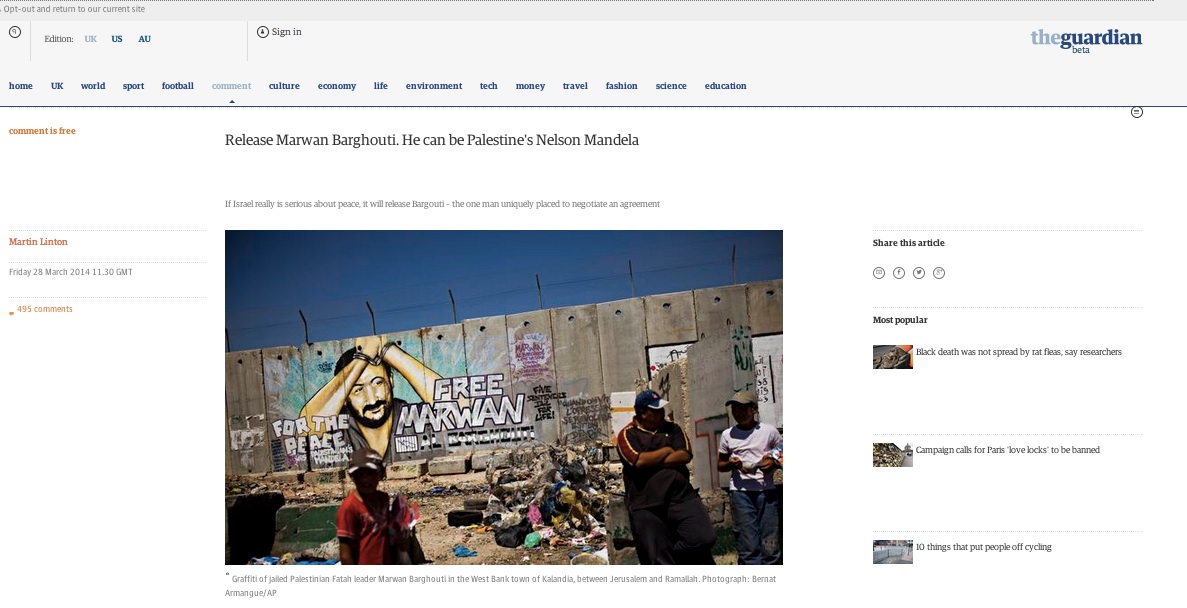
Guardian CIF on Marwan Barghouti

The Guardian published the following article by Martin Linton, on why Israel should release Marwan Barghouti for the future of the peace talks.

Read the Guardian article>

guardian marwan

Palestinian Bedouin clearances

The Israeli government has postponed the Prawer-Begin Bill that would have forcibly relocated 40,000 Bedouin Arabs from their ancestral lands in the Negev to government-designated towns. But this is only a temporary delay for consultations. Demolitions of Bedouin homes are also continuing in Khan Al Ahmar and other areas in the Judean desert to the east of Jerusalem.

Read a mini-briefing on Bedouin clearances>


child detainees update

The Britain-Palestine All Party Parliamentary Group welcomed a recent announcement that Israel will establish a pilot scheme to issue summonses to Palestinian children suspected of crimes, instead of using night time arrests. The cross-party group of MPs and peers called on the international community to ensure this happens as part of a complete overhaul of the system. The aim is to ensure that all child detainees are treated according to international law.

A recent report by Military Court Watch, supported by UNICEF, found that over half of children held in military custody had been arrested at night.

Details of the pilot programme to reduce night-time arrests– including who is supervising implementation, and the extent of the pilot’s reach, timeframe and monitoring and assessment –  are not yet clear.   The BPAPPG are therefore calling for Israel to provide further detail on the proposal, and implement the programme as swiftly as possible.

It is at the point of arrest and the subsequent 24 hours when Palestinian children suffer the most traumatic experiences. The evidence shows that Palestinian minors when released from detention suffer from many types of trauma related conditions, including bed-wetting, aggression, lack of motivation, loss of concentration, anxiety and obsessive compulsive behaviour.

According to the UNICEF report of 2013:

“Many children are arrested in the middle of the night, awakened at their homes by heavily armed soldiers. Some children are arrested in the streets near their homes, near bypass roads used by Israeli settlers or at army checkpoints inside the West Bank. Many of the children arrested at home wake up to the frightening sound of soldiers banging loudly on their front door and shouting instructions for the family to leave the house. For some of the children, what follows is a chaotic and frightening scene, in which furniture and windows are sometimes broken, accusations and verbal threats are shouted, and family members are forced to stand outside in their night clothes as the accused child is forcibly removed from the home and taken away with vague explanations such as “he is coming with us and we will return him later”, or simply that the child is “wanted”. Few children or parents are informed as to where the child is being taken, why or for how long.”

The BPAPPG and Caabu have taken 12 Parliamentary delegations to the Israeli military court at Ofer. Both have pushed for an end to the use of night time arrests except in exceptional cases. In 2013, the issue of pilot programmes was raised with the Israeli authorities, who stated that the idea was under consideration.  The BPAPPG state that an end to night time arrests must be part of a broader overhaul of the whole detention process that includes full audio-visual recordings of interviews, consulting a lawyer before interrogation and the presence of a parent throughout.

Richard Burden MP, Chair of the BPAPPG said:

“The treatment of Palestinian children in Israeli custody remains an outrage. What we, as MPs, have seen in these courts and heard from Palestinian detainees and their lawyers, shows just how important it is that proper legal processes and protections are implemented.” We will now be seeking answers on how this pilot scheme will ensure that the human rights for all children in Israel and the Occupied Palestine Territories are finally upheld.”

Read a mini-briefing on child detainees>


Unemployment briefing

The unemployment rate in Gaza Strip increased from 32.5% in the 3rd quarter 2013 to 38.5% in the 4th quarter 2013 while in the West bank it was 18.2% in the same period, according to the Palestinian Central Board for Statistics.

This is not surprising given that the Israelis impose a near-total ban on exports from Gaza, leaving all but a handful of Gaza’s many factories mothballed. In the week ending March 28th there were only 6 lorryloads of exports allowed out, compared with a weekly average of 240 before the blockade according to UN figures.

The Israelis also restrict imports to about a third of their pre-blockade level. In the same week 521 lorry loads were imported compared with a weekly average of 2,807 before the blockade.

The unemployment rate for males was 23.1% compared with 33.5% for females.

The highest unemployment rate in the 4th quarter 2013 was 43.9% among youth aged    20-24 years. For years of schooling, the unemployment rate among females with 13 years of schooling or more was 46.1%.

The highest unemployment rates in the West Bank governorates was in Hebron with 25.3%. In Gaza Strip, the highest unemployment rate was in Rafah with 48.1%.

UN OCHA figures>

Palestinian Central Bureau of Statistics (PCBS)>

Mini-briefing on settlement trade

William Hague applauds the effectiveness of economic sanctions on Iran and says this week’s deal “vindicates the policy of pressure through sanctions”, but recoils from even the mildest form of economic pressure on Israel – such as advising UK firms not to trade with illegal settlements – even though he admits Israel is in clear breach of international law on settlements, on the wall, on prisoners in Israeli jails and on east Jerusalem.
 
In September he issued guidance to UK firms doing business with countries with poor human rights records and is due to write country-specific guidance on Israel, but will he advise firms not to trade with illegal setlements?  He says they are “illegal and an obstacle to peace”. But EU trade with £200 million a year keeps them going. 
 
Netanyahu sits down to talks, but makes a mockery of them by announcing 4,000 new homes in illegal settlements on Palestinian land. The talks are floundering. Robust UK business guidance to stop trading with settlements might just reinvigorate them. 
 

Mini-briefing on child detainees

 
Hugh Robertson pledged his support last month for the Foreign Office-funded report Children in Military Custody and its 40 recommendations: “I entirely support it and during my time as a minister, I will do everything I can to ensure that its recommendations are properly and correctly implemented.” 
 
The report’s authors, Sir Stephen Sedley QC, Baroness Scotland, and others, will revisit Israel in March to review progress.  So far only two or three of their recommendations have been carried out by the Israelis, reducing the maximum period of detention of children without charge from 60 to 40 days and the maximum before appearing before a judge from 4 days to one for 12-13 year-olds and to two for 14-15 year olds.
 
This does only a little to reduce the abuses which mainly occur in the first 24 hours after Palestinian children are arrested in the middle of the night, interrogated without parents or lawyers present, bullied into signing confessions in a language they do not understand and jailed sometimes as young as 12.  


Mini-briefing on Bedouin clearances

 
The Israelis are trying to “relocate” 30,000 Palestinian Bedouins from their villages in the Negev and remove them from their ancestral grazing lands.  The “relocation” is done by evicting them and demolishing their houses. 
 
At the same time they are trying to “relocate” Bedouins in semi-desert areas around to Jerusalem to make way for new illegal settlements. 
 
Bedouins are families who live in semi-arid areas and traditional live a semi-nomadic lifestyle, moving their flocks of sheep or goats around according to season. They have lived in the Negev for at least 700 years.
 

Mini-briefing on Gaza

 
Children in Gaza are wading through streets flooded with sewage. Power outages, often for 18 hours out of 24, cause sewage pumps to fail and streets to flood. The health minister in the Gaza Strip has warned that the territory is on the verge of a major health catastrophe.“The electricity goes off for 12 hours at a time, and then comes back on for six, and then back off again for 12,” he explained.“Gaza is quickly becoming uninhabitable,” according to the UN. 
 
From the JFJFP newsletter: There’s a humanitarian disaster going on in Gaza but it doesn’t seem to be attracting much international attention let alone effort. There is such a shortage of fuel that power plants, lighting, sewage processing and small private or corporate pumps and generators cannot function. The effort to keep life going is exhausting and the threat of the diseases borne by polluted water is very high. Israel, General Sisi, the PA and Hamas are all blamed by people in Gaza. They also say – what have we done to deserve this?