Author: Sara Apps

Written questions

Roger Godsiff MP: What representations has Foreign Secretary made to his Israeli counterpart on the recent destruction of fruit trees at the Tent of Nations farm?

Lord Judd: What representations have HMG made to G4S about the legal implications of its remaining involvement with the Israeli Prison Service until 2017, in the light of Article 76 of the 4th Geneva Convention and its application to the detention of Palestinians?

Baroness Tonge: What discussions have HMG had with the new President of Egypt concerning the opening of Rafah crossing to Gaza, in order to facilitate travel and the transfer of medical supplies?

Baroness Tonge: What is HMG’s most recent assessment of the level of medical supplies in Gazan hospitals? Baroness Northover: (extract) “The World Health Organisation (WHO) has estimated that in Gaza at 29% of drugs are at zero stock (less than 1 month’s supply).”

Baroness Tonge: What discussions have the Government held with their European partners with regard to listing Israeli settler groups such as Hilltop Youth as terrorist groups, following the US State Department’s description of recent settler acts of violence as terrorist incidents?

Baroness Tonge: What action do HMG plan to take to promote the education of UK citizens about the events of 1948 in Palestine?

Lord Hylton: What representations have the Government made to the government of Israel about its holding children detained in the West Bank and East Jerusalem in immediate solitary confinement; whether they have any plans to work within the European Union to end the practice; whether they know when the proposed system of summons will start; and whether they will take steps to ensure access by parents to their children in custody?

Baroness Warsi: The system of summons started in February 2014. It has already shown initial success in decreasing the number of children arrested at night. We intend to carry out further analysis on this system over the coming months. As a recent progress report by the United Nations Children’s Fund (UNICEF) indicates, Israel has taken some positive steps towards addressing the recommendations in UNICEF’s Children in Israeli Military Detention report. These include: the introduction of legal obligations to inform the child’s parents of an arrest and grant them legal status to be represented in court, as well as to notify minors of their legal rights; and standard operating procedures on methods of restraint. The Government will continue to work, both through bilateral engagement and through the EU, to encourage Israel to take further positive steps.

Baroness Tonge: What assessment have the Government made of the impact of the Foreign and Commonwealth Office-sponsored report, Children in Military Custody, on Israeli interrogation methods of Palestinian children; and what follow-up to the report they intend to undertake.

Baroness Warsi: The Minister wrote to the Israeli Attorney General on 31 March 2014 to welcome the steps taken to date and to call for further measures, including the mandatory use of audio-visual recording of interrogations, investigation into continued reports of single hand ties being used, and an end to solitary confinement for children. These were key UK recommendations at Israel’s Universal Periodic Review session at the UN Human Rights Council on 29 October 2013.

A progress report published in October 2013 by the United Nations Children’s Fund (UNICEF) indicates that Israel has taken some positive steps towards addressing the recommendations in the report. These include: the introduction of legal obligations to inform the child’s parents of an arrest and grant them legal status to be represented in court, as well as to notify minors of their legal rights; and standard operating procedures on methods of restraint. The Israeli military are also piloting a new procedure across the West Bank, whereby children are issued a summons to attend a police station in the morning, rather than being arrested at night, in their homes. The UK believes that the report “Children in Military Custody” has helped contribute to these changes in practice.

EDM 183 – PRESBYTERIAN CHURCH OF THE UNITED STATES AND ISRAEL

Tabled by Sir Bob Russell MP

“That this House congratulates the Presbyterian Church of the United States on its vote to divest from Hewlett-Packard, Motorola Solutions and Caterpillar, all companies with well-documented ties to the Israeli illegal occupation of the West Bank in defiance of international law, the Geneva Convention and UN resolutions; notes that this is the biggest move yet by any institution in the US to take non-violent action to end Israel’s occupation; and calls on the Government to urge British companies with interests in the West Bank, such as G4S, to terminate their involvement which supports the illegal occupation.” http://www.parliament.uk/edm/2014-15/183

Palestine Briefing June 2014

Foreign Secretary criticised  for ‘softly-softly’ approach

Is this the right time for action? No, says Hague

Talks ‘paused’, not failed

Having pinned his entire strategy on US-sponsored peace talks for the last four years, and having seen them end in abject failure, the Foreign Secretary stood at the despatch box like a man in total denial – the talks were only ‘paused’, there was no need to do anything except sit and hope ‘to see them revived’.

When Labour MP Ben Bradshaw put it to him that the Israelis had deliberately scuppered the talks with a surge in settlement building and asked “is now not the time for a recalibration of our policy towards Israel, beginning with the illegal settlements?“, Wiliam Hague’s answer put paid to any hopes of a more robust policy or of a UK-led initiative.

“Is the time right now for such a recalibration? I think the honest answer to that is ‘no’…. Secretary Kerry has said that there is a pause in the negotiations; we would like to see them revived. I think everything we do has to be consistent with supporting that.”

Liberal Democrat MP David Ward said if the talks were ‘paused’, there was certainly no pause in Israel’s expansion of illegal settlements which had continued apace throughout the negotiations:

“What is the point of something being illegal under international law if the international community is not willing to deal with the criminal breaking the law? Is not this softly-softly approach towards Israel failing to bring about peace and justice for the Palestinians?”

The Foreign Secretary affected not to notice when one of his own senior backbenchers tossed him a well-crafted question pointing to the double standards at the heart of Britain’s policy towards Israel and Palestine.

Andrew Selous (South West Bedfordshire): “The Foreign Secretary has said that the UK’s continuing support for the new Palestinian government depends on its commitment to the principles of non-violence and accepting Israel’s legitimate right to exist. Does the UK’s continuing support for Israel also rest on a commitment to non-violence and the Palestinians’ right to a home of their own?”

William Hague was obviously unprepared for this shaft of sunlight on an embarrassing inconsistency in his foreign policy and decided that the best policy was to give the question what his predecessor George Brown once called ‘a total ignoral’:

“We have in this country,” he intoned, “a long-standing recognition of Israel and support for Israel’s right to exist.” 

What he was ignoring was the debate within the  Foreign Office over the best way to revive the peace talks.  Is it just to sit and wait? Or is it to exert gentle economic pressure on the Israelis – for instance, by discouraging UK firms from trading with illegal settlements in the West Bank?

The Foreign Secretary has recently taken the first small step in the latter direction by issuing business guidance on the Government website. It was never announced and this was the first time Mr Hague had referred to the new policy, though he presented it as ‘long-standing’ when it actually dates from December 3:

“The UK’s position on this is long-standing: settlements are illegal—we neither support nor encourage trade, we make clear the risks to business.”

However small, this was significant because it was the first time that the Foreign Secretary has taken action on the settlements, as opposed to verbal protests which he makes regularly and repeated at question time:

“I deplore the recent decisions taken by the Israeli authorities to expand the number of illegal settlements.”

“We are very clear about where we stand on settlements.” 

We have made our views about recent settlements announcements abundantly clear.”

He was also asked by Conservative MP Rob Wilson and Labour MP Grahame Morris what steps he was taking to ensure that residents of East Jerusalem are permitted to vote in the Palestinian elections – despite threats to stop them from Israel’s prime minister Benyamin Netanyahu.

“It will be of paramount importance that those elections, which are scheduled to take place within six months of the formation of the new government, are free and democratic and that Palestinians throughout the occupied territories are able to take part in them. We will of course make representations to the Israelis and to the Palestinians about that.”

Grahame Morris and SDLP MP Mark Durkan also pressed the Foreign Secretary to protest about the Israeli refusal to allow ministers in the new technocratic government from travelling from Gaza to the West Bank, forcing the Palestinian president Mahmoud Abbas to conduct the swearing-in ceremony earlier this month by video-link.

Netanyahu has also arrested and jailed 24 members of the present Palestinian parliament – mainly without charge or trial – making it impossible for them to meet or function or even vote to approve the new government and the holding of elections.

The Foreign Secretary agreed with Mark Durkan that it was important to lift travel restrictions on Palestinian ministers so that the new government is able to function.

Questions to Foreign Secretary

Tuesday June 17th

Middle East

3. Andrew Selous (South West Bedfordshire) (Con):What discussions he has had with the Israeli Government on the new Palestinian Government.[904245]

The Secretary of State for Foreign and Commonwealth Affairs (Mr William Hague):The Minister for the Middle East last discussed the matter with Israel’s chief negotiator on the Middle East peace process, Tzipi Livni, on 12 June. We have been clear that reuniting Gaza and the west bank under a Government committed to peace is a necessary condition for resolving the conflict.

Andrew Selous:The Foreign Secretary has said that the United Kingdom’s continued support for the new Palestinian Government depends on their commitment to the principle of non-violence and acceptance of Israel’s legitimate right to exist. Does the UK’s continuing support for Israel also rest on the commitment to non-violence and the Palestinians’ right to a home of their own?

Mr Hague:We have in this country a long-standing recognition of Israel and support for its right to exist is evident in this country, but we want to see all sides in the Middle East come together to agree a two-state solution that brings lasting security and peace to Israel and a sovereign, viable state for Palestinians. We will continue to press both sides to resume the negotiations, which are going through a pause at the moment, because time is running out to bring about that solution.

Mrs Louise Ellman (Liverpool, Riverside) (Lab/Co-op): Does the Foreign Secretary believe that Hamas can currently be peace negotiators when only a month ago its Prime Minister called for the bombing of Tel Aviv?

Mr Hague: Of course, our policy on Hamas is what it has been for a long time. We look to Hamas to renounce violence, to recognise Israel and to accept previously signed agreements. We call on all those in the region with influence over Hamas to encourage it to take these steps. It has not done so; it should do so. The new Government of the Palestinian Authority do not contain Hamas members. They have signed up to the Quartet principles, which we welcome.

Alistair Burt (North East Bedfordshire) (Con): The all-party group on Egypt was in Cairo over the weekend. We heard from the Foreign Minister the reassurance of Egypt maintaining its support for the long-standing peace agreement with Israel. Does the Foreign Secretary agree that that is an essential pillar for going forward? Does he also agree with the view that, with all that is going on in the region, both the Israelis and the Palestinians would be unwise to miss the opportunity they have now? Unless they seek a proper negotiation and solution, the outlook for both is bleak if we cannot rekindle the Middle East peace process.

Mr Hague: My friend is absolutely right. As I said a moment ago, time is running out. Secretary Kerry, through his tireless work in the past year and a half, has created an opportunity for Israelis and Palestinians to succeed in negotiations on final status issues and on arriving at a two-state solution. Unless that opportunity, which is still open, is seized by both sides, the outlook will be very, very bleak within the next few years.

Ian Paisley (North Antrim) (DUP): Will the Foreign Secretary elaborate on discussions he has had with the Israeli Government on the kidnapping of Israeli civilians?

Mr Hague: We deplore the kidnapping of three Israeli teenagers. I discussed this on Sunday with the Israeli security Minister, Mr Steinitz. I will be talking to the Israeli Foreign Minister, Mr Lieberman, later today. We again appeal for the safe return of the three teenagers.

Martin Horwood (Cheltenham) (LD): I welcome the EU Foreign Minister’s statement, which condemned all extremism and all violence against civilians but welcomed Palestinian reconciliation. Is there any way in which the considerable economic ties between the EU and both Palestine and Israel can be used to encourage both parties back to the negotiating table?

Mr Hague: For Israelis and Palestinians, the outlook for economic ties with the whole of the European Union would be very bright indeed if a two-state solution could be agreed. We have been clear that an unprecedented offer of close economic ties is available for Israelis and Palestinians. That is part of the great prize of settling these issues and a further incentive to do so. Illegal Settlements: West Bank

Mr Ben Bradshaw (Exeter) (Lab): What his policy is on trade with illegal settlements in the West Bank.[904253]

William Hague: I deplore the recent decisions taken by the Israeli authorities to expand the number of illegal settlements. The UK’s position on this is long standing: settlements are illegal—we neither support nor encourage trade, we make clear the risks to business, and we ensure all consumers can make their own choice through the labelling of goods.

Mr Bradshaw: In February, the Foreign Secretary said that the recent talks were the last chance for a two-state solution. Given the Netanyahu Government’s relentless expansion of the illegal settlements, which scuppered those talks, and the warning from Senator Kerry that Israel risks becoming an apartheid state, is now not the time for a recalibration of our policy towards Israel, beginning with the illegal settlements?

Mr Hague: As the Member knows and as I have just said, we are very clear about where we stand on settlements. But is the time right now for such a recalibration? I think the honest answer to that is no, because our efforts are geared towards a resumption of negotiations if it is at all possible. Secretary Kerry has said that there is a pause in the negotiations; we would like to see them revived. I think everything we do has to be consistent with supporting that, but we have made our views about recent settlements announcements abundantly clear.

Bob Stewart (Beckenham) (Con): What is the Foreign Secretary’s assessment of how we can change the situation whereby Palestinian Arabs living in the west bank continue to be tried under martial law in the Ofer military court, whereas Israelis living there are subject to civil law?

Mr Hague: Of course, this is a further continuing difficulty and it reinforces the case for these issues to be fully resolved, and for a final status settlement of these issues that brings about a two-state solution for Israelis and Palestinians. Otherwise, there will constantly be the great variety of extremely troubling issues that are raised in this House.

Ian Austin (Dudley North) (Lab): Is not Britain’s role to get Israelis and Palestinians who believe in peace and a two-state solution working together and trading with each other, instead of campaigning for boycotts, disinvestment and sanctions, which just drive people further apart? The Palestinians working at SodaStream are paid three times more than the average Palestinian, so boycotting such companies would actually hurt the very people they claim to be trying to help.

Mr Hague:As the Member knows, we do not encourage boycotts in any way. The British Government do not support boycotts or a de-legitimisation of Israel, but we do support, as did the last Government, labelling of products from illegal settlements in the west bank, and I think that is the right thing to do. But the Member is quite right that our emphasis is on bringing Israelis and Palestinians together, and this is a more important time than ever to try to do that.

Duncan Hames (Chippenham) (LD):It is certainly urgent. Does the Foreign Secretary believe that the public can have confidence in the labelling of goods from illegal settlements, or can the supply chain be sufficiently complex to ensure that the public do not have the information they may seek?

Mr Hague: The evidence I have seen is that the guidelines on this are well observed, and work is going on on EU-wide guidelines. But of course, where there are serious problems with them, if my Friend or others would like to bring that to our attention, I will investigate.25.[904267]

Grahame M. Morris (Easington) (Lab): Does the Foreign Secretary agree that, to achieve a democratic solution, residents of East Jerusalem must be permitted to vote in the Palestinian elections—and that includes releasing Palestinian MPs who are held in administrative detention, and the free passage of movement?

Mr Hague: It is very important that Palestinians are able to vote freely in the elections, which are envisaged within six months, for the new technocratic Government being created. Of course, we will make that point to the Israelis and to the Palestinians themselves. Middle East 17.[904259]

Andrew Percy (Brigg and Goole) (Con):  It was good to hear the Foreign Secretary condemn the abduction of three Israelis. Unfortunately though, Hamas, which is now part of the unity Government, declared the abduction to be a success. Will he further condemn the Hamas Prime Minister who, in April 2014, said:“Abducting Israeli soldiers is a top priority on the agenda of Hamas and Palestinian resistance.”We will not get peace with a unity Government who include people with such views.

Mr Hague: Let me say again that the new Government of the Palestinian Authority contain no Hamas members and have signed up to the Quartet principles, but I absolutely condemn any encouragement to foment further tensions, including the kidnapping of the three Israeli teenagers. That is exactly the sort of thing that obstructs a successful peace process and is presumably designed to do so. It is important that Hamas or anyone else desists from it.

Mr Philip Hollobone (Kettering) (Con): Last year, the Palestinian Authority paid more than £60 million to Palestinians convicted of terror offences. What is the Foreign Secretary’s assessment of that policy of financially rewarding terrorism? Is he aware of recent reports that the Palestine Liberation Organisation has been mandated by the Palestinian Authority to continue that awful practice on its behalf?

Mr Hague: The Palestinian Authority is working very hard, as we want it to do, in its new incarnation and with its new members. It is committed to the Quartet principle of bringing about a lasting and peaceful two-state solution with Israel, and we look to it to do that. We expect all its actions to be consistent with doing that. We give considerable financial aid to the Palestinian Authority, and I know that the Department for International Development takes great care over the allocation and use of that aid. Topical questions

Mr Rob Wilson (Reading East) (Con): What steps is the Foreign Secretary taking to ensure that the upcoming Palestinian elections in places such as East Jerusalem will be free and democratic?

Mr Hague: As I mentioned earlier, it will be of paramount importance that those elections, which are scheduled to take place within six months of the formation of the new Government, are free and democratic and that Palestinians throughout the occupied territories are able to take part in them. We will of course make representations to the Israelis and to the Palestinians about that.

Mr David Ward (Bradford East) (LD): The Foreign Secretary referred to the pause in negotiations between Israel and the Palestinians, but there has been no pause in the expansion of what he himself has described as illegal settlements. What is the point of something being illegal under international law if the international community is not willing to deal with the criminal breaking the law? Is not this softly, softly approach towards Israel failing to bring about peace and justice for the Palestinians?

Mr Hague: No one has succeeded in bringing about lasting peace so far, but we have to continue to try to do so. The only way in which Palestinians will be able to enjoy what I think we all believe in here—a viable and sovereign state of their own—is through successful negotiations arriving at a two-state solution. All our actions are therefore consistent with promoting that.

Mark Durkan (Foyle) (SDLP):Has the Secretary of State emphasised to the Israeli Government that travel restrictions or other constraints that would prevent Ministers in the technocratic Government from meeting will mean only that they are unable to meet their responsibilities not just to all Palestinians but to the peace process?

Mr Hague:Of course we want the technocratic Government of the Palestinian Authority to be able to function. They have committed themselves to the Quartet principles—that, to us, is a very important test—and so we want them to be able to function and to make decisions. Questions on International DevelopmentWednesday June 18th 2014

Mark Menzies (Fylde) (Con): Given that the unity Government of Palestine have unequivocally endorsed the Quartet principles, will the Secretary of State confirm that she will robustly continue DFID’s financial support to them, or even increase it?

Justine Greening:We will continue to provide support to the Palestinian people. The UK has welcomed the formation of the new interim technocratic Government. We have also made it clear that our continued support for that new Government will rest on their commitment to the principles of non-violence and their acceptance of all previous agreements and obligations, including Israel’s legitimate right to exist.

Statement by Foreign Secretary William Hague on June 3rd:

“We welcome yesterday’s announcement on the formation of a new interim technocratic government for the Occupied Palestinian Territories. Reuniting Gaza and the West Bank under a government committed to peace is a necessary condition for resolving the Israel-Palestinian conflict. We have made clear that our continued support to the new government will rest on its commitment to the principle of non-violence, and an acceptance of all previous agreements and obligations, including Israel’s legitimate right to exist. We now look to the new government to demonstrate these commitments through its actions as well as its words.”

ON RADIO 4 FRIDAY 19 JUNE 2014 AT 9 AMKirsty Young’s castaway this week is the Palestinian author and human rights activist, Raja Shehadeh.

TUESDAY 23 JUNE Mother of one of the Hares boys Umm Fady speaking about the treatment of Palestinian teenagers at the Britain-Palestine All-Party Parliamentary Group.  Passholders only.

EDM 49: 49 MPs have signed EDM 49 on the treatment of Palestinian children: “That this House notes that Israeli forces continue to use excessive force including live ammunition and rubber coated metal bullets on unarmed protestors, including children and that 1,400 children have been killed in this way since 2000; further notes the lack of transparency in the investigation of such incidents; acknowledges the excellent work that Defence for Children International Palestine do in increasing awareness of these deaths; further notes that since January 2008, 129 children have been affected by settler violence in the West Bank and East Jerusalem, including four fatalities with each of the cases occurring near Palestinian neighbourhoods, villages or roads located close to Israeli settlements and the nature of the violence includes being shot at, beaten, pelted with stones and sprayed with gas; and calls on the Government to press the Israeli government to respect the right to peaceful protest and prioritise the safety of all children who come under such attack on a routine basis.”
Stop trade with illegal Israeli settlements on stolen Palestinian land

The UK Government says settlements are “illegal, an obstacle to peace and not helpful in creating the solution to the two-state process”. However, British firms are keeping these illegal settlements in business by trading with them and investing in them.

The European Union is the biggest donor of aid to the Palestinians. But it undermines its own policy by importing goods worth £198 million a year from the settlements compared with only £13 million a year from Palestine.

Trade is big business for the illegal settlements. Without access to export markets some would not survive. Israel puts the value of the settlement export trade at $300m (£198m) annually. So, whilst we are funding Palestinian projects to help protect them against the encroachment of settlements we are providing the financial incentive to keep the settlements expanding.

The increased involvement of UK businesses such as G4S and Veolia in settlements is causing reputational damage to themselves and is in apparent conflict with government policy on the illegality of settlements.

For instance, Tesco is profiting from and providing economic support to Israel’s illegal settlement enterprise and contributing to Israel’s deliberate destruction of Palestinian agriculture through its relationship with the Israeli firm Mehadrin, Many illegal settlements in the Jordan Valley region are only economically viable because they are able to export their produce to Tesco and other supermarkets.

The Dutch government has already stated that it discourages financial relationships with illegal Israeli settlements and the German and Dutch governments have intervened when a business registered in their country has been shown to be participating in Israeli violations of international law.

The British security company G4S provides equipment and services to Israeli-run checkpoints and terminals in the West Bank and Gaza, and to security services to private homes and businesses inside illegal Israeli settlements

This not only enriches the settlements, but impoverishes the Palestinians. The settlements achieve their economic success at the expense of Palestinian economic viability. Additionally the West Bank is interlaced with roads which link settlements to Israeli ports and are closed to Palestinians.

They are not just setting up factories in uninhabited deserts. They take all the lushest and most fertile land in the Jordan valley, the rich mineral resources from the Dead Sea and 80% of the water from the aquifer that runs under the West Bank. Why do you think the Palestinians grow so many olive trees?  Because it’s the only plant that can survive with so little water.  Even then, the Israelis have demolished 800,000 olive trees.

The settlements have a negative  impact on the lives of Palestinians living in East Jerusalem and the West Bank, resulting in the need for more aid for Palestinians. This vicious cycle reveals the absurdity of EU and UK policy making on Palestine.

In February 2013 Palestinian trade unions and agricultural organisations, representing farmers and workers across the occupied Palestinian territories, called for action to end European trade with settlement export companies. In a briefing titled “Farming Injustice”, the organisations explained how European trade with illegal Israeli settlement companies helps settlements to flourish and causes the dispossession and displacement of Palestinians and the destruction of Palestinian agriculture. Many illegal Israeli settlements are only able to flourish because the companies operating within them are able to export their produce to UK high street retailers.

Is it legal? Some international lawyers say we have an obligation to stop trading with illegal settlements. Other say we have the power (without breaking EU or GATT rules) rather than an obligation to do so.

Is it ethical. All agree that settlements profit from the expropriation of Palestinian resources.  By trading with settlements, we profit from Palestinian poverty.

Is it practical? Whilst we are funding Palestinian projects to help protect them against the encroachment of settlements, we are providing the financial incentive to keep the settlements expanding.

It is a question of integrity. The UK Government claims to regard it as illegal, but will do nothing about it.  Do we take the same attitude to chemical weapons, to blood diamonds, to state-sponsored terrorism?

On December 3rd 2013 the Government’s Overseas Business Risk Register issued new business guidance to UK firms trading in Israel.  This was done without any press release or announcement.  The new advice says “we do not encourage” UK business to trade with or invest in settlements. This is a very small step in the direction of a ban on settlement trade.  It is a recognition that trade with illegal settlements is not to be encouraged.  But it is a half-hearted start.  It should say at least “discourage” or “advise them not to trade or invest”.

The EU also announced in a directive issued on July 7th 2013 that it would stop giving research grants to companies based in illegal settlements, but settlements will still benefit from trade with the EU. Stopping trade with illegal settlements is the only policy that is consistent with the UK’s declared policy of support for the state of Israel, but opposition to settlements.

Who’s against?

12 Ambassadors

Leaked reports of a confidential 2012 report by EU Ambassadors and Consuls to Israel and the Palestinian territories showed that they recommended to their governments that the EU should “prevent, discourage and raise awareness of” the trade and investment by EU companies that support illegal Israeli settlements.

EU governments are thus going against the advice of their own ambassadors by refusing to impose a ban on trade and investment in illegal settlements.

Charities and NGOs.

Reports by NGOs calling for a ban on settlement trade, such as “Trading Away Peace” supported by 22 churches and charities, explains how Europe helps sustain illegal Israeli settlements[i]


The TUC

The TUC Congress voted in 2009 to “call on the government to …. seek EU agreement to impose a ban on the importing of goods produced in the illegal settlements.  In 2010 the TUC extended this policy to  “companies who profit from illegal settlements, the Occupation and the construction of the Wall.”

The Co-op

The Co-operative Group announced in 2012 that it would no longer source products from any supplier that operates in illegal settlements and cut ties to four Israeli companies following pressure from its members.

Other countries

During his visit to London in July 2013 Palestinian President Abbas urged Britain to “use its good offices” with European countries to persuade them not to trade with settlements. He said that 30 other countries were considering similar action.

He said he was not asking the British government to boycott Israel.  The Palestinian Authority had commercial relations with Israel. But he wanted the British government to stop supporting settlements.

The Dutch government has stated that it discourages financial relationships with illegal Israeli settlements and the German and Dutch governments have intervened when a business registered in their country has been shown to be participating in Israeli violations of international law.

Many Israelis agree with Ran Gidor, former political counsellor at the Israeli Embassy in London, who said in the Commons that settlements are “the single biggest mistake in Israel’s history” – a disaster for Palestinians but a disaster also for Israel.

Ending trade and investment with the settlements would be an anti-settlement policy, not an anti-Israel policy.  It will not affect the economy of Israel itself.  But it will send a message to Israel’s leaders that we will not condone or cooperate with their ill-judged and illegal settlement project that threatens the future for both Palestine and Israel.”

We believe that the FCO guidance should explicitly advise UK businesses not to support settlement activity. This would include advice to cease trade with companies exporting from Israeli settlements and cease involvement and investment in companies, businesses, and infrastructure services operating in the settlements and supporting the occupation.

The US will never stop the Israelis.  The EU will never agree.  It’s up to countries like Britain and France to put pressure on Israel to reach a settlement. The first step has to be focused on the root cause of the trouble – the settlements.

About these ads

Occasionally, some of your visitors may see an advertisement here.

Tell me more | Dismiss this message


Palestinians face sanctions for going to United Nations

US, Israel to punish Palestine for exercising right to join UN

Free Palestine won’t need aid – DfID
Is it a crime to go to the United Nations? Is it a crime for a country to sign up to UN conventions and join UN agencies?
Yes, according to the Americans.
The US ambassador to the UN, Samantha Power, warned last week that America “will oppose any attempt to upgrade the status of the Palestinians everywhere in the UN”.
Yes, according to Israel.
Israel’s prime minister Binyamin Netanyahu imposed sanctions on the Palestinian Authority for signing up to UN conventions this week by ordering his ministers not to speak to Palestinian ministers or their civil servants.
We’d rather you didn’t do it, says the FCO.
The Middle East minister told David Winnick MP that, while the UK would “ultimately” like to see a Palestinian state sign up to UN conventions, “at this stage” it believed the “only route” to ending the occupation was through negotiations and it should focus on that.
This was the bizarre reaction to Palestinian President Mahmoud Abbas’s decision last week to sign letters of accession to 15 UN treaties and conventions – exercising a right he has had since November 2012 when the UN voted by 138 to nine to recognise Palestine as a state.
The Palestinians agreed last summer not to exercise this right during the nine months of the peace talks provided the Israelis released 106 prisoners who have been in Israeli jails for more than 22 years.
The Israelis failed to release the last batch of 26 prisoners on Saturday March 29th and as a result President Abbas felt free to sign the letters on Tuesday April 1st.
However, he made it clear he would suspend action on the applications to the UN if and when the prisoners were released and he was willing to continue the talks until the final day of the nine months, April 29th.
If they are not released, he will in due course apply to join all 63 UN bodies – including the one the Israelis fear most, the International Criminal Court.  Once Palestine is a member of the ICC, Israeli generals can be tried for war crimes in the occupied West Bank and Gaza.
At Foreign Office questions this week William Hague did his best to convince himself that the talks will continue – even though John Kerry has now washed his hands of them and blamed the Israelis for causing the collapse.http://mondoweiss.net/2014/04/blames-israel-breakdown.html
In the Lords Lord Turnberg urged him to start thinking of a Plan B.
At DfID questions in the Commons Aid Minister Alan Duncan said Israeli restrictions did tremendous damage to the Palestinian economy and to the living standards of ordinary Palestinians.
“The simple truth is that they are not allowed to develop their banking or information and communications technology sectors, or to build even their basic infrastructure.
“Were these restrictions to be lifted … within a relatively short space of time the Palestinians would probably not need our aid at all.”
During the so-called ‘peace talks’ there have been 56 Palestinians killed, 146 houses demolished, 550 attacks by settlers, 897 Palestinians injured, 3,061 arrested, 3,767 military raids and 10,509 new homes built in illegal settlements – enough to house 52,000 new settlers. 
 
Is any more proof needed that the Israelis use ‘peace talks’ as a cover for the accelerated take-over of the West Bank?


International Development Questions

WEDNESDAY 9 APRIL 2014 Oral Questions to the Secretary of State for International Development

Sir Peter Luff (Mid Worcestershire) (Con): What assessment she has made of the effectiveness of her Department’s support for the Palestinian Authority.

Aid Minister Alan Duncan: The UK is providing effective support for the Palestinian Authority in very challenging circumstances. The Palestinian Authority has developed institutions to the point where the international community has recognised it as technically ready for statehood, and it has made impressive progress in delivering improved outcomes in health and education.

Sir Peter Luff: Having just returned from a Select Committee visit to the Palestinian occupied territories and seen the excellent work being done there by the Department, may I ask whether the Minister agrees that its work to support the private sector would be much more effective if Israel lifted many of its restrictions, which can have nothing to do with its essential security, on the freedom of Palestinian business people to develop their economy in areas such as the banking sector, water supply, and even 3G telephone networks?

Mr Duncan: I am grateful to him for his appreciation of DFID’s work in the occupied Palestinian territories and glad that he and the Committee had such a useful visit. Israeli restrictions do tremendous damage to the economy and to the living standards of ordinary Palestinians. The simple truth is that they are not allowed to develop their banking or information and communications technology sectors, or to build even their basic infrastructure. Were these restrictions to be lifted, not only would DFID’s work to support the private sector be much more effective, but within a relatively short space of time the Palestinians would probably not need our aid at all.

Richard Burden (Birmingham, Northfield) (Lab): Is the Minister aware that the World Bank has said that Area C of the West Bank, particularly the Jordan valley, is vital to the future economic viability of a Palestinian state? Presumably that is why the Department is looking to fund infrastructure projects there. What is his view of the fact that illegal Israeli planning restrictions are stopping those infrastructure projects being built, and for how long will the Government allow Israel to have a veto over economic development in the West Bank?

Mr Duncan: I fully understand what he says. I think the Select Committee saw a direct example of the destruction of olive groves when it was there. It is essential that area C is able, through planning arrangements, to develop its economy; otherwise there can be no sensible or useful economic future in the Palestinian territories.

Sir Malcolm Bruce (Gordon) (LD): May I confirm what the Minister says—that without access to area C there is no future for a two-state solution or for an economically viable Palestine? The Palestinian Authority pleaded with us to put all possible pressure on Israel to allow access. We met someone from a company who is saying that the cost of land in areas A and B is prohibitive and that without access to area C he cannot develop his business.

Mr Duncan: I fully concur with him. I hope that a full understanding of this can be included in the peace talks that we hope are continuing towards a productive and useful conclusion.

Mark Lazarowicz (Edinburgh North and Leith) (Lab/Co-op): What recent representations have the Government made to the Israeli authorities about the continued forcible removal of populations, and property demolition, in the occupied territories? Yesterday the Foreign Secretary met the Israeli Minister for International Relations: was this issue raised with him?

Mr Duncan: I was also at that meeting, and I can assure the Member that we raise such matters regularly. It is essential that some kind of normal activity can be permitted in the occupied Palestinian territories; otherwise, as Sir Malcolm Bruce said, there will not be a two-state solution and there is a danger of permanent conflict and tension.

Foreign Office Questions

TUESDAY 8 APRIL 2014
Oral Questions to the Secretary of State for Foreign and Commonwealth Affairs
Ann McKechin (Glasgow North) (Lab): What recent assessment he has made of progress in peace negotiations between Israel and Palestine.
William Hague: In the past few days, I have discussed progress with Secretary Kerry and President Abbas, and I will speak to my Israeli counterparts in the coming days. Secretary Kerry’s tireless efforts provide an unparalleled opportunity to achieve a two-state solution. I urge both parties to show the bold leadership needed to resolve this conflict once and for all.
Ann McKechin: The Foreign Secretary will be aware of press stories that the latest report by the European heads of mission in East Jerusalem states that Israeli policies in Jerusalem are aimed at “cementing its unilateral and illegal annexation of East Jerusalem”, with an unprecedented surge in settlement activity. Does the Foreign Secretary concur with that view and, if so, what is he doing to ensure the future of Jerusalem as a shared capital as part of the negotiations?
Mr Hague: Jerusalem, as a shared capital, is part of what we believe is a characteristic of achieving a two-state solution, along with a solution based on 1967 borders, with agreed land swaps and with a just, fair and agreed settlement for refugees. It is vital that that possibility is kept open. That is why so many of us on all sides of the House have voiced such strong disapproval of settlements on occupied land, which are illegal. We make that point regularly to the Israelis—indeed, I will do so to an Israeli Minister this afternoon—and we urge them to take the opportunity of peace.
Dr Matthew Offord (Hendon) (Con): Last December, the Foreign Secretary said that the British Government have been “clear to the Palestinians that there is no alternative to negotiations” and that “we oppose unilateral measures”. What representation has he made to the Palestinian Authority following its return to unilateral actions last week, in violation of its commitment to abstain for the duration of direct peace talks?
Mr Hague: I called President Abbas last Thursday to repeat our view that the only chance of achieving a viable and sovereign Palestinian state is through negotiations. President Abbas assured me that he remains committed to negotiations, so we will continue to encourage him and Israeli leaders to make a success—even at this stage—of this opportunity.
Mrs Louise Ellman (Liverpool, Riverside) (Lab/Co-op): It is essential that both sides return to negotiations and that they recognise that they will both have to make great compromises to secure a negotiated peace. Does the Foreign Secretary believe that the Palestinian leadership has been preparing the Palestinians for peace when terrorists freed by Israel have been welcomed in the Palestinian Authority as heroes? A broadcast by Palestinian Authority TV has honoured Dalal Mughrabi, who was responsible for a hijacking in which 37 Israeli citizens, including 12 children, were killed.
Mr Hague: Prisoner releases are always controversial in a peace process, as we know well in our own country, but I absolutely regard President Abbas, the leader of the Palestinians, as a man of peace, and I pay tribute to the bold leadership that he has shown on these issues in recent months. As she has just heard, I have urged him to continue with that, and we must focus on that point.
Ian Lucas (Wrexham) (Lab): What is Government policy on Palestine applying as a state to be a member of international political or cultural organisations?
Mr Hague: Last week, President Abbas signed and submitted letters of accession to 15 conventions, including the fourth Geneva convention. No decision is imminent or necessary at the moment on these things, and given that our focus is on urging both Palestinians and Israelis to make a success of the negotiations, I do not believe that it would be wise for us or other countries to pass judgment on those applications now.

Free Marwan Barghouti meeting

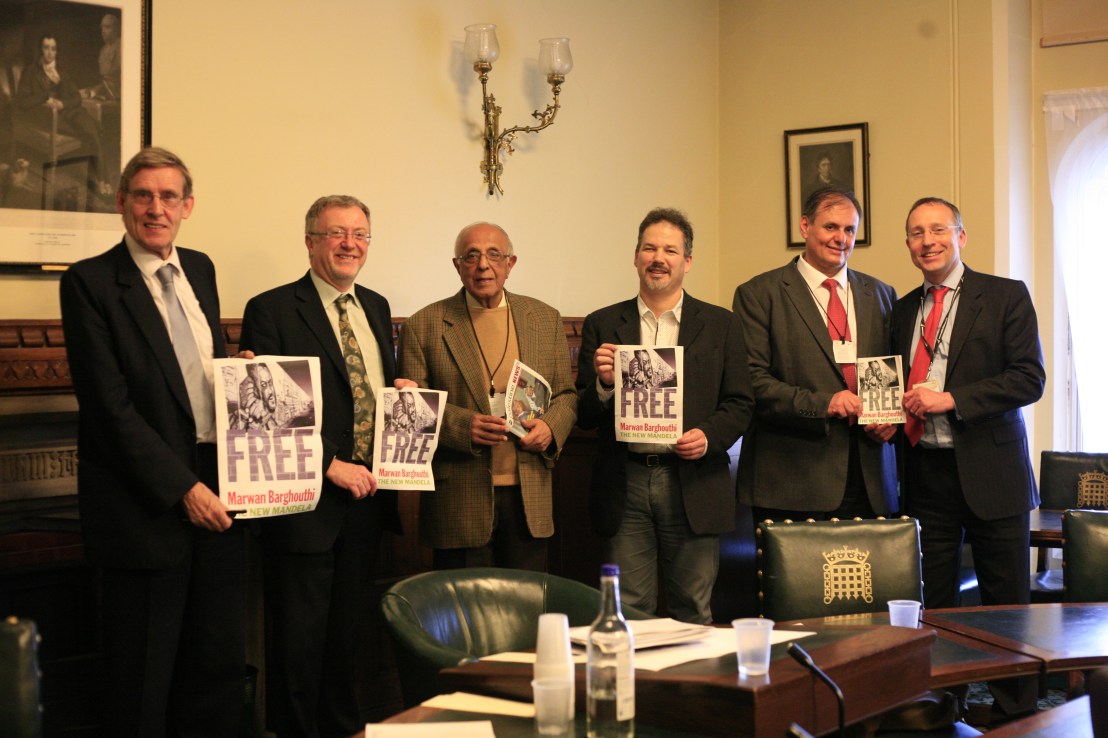
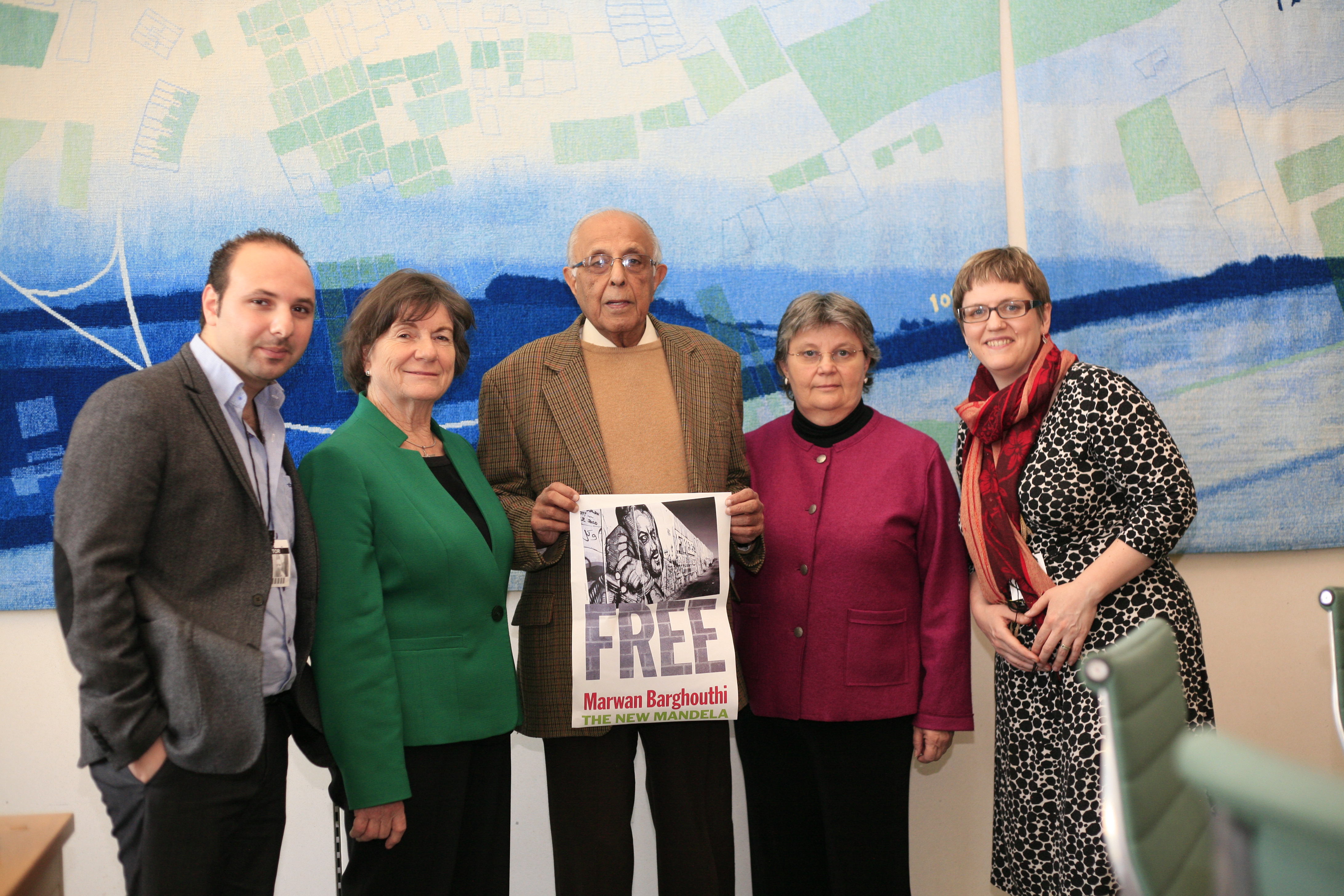
On Tuesday 1st April Ahmed Kathrada came to speak at the House of Commons. He called on members of the All Party Parliamentary Britain-Palestine group and the invited guests to join the campaign to free Marwan Barghouti, Palestine’s most significant political prisoner.

Martin Linton, Richard Burden, Ahmed Kathrada, Dan Judelson, Fadel Takrouri and Andy Slaughter MP Copyright held by PalestineBriefing. Not to be used without permission.
Martin Linton, Richard Burden, Ahmed Kathrada, Dan Judelson, Fadel Takrouri and Andy Slaughter MP. Copyright held by Martin Linton of Palestine Briefing. Picture not to be used without permission.


The meeting was organised by the All Party Parliamentary Britain-Palestine group and Palestine Briefing, timed just after the expected release of the fourth group of Palestine’s political prisoners from Israeli prisons.

Ahmed Kathrada – like the man he was there to talk about – is of huge symbolic importance for Palestine solidarity.  The man who began the first campaign – in the 1960s – to free Nelson Mandela, a man regarded by the majority of the western world as a terrorist at the time – only to be jailed himself for many years. Ahmed Kathrada has shown huge personal, political and physical courage over his long life and heading up the campaign to free Marwan Barghouti.

He spoke about when Mandela was released from prison and was advised to break ties with the Palestine Liberation Organisation and few other liberation groups. Mandela refused, saying “when we came to you for help you disowned us as terrorists. It would be ungrateful of us to disown them now.”

Mr Kathrada told us of how he took Fadwa Barghouti, Marwan’s wife and Fateh Council member, to the cell in Robben Island that Nelson Mandela had occupied.

Ahmed Kathrada said he very much hoped the campaign to free Marwan Barghouti “will take on the proportions of the Free Nelson Mandela campaign.”

Mr Kathrada recounted how in 1985 Mandela was taken away and isolated by the Apartheid South African authorities. But during this time Mandela took the bold step of starting to talk to the Government.  He told them that negotiations would be impossible until they:

  • released the political prisoners

    Raed Debiy, Baroness Jenny Tonge, Ahmed Kathrada, Barbara Hogan, Sara Apps
    Raed Debiy, Baroness Jenny Tonge, Ahmed Kathrada, Barbara Hogan, Sara Apps
  • removed the ban on political organization
  • allowed exiles to return

It took time but eventually the authorities acceded to all those demands.

Palestinian Ambassador, Professor Manuel Hassassian, delivered a powerful speech, thanking Ahmed Kathrada for his presence. He pointed out that in fact pre-Oslo prisoners were meant to be released as part of the Oslo process, so in fact Israel has now failed to honour its commitment to free them several times.  This prisoner release was not part of the Kerry plan, but was in fact agreed before that: the Palestinian leadership agreed not to go to the UN bodies and the ICC in exchange for the release of the prisoners.

The Ambassador said it was right that Marwan should be the symbol for the struggle to release the Palestinian prisoners because of his outstanding popularity and he is the uncontested symbol of the Palestinian prisoners.

The invited audience included many notable individuals including: Afif Safieh from Fateh’s  council, Betty Hunter Honorary President of Palestine Solidarity Campaign, Ziad El Aloul from Palestinian Forum of Britain, Aimee Shalan from Medical Aid for Palestinians.

Afif Safieh talked about the moving first meeting between Yasser Arafat and Nelson Mandela, and how Mandela had said the liberation of South Africa was incomplete without the Palestinians.

It was notable what a strong presence of Palestinians there was in the audience, which is perhaps not surprising as Marwan Barghouti polls as the most popular Palestinian politician within the West Bank and Gaza. But Marwan Barghouti has been explicit himself that this is a campaign for all the political prisoners, of which he is a symbol.

Free Marwan Barghouti!

Sara Apps

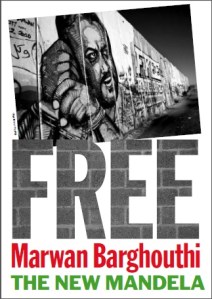
Free Marwan Barghouti: the New Mandela

Read our new Free Marwan Barghouthi pamphlet, calling for the release of the best known Palestinian political Free Marwan Barghouthi for web prisoner. 

The campaign was launched by the veteran South African ANC politician Ahmed Kathrada. Back in the 1960s Kathrada founded the first Free Marwan Barghouti pamphlet fp imagecampaign to Release Mandela and was then jailed himself and spent many years on Robben Island.  He returned to Mandela’s cell on Robben Island to launch the campaign to Free Marwan Barghouthi with Fadwa Barghouti, Marwan’s wife.

Momentum is now growing behind the campaign which is supported by all the Palestinian political parties and human rights organisations and by the overwhelming majority of Palestinians as well as a constellation of former prime ministers and Nobel prize winners.

To coincide with what should have seen the release of the fourth group of prisoners as part of the Kerry talks,  we are launching a new pamphlet calling for the release of Marwan Barghouthi as part of the peace process.

In brief the pamphlet says:

The death of Nelson Mandela reminds us that often the first step towards the resolution of a conflict is the release from prison of a national leader who has the authority to unite, to negotiate and to resolve.

Mahatma Gandhi, Jawaharlal Nehru and Jomo Kenyatta are all examples of national leaders who were released by the British so that they could negotiate their countries’ independence.  The pattern was repeated in South Africa when Mandela went from a prison cell to the presidents’ palace in just four years.

It will be twelve years on April 15th since Israeli security agents, posing as ambulance workers, seized Barghouthi and took him to an Israeli prison. 

But even after 12 years in an Israeli jail Barghouthi remains one of Palestine’s most popular politicians – capable, according to the polls, of beating any other candidate for the presidency. Many believe he could come out of prison, stand for election, win the presidency, unite the Palestinian factions, negotiate a settlement, put it to his people, win their support and then preside over a process of “truth and reconciliation” in a newly-independent country.

Timeline of event

March 28: Publication of pamphlet entitled “Free Marwan Barghouthi” by Palestine Briefing.  Copies will be available at the meeting or from info@palestinebriefing.org

March 29: Israel due to release final group of pre-1992 Palestinian prisoners as part of agreement with US Secretary of State John Kerry

March 30: Palestinian Land Day

April 1: Ahmed Kathrada visiting the UK, supporting the Free Marwan Barghouti Campaign

April 8: Foreign & Commonwealth Office questions

April 15: 12th anniversary of Marwan Barghouthi’s imprisonment

April 29: Final day of Israeli-Palestinian peace talks brokered by US Secretary of State John Kerry

Read the Free Marwan Barghouthi pamphlet now

Special conference speech: Martin Linton

Martin Linton spoke at Labour’s Special Conference 2014, a conference to debate and decide on the reforms that Ed Miliband called to make Labour more deeply rooted in the lives of working people and their communities. Here is his speech:

I’ve got 3 minutes to tell you two stories which I hope will show you why this reform is needed and why it should have been done years ago.

I’ve always found it ludicrous that we have 3,000,000 affiliated trade union members of the Labour Party, but we’re not allowed to know their names and addresses.

Their affiliation fees are very welcome, but if we have 3 million trade union members it means we have on average 4,600 per constituency and their names and addresses would be gold dust to any MP, candidate or organiser, as would their participation in the local party.

When I was an MP I used to ask my union, the GMB, sometimes to mail their levy-paying members on our behalf, which they did.

But we could never come face to face with them because we don’t have any large work places, or even work places where the majority of employees live in the constituency,

In the end we asked the unions to invite members with postcodes in our constituency to a reception.

And at this reception, for the first time, we met lots of working-class Labour voters who were affiliated members, paid money to the Labour Party, voted in Labour leadership elections, the very people who are missing from our membership.

Secondly, in the 1980s I wrote a Fabian pamphlet in which I described the way trade unions affiliated to the Swedish Social Democrats – whole branches affiliated and all the members of the branch became members of the local constituency party – except for those who were opted out.

I got a phone call from a newly-elected MP who invited me to lunch at the Commons to talk about changing the system of trade union affiliation. He was really keen on it.

Now this MP – I don’t think I need to tell you his name – he did a lot of things I agree with, a few I don’t agree with – particularly on the Middle East, but he never got round to changing the affiliation system.

So I think it’s to the credit of Ed Miliband and Paul Kenny and the other union leaders that they have done what Tony Blair failed to do.

Of course we won’t keep all of our affiliated members. But the unions will still have political funds and they will still have an interest in getting a Labour government elected.

That’s the glue that holds us together. It’s in the interests of the Labour Party to win trade unionists’ votes and it’s in the interests of the unions to get a Labour government elected.  We don’t need the belt and braces of an antiquated system.

Children Of The Occupation

Read Harriet Sherwood’s article about children growing up in occupied Palestine

“Around four million Palestinians have known nothing but an existence defined by checkpoints, demands for identity papers, night raids, detentions, house demolitions, displacement, verbal abuse, intimidation, physical attacks, imprisonment and violent death. It is a cruel mosaic: countless seemingly unrelated fragments that, when put together, build a picture of power and powerlessness.”

Read article>