Author: Sara Apps

Aid Minister urges Gaza exports

Allow Gazan entrepreneurs to start exporting to Israel again, says minister|

International Development questions – Wednesday 3rd June 

Aid minister Desmond Swayne said at International Development questions in the House of Commons that there could be no future for Gaza until exports were again allowed into and out of the strip.He was responding to a question from Andy Slaughter MP calling for the re-opening of all the goods and passenger crossings between Gaza and Israel.

The result of the blockade is that hundreds of factories are standing idle. Unemployment is 44.8 per cent (2014 Q4) which the World Bank says in “probably the highest in the world”. Youth unemployment is 60 per cent.

The only hope for young people is to continue their education, and many go abroad to study for higher degrees, but then they come back and find they still cannot get a job. No prizes for guessing what this does to young people.

Gaza is desperate and Gaza is angry, UN Special Coordinator for Gaza
The UN Special Coordinator for Gaza said after his first visit in his report to the Security Council: “Gaza is desperate and Gaza is angry.”So why do the Israelis persist in restricting exports out of Gaza even more tightly than imports? There is no plausible security reason for banning exports. Lorries laden with Gazan strawberries or tulips are hardly a terrorist threat.

One can accept it is possible for a lorry full of imported food to be used to conceal weapons and for cement to be used to build tunnels, but what is the security concern about exports?

It’s not as though Gazans are exporting arms to Israel. And in any case there is a scanning machine donated by the Dutch government and sitting unused at the Kerem Shalom crossing. It could be used to scan the contents of exports.

Israel restricts imports to just under half their pre-blockade level (49 per cent), but they restrict exports to only 8 per cent of their pre-blockade level. In the first half of 2007 there were 240 lorryloads of exports out of Gaza a week; in the last week for which figures are available (May 19-25th) there were 19.

The 19 lorryloads are not even all technically exports. More than half are just being transferred across Israel to the West Bank. It was part of the Oslo agreement to build a secure road to link Gaza and the West Bank, only 25 miles apart, so there could be unrestricted trade between two parts of Palestine, but the Israelis have never allowed it.

It is not as though Israeli businessmen are frightened of competition from Gaza.  Quite the reverse. The Gazan and Israeli economies are complementary.  Before the blockade Israel exported half-finished goods to Gaza’s factories and then imported them back as high-quality furniture and textiles for the Israeli market.

Gaza is a very entrepreneurial society.  Before the blockade there were business parks along the border with Israel, full of modern factories producing furniture, textiles, shoes and foodstuffs which were immediately sent across the Karni crossing to be sold on the Israeli market.

But in the final days of the Israeli attack on Gaza in 2009 and again in 2014 Israeli tank brigades targeted factories, dynamiting buildings and systematically destroying machinery. Palestinian businessmen who had been trading with Israel for years and were on good terms with their Israeli counterparts could not understand these vindictive acts.

Today one million Gazans, more than half the population, are dependent on food aid from the United Nations agency for refugees, UNRWA, and Gaza is top of the aid-recipients’ league table. The Qataris have recently been sending huge amounts of aid through the Rafah crossing with Egypt.

But as the World Bank has said and as British government ministers have said many times, Gaza’s need for aid will soon disappear when the blockade is lifted. British ministers press for free trade between Gaza and the West Bank, for an expansion of the Erez and Kerem Shalom crossings, for a sea route from Cyprus to Gaza – but none of these will happen unless Britain starts to use or threaten trade sanctions.

Gaza also used to export labour to run Israel’s factories.  Before the blockade in 2004 there were half a million crossings through the Erez crossing into Israel and now there are less than 30 per cent of that number – roughly12,600 a month.

Israeli businesses have been pressing for the lifting of restrictions and the resumption of exports. The Quartet has negotiated an agreement between Israel and the Palestinian Authority. But it would mean Israel having to accept value-added tax forms issued by Hamas in Gaza and they refuse to do that.

The Israelis seem to believe that a policy of “semi-starvation” will force the Gaza’s Palestinians into submission, but this is clearly counter-productive. A policy of unrestricted trade (with all the normal border security controls) is far more likely to lead to normalisation.

There is nothing in this world worse than unnecessary suffering. There is already far too much suffering from wars and famines and natural disasters, but what is unforgivable is the imposition of unnecessary suffering on the Palestine people.

The Arab village that Israel plans to demolish

Villagers say: ‘Why evict us when we can both live here? There’s plenty of space.’

This is the village that the Israelis plan to demolish in its entirety anytime after the middle of March and replace with a new village on the same site with the same name – Hiran – but with Jewish inhabitants instead of Arabs.

The 500 Arab residents of the village have lived in the village for nearly 60 years and were in fact ordered to move there by the Israeli military commander of the Negev who gave them a lease to build a village, farm the land and graze their sheep.

The village leaders say there is no need to evict them as the Jewish settlers can move onto a site nextdoor. “We are not against them living here, but we want to stay here too and live together with them as neighbours,” says Atwa Abu Alkia’n.

They point out that there is plenty of space – 3¼ million acres – in the Negev and the settlers don’t need to move to the one small acre of land where they have been living since 1956.

Thirty Jewish settler families are currently living in portakabins a couple of kilometers away waiting for the new houses to be built so they can move in.

The Israeli state has made it clear that the new village is for Jewish residents only and the Arabs must move out.

They have put demolition orders on every house in the village and the courts have fixed the middle of March as the date when the demolition orders take effect.

That means the demolition could coincide with the date of the Israeli election on March 17th.

See the village on YouTube:

Only international protest will save the villagers from being evicted

Villagers say only international protests can stop the Israelis from demolishing the village.  While Israelis are focused on the March 17 election, who will stop the bulldozers from demolishing the village of Umm Al Hiran?

This village is in Israel, not the Palestinian Territories. Its residents are full citizens of Israel.  Yet they are treated as though they had no rights, no importance.

At the time of Israel’s war of independence in 1948 the villagers were thrown out of their ancestral village in a more fertile area in the Western Negev to make way for a Jewish kibbutz as part of the drive to “make the desert bloom”.

Eight years later they were forcibly moved again to their present location in the Atir valley in the less fertile northern Negev where they rebuilt their village and called it Um Al Hiran.

“It was a desert with no roads, water, houses or services. We built the village. We invested in the houses, the roads and the water pipes. Life has been tough, but we worked hard to develop this place into a beautiful and wonderful village,” said the village sheikh.

Like all the other “unrecognised” villages in the Negev, they are provided with no mains electricity, no paved roads, no water, no sanitation.  They have to do their best buying water from tankers and using solar panels for intermittent power.

This is not because it is remote. On the contrary, the Jewish owner of a dog-kennel only 800 metres away is provided with all mod cons. The Israelis do this solely to make life difficult for Arab villagers so they will move.

And it is not a question of money. Often if the villagers try to pave the roads, army bulldozers break them up; if they install water pipes, they are disconnected; if they build stone houses, they are demolished. The Israelis want the buildings to look temporary, ramshackle, worthless.

This makes it easier for the Israelis to sustain the myth that the villagers are Bedouin nomads who originate from other countries. In fact, while they are all proud of their Bedouin heritage, it is historically verifiable that their families have lived in the Negev for hundreds of years.

And while a few of the villagers are still engaged in the traditional Bedouin occupation of sheep-farming, Umm Al Hiran also has lawyers, teachers and doctors among its 500 residents.

A few weeks ago the leader of the Jewish settlers came and drank coffee with the villagers to ask them, disingenuously, why they were trying to block plans for the new Jewish village in the courts.

Salim Abu Alkia’n, Atwa’s brother, explained patiently: “To all the Jewish people who want to live in this town I say that people are already living in this town. We have been living here for 60 years and, even if they demolish our homes, we will stay here forever.”

Israelis can be excused for not knowing about the village, as it does not appear on Israeli maps.  Even when the National Council for Planning and Building approved plans for a new Jewish town on the site in 2010, they submitted a map to the planning committee that made no reference to the fact that there was already an Arab village on the land.

When they applied for demolition orders, they claimed the buildings “had been discovered” by an inspection patrol and they had been “unable to identify or reach the people who owned the houses”.

When they applied for eviction orders, they described the villagers as “trespassers” squatting illegally on state land and the magistrate had to point out that they had lived on the land for years with the state’s knowledge and consent.

Nothing changes, but everything changes after recognition vote

recognisepalestine

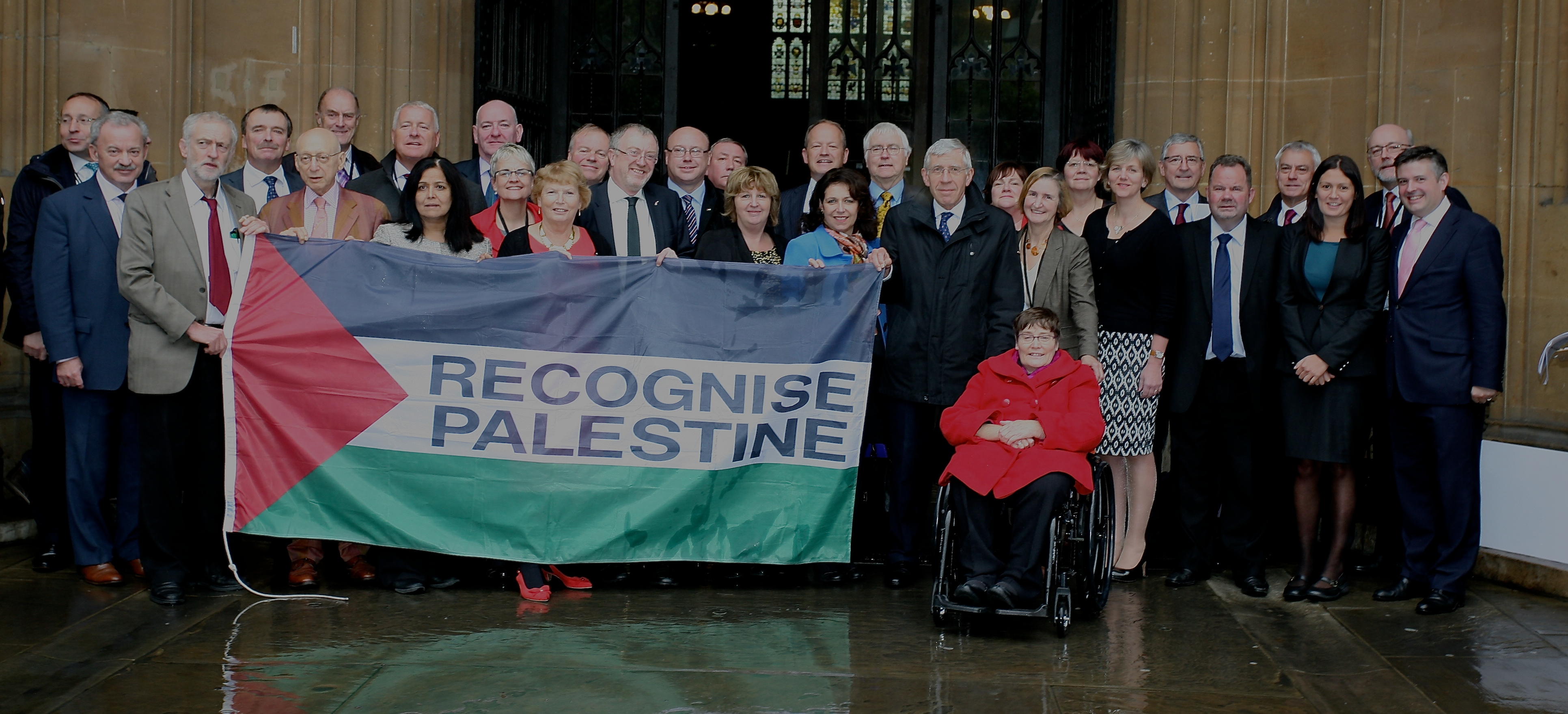
MPs voted in favour of the UK recognising Palestine by an unexpectedly large majority of 262 after a five-hour Commons debate called by Easington MP Grahame Morris. Commentators were quick to dismiss it as “merely an expression of Parliament’s view” that will not commit the Government because it was “only” a backbench debate.

But although the vote is not binding on the Government, it is clear that MPs have changed their views and it is only a matter of time before the Government will have to change its policies. And, although recognition is a minor issue and will not directly affect the lives of Palestinians, there is a good chance that this decisive vote will lead to stronger steps that will begin to put real pressure on the Israelis. The 274-12 vote came about because of a deep underlying shift in MPs’ attitudes to Israel, caused by their shock at the brutality of the Gaza war and their huge postbags of letters from constituents demanding action.

It emerges from the vote that:

  • Half the MPs listed as supporters of Labour Friends of Israel voted in favour of recognising Palestine despite last-minute pleas from senior Israeli politicians to vote against.
  • 40 Conservative MPs – including some members of Conservative Friends of Israel – backed the recognition motion and the Conservative Home website reported that ‘support for Israel is slipping away’.

Ed Miliband put a ‘one-line whip’ on the vote – meaning that MPs could either vote for the motion or abstain – but 80% of his MPs and 21 of 26 members of his Shadow Cabinet voted for the motion. MPs received a huge number of emails – 57,808 through the Palestine Solidarity Campaign website alone – from their own constituents urging them to attend the debate and vote for recognition. This represents a sea-change in both parties.

Conservative Friends of Israel, who are strongly opposed to the recognition of Palestine, claim to have 80% of Tory MPs on their books (242 of 303), but in the event only six Conservatives voted against. Part of the reason may have been that CFI, realising they were going to lose, encouraged their supporters to stay away from the vote – in the hope that the motion would be approved without a physical division where MPs are counted through the voting lobbies. That would mean that the motion would be declared ‘carried’ but no one would know exactly how many or which MPs had voted for or against the motion.

This plot was foiled by two MP who supported recognition but shouted ‘no’ when the Speaker called for ‘ayes’ and ‘noes’ and acted as tellers for the ‘noes’ – without which the Speaker would have been obliged to call off the division. Labour MP Jeremy Corbyn rose on a point of order after the division to explain that he and Batley & Spen MP Mike Wood volunteered as tellers “to ensure that democracy could take place and that Members could record their vote, because those who were opposed to the motion declined to put up tellers”.

If the two ‘no’ tellers are included there were 195 Labour MPs voting for recognition – more than twice the current total of MPs who support Labour Friends of Palestine & the Middle East. While it has been Labour Party policy since 2011 to support the recognition of Palestine, first by the UN and now by the UK, there was no obligation on MPs to turn up for a backbench debate and the numbers were another indication of the rapid fall-off in uncritical support for Israel on the Labour benches. Coalition ministers were told to abstain, but Conservative and Liberal-Democrat MPs were free to vote as they liked.

Although only 40 Conservatives voted for the motion, this was a big increase from the 10 or 15 known to support the Palestinian case in the past.

The real surprise was the number of Conservatives who abstained because they were disillusioned by recent actions of the Israeli government. Typical was the distinguished chair of the Foreign Affairs Committee Sir Richard Ottaway who told the Commons that he had stood by Israel through thick and thin for 20 years but was outraged by the recent Israei annexation of Palestinian land and “such is my anger over Israel’s behaviour in recent months that I will not oppose the motion”.

It was the highest ever attendance at a backbench debate (other than the European referendum debate which was whipped) and out of a total of 43 speeches, only six were from opponents of recognition, with the result that Conservative MPs who have previously been reluctant to express their support for the Palestinian case spoke with passion and eloquence, as though a gag had been removed.

In the event there were 195 Labour MPs supporting the motion, 40 Conservatives, 28 Liberal Democrats, nine Scottish and Welsh nationalists and four Northern Irish (2 SDLP, 1 Independent, 1 Alliance). The noes were six Conservatives, five Ulster Unionists and one Liberal Democrat. Other than the 140 MPs on the “payroll” vote of ministers and ministerial aides who are expected to abstain in backbench debates, the number of MPs who abstained or were absent was 220.  Even if they had all voted ‘no’ (and a number have said they would have voted ‘yes’ but could not be there) opponents of recognition would still have had only 232 votes against the 278 votes in favour of recognition.

Baroness Warsi, who resigned from the Government in August in protest at the strongly pro-Israeli policy, said at the time that many of her ministerial colleagues and most of the officials in the Foreign Office agreed with her, but policy came from a small group at the top. There was a natural majority not only in the country, but also in Parliament and in the Foreign Office for the recognition of Palestine, but “you’ve a small group of politicians who are keeping a close grip on this and who are not allowing public opinion, ministerial views, parliamentary views and the views of the people who work in this system.”

Call it what it is – theft, apartheid, extremism 

We should not use euphemisms to describe what is happening in Palestine. We should use words like ‘theft’, ‘apartheid’, ‘criminal’, ‘extremist’. That’s the view expressed by Conservative MP and former minister Sir Alan Duncan in a speech to the Royal United Services Institute on Tuesday 14 October 2014.

“Illegal construction and habitation is theft, it is annexation, it is a land grab – it is any expression that accurately describes the encroachment which takes from someone else something that is not rightfully owned by the taker. As such, it should be called what it is, and not by some euphemistic soft alternative.

“Settlements are illegal colonies built in someone else’s country. They are an act of theft, and what is more something which is both initiated and supported by the state of Israel.

“It is no exaggeration to say that many settlers are state-supported militia, defying international law, driving out the rightful inhabitants from their land, and creating an illegal economy at the expense of those who have been cruelly displaced.

“No settlement endorser should be considered fit to stand for election, remain a member of a mainstream political party, or sit in a Parliament. How can we accept lawmakers in our country, or any country, when they support lawbreakers in another?  They are extremists, and they should be treated as such.”

Read more>

Cameron rejects Commons’ vote

David Cameron lost little time in pouring cold water on Monday’s vote in the Commons, telling Liberal Democrat MP David Ward during Prime Minister’s questions, that Palestine will not be recognised until “negotiations that bring about a two-state solution”.

This is precisely what the House of Commons rejected by voting by 274-12 on Monday that Britain should recognise Palestine without any preconditions and without waiting for peace talks – because, as Grahame Morris said in his introduction, there were no peace talks and no prospect of peace talks, so this would give the Israelis a veto on UK policy and recognition should be a matter for the UK alone.

Negotiations broke up on April 29th after nine months of fruitless of talks when the Israelis announcement yet another illegal settlement in Palestinian East Jerusalem and there is no likelihood of talks restarting at any point in the near future.

David Ward (Bradford East) (LD):

The Palestinian ambassador, Mr Hassassian, has described Monday’s vote on the recognition of the Palestinian state as “a momentous vote”. Indeed it was. He has also said:“Now is the time for the UK government to listen to its democratically elected parliament and to take decisive political action by recognising the State of Palestine and upholding its historical, moral and legal responsibility towards Palestine”.Does the Prime Minister agree?

The Prime Minister:

Of course, I look forward to the day when Britain will recognise the state of Palestine, but it should be part of the negotiations that bring about a two-state solution. That is what we all want to see—a state of Israel living happily and peacefully alongside a state of Palestine—and that is when we should do the recognition.

Although the parliamentary motion is not binding on government, the hope is that it will encourage other European countries to announce recognition of Palestine – France and Ireland are known to be considering it – to create a bandwaggon effect after the announcement by the new Swedish government earlier this month that they will recognise Palestine.

Already 135 countries (out of 193) recognise Palestine, including many EU states, and the main exceptions are the major West European and North American countries.  Even without the support of the British government, the British Parliament may inspire other countries to follow suit.

But the more important effect of Monday’s vote is that many MPs have voted in support of Palestine for the first time and this may embolden them to go on to give their support to the Palestinians on other issues, such as discouraging or banning trade with the illegal settlement or putting economic pressure on Israel to stop building more settlements.

For Palestinians recognition will make no visible difference – except that a small well-fortified building in East Jerusalem will take down a sign saying “British Consulate-General” and put up a new sign saying “British Embassy to Palestine”.

For the first time the House of Commons has demonstrated its support for the Palestinians’ case and the Palestinians’ hope – and the Israelis’ fear – will be that they will do so again on an issue which will have more than a symbolic effect on the long-running conflict.

Highlights of Debate on Motion to recognise Palestine as a State

A Backbench debate on Monday 13 October 2014 was secured by Grahame Morris MP  “That this House believes that the Government should recognise the state of Palestine alongside the state of Israel. An amendment was proposed by Jack Straw to add ‘as a contribution to securing a negotiated two state solution.’ This amendment was accepted.
The amended motion was carried 274 votes for, 12 against.
Highlights from the debate 
Grahame M. Morris: As the originator of the Balfour declaration and holder of the mandate for Palestine, Britain has a unique historical connection and, arguably, a moral responsibility to the people of both Israel and Palestine. In 1920, we undertook a sacred trust—a commitment to guide Palestinians to statehood and independence. That was nearly a century ago, and the Palestinian people are still to have their national rights recognised. This sacred trust has been neglected for far too long. As the Lady has just said, we have an historic opportunity to atone for that neglect, and take this small but symbolically important step.
Sir Edward Leigh (Gainsborough) (Con): I understand the Government’s position, but they should listen to the voice of this House. Virtually everybody who has spoken—not just lefties waving placards in Trafalgar square, but virtually every Conservative MP—has said that now is the time to recognise the justice of the Palestinians’ case.
I have nothing but respect and support for the state of Israel. I think that all of us are very philo-Semitic. But the [Israelis] have to open their hearts. They have to start relaxing controls in and out of Gaza. They have to start relaxing controls at the Bethlehem checkpoint and they have to stop the settlements. There has to be some way forward. We have to recognise, however naive this may sound, that we are part of a common humanity.
Mr Andy Slaughter (Hammersmith) (Lab): this country has a special duty here. It is easy to try to duck that duty. We are the authors of the Balfour declaration and we were the occupying power. Anybody who goes to the Middle East knows—I am sure that the Minister would agree with me on this—that the views taken by the British Government and the British people run powerfully in the region. We should set an example. Yes, 135 countries have recognised Palestine and yes, we are behind the curve in this matter, but it is not too late for us to set an example to Europe and the rest of the world and show that we believe in equality and fairness in international statecraft as much as we believe in our own country.
Sir Nicholas Soames (Mid Sussex) (Con): What entitles the United Kingdom to withhold a recognition that is the birthright—the long overdue birthright—of each and every Palestinian child? It would be shameful not to take the step of recognition now, when it would make a real difference.
The United Kingdom was a midwife at the birth of Israel and is a permanent member of the UN Security Council. That means an aspiration to take a lead in world affairs. We should take that lead now on this vital issue through a decisive vote of the British House of Commons.
Sir Gerald Kaufman (Manchester, Gorton) (Lab): There The recognition of Palestine by the British House of Commons would affect the international situation. It would be a game changer. I call on both sides of the House to give the Palestinians their rights and show the Israelis that they cannot suppress another people all the time. It is not Jewish to do that. They are harming the image of Judaism, and terrible outbreaks of anti-Semitism are taking place. I want to see an end to anti-Semitism, and I want to see a Palestinian state.
Mr Jack Straw (Blackburn) (Lab): Their illegal occupation of land is condemned by this Government in strong terms, but no action follows. The Israelis sell produce from these illegal settlements in Palestine as if they were made or grown in Israel, but no action follows. The Israeli Government will go on doing this as long as they pay no price for their obduracy.
Richard Burden (Birmingham, Northfield) (Lab): I received an e-mail today from a Palestinian living in East Jerusalem. He described some of his life under occupation in East Jerusalem and he asked me to say this tonight: “I want to see light at the end of the tunnel, but I really want to see light at the end of the tunnel; I don’t want to see a train coming at me from the other end.”
Sir Richard Ottaway (Croydon South) (Con): I have stood by Israel through thick and thin, through the good years and the bad. I have sat down with Ministers and senior Israeli politicians …. and I thought that they were listening. But I realise now, in truth, looking back over the past 20 years, that Israel has been slowly drifting away from world public opinion.
The annexation of the 950 acres of the West Bank just a few months ago has outraged me more than anything else in my political life, mainly because it makes me look a fool, and that is something that I resent.
Under normal circumstances, I would oppose the motion tonight; but such is my anger over Israel’s behaviour in recent months that I will not oppose the motion.
I have to say to the Government of Israel that if they are losing people like me, they will be losing a lot of people.
Sir Alan Duncan (Rutland and Melton) (Con): Recognition of statehood is not a reward for anything; it is a right. The notion that it would put an end to negotiations, or somehow pre-empt or destroy them, is patently absurd; Palestine would still be occupied, and negotiations would need to continue, both to end that occupation and to agree land swaps and borders. Refusing Palestinian recognition is tantamount to giving Israel the right of veto.
A lot of people feel intimidated when it comes to standing up for this issue. It is time we did stand up for it, because almost the majority of Palestinians are not yet in their 20s. They will grow up stateless. If we do not give them hope, dignity and belief in themselves, it will be a recipe for permanent conflict, none of which is in Israel’s interests. Today, the House should do its historic duty.
Mike Wood (Batley and Spen) (Lab): We will be voting tonight for the recognition of a Palestinian state. That is not just about recognising the inalienable right of Palestinians to freedom and self-determination but about Israel’s need to be saved from itself. What Israel is looking at in a one-state solution is a continuation, year after year, of war and violence such as we have seen building in the past 20 years. The Israelis have just finished a third incursion into Gaza in 10 years. Are we suggesting that every two years another 1,500 people should be killed and another 100,000 people rendered homeless as a continuation of the process of driving everybody who is not Jewish out of what is considered to be greater Israel?
Mr David Ward (Bradford East) (LD): What I do not understand is why the Palestinians should have had to pay such a terrible price for the creation of the state of Israel, where it was believed that security could be created, or why the Israelis believed that the brutal expulsion and continued suppression of the Palestinians would ever lead to the sense of security that they seek.
Anas Sarwar (Glasgow Central) (Lab): There are moments when the eyes of the world are on this place, and I believe that this is one of those moments.
Mr Andrew Love (Edmonton) (Lab/Co-op): , three years ago at the United Nations, the then Foreign Secretary said that Palestine met the conditions and was ready for statehood. How long do they have to wait?
Mr Tobias Ellwood, Middle East minister: The UK will bilaterally recognise a Palestinian state when we judge that that can best help bring about peace. The UK will recognise a Palestinian state at a time most helpful to the peace process, because a negotiated end to the occupation is the most effective way for Palestinian aspirations of statehood to be met on the ground.
The UN estimates that it could take 18 years to rebuild Gaza without major change. It says that Gaza could become unliveable by 2020. If the underlying causes are not addressed, it risks becoming an incubator for extremism in the region.
Ian Lucas (Wrexham) (Lab), shadow Middle East minister:  The Labour party supported Palestinian recognition at the UN and we support the principle of recognition today, because we believe it will strengthen the moderate voices among the Palestinians who want to pursue the path of politics, not the path of violence.
It is crucial, at this time when help is needed, that President Abbas receives support for the political path he has chosen. We need to support President Abbas to follow the path of peace and not the path the terrorists of Hamas inflict on the people of Israel, Labour believes that, amid the despair today, we need to take a dramatic step.
Labour urges the Government to listen to the House of Commons—listen to the voices on the Conservative Benches, the Liberal Democrat Benches, the Labour Benches, all the Benches—and give Palestinians what they have as a right: statehood. This it not an alternative to negotiations; it is a bridge for beginning them.
Julie Elliott (Sunderland Central) (Lab): This year’s conflict in Gaza shows how unequal the two sides are. There were some 1,462 civilians killed on the Palestinian side and seven on the Israeli side. All of those are a personal disaster for the victims’ families and are regrettable, but we can see from the numbers the scale of the imbalance in this situation.
Given the imbalance, Palestinian statehood would not harm Israel in any way, but it would give some support to the Palestinian people.
Mr Peter Lilley (Hitchin and Harpenden) (Con): In line with our traditional policy, we should recognise the Palestinian state as a reality. We would not be granting it anything; we would simply be recognising a fact.
Andy McDonald (Middlesbrough) (Lab): Every day that the establishment of the Palestinian state is postponed merely guarantees the continuation of the conflict, with more innocent people losing their lives. We owe it to all those who have lost their lives on both sides, and those whose lives are constantly at risk, to bring this tragedy to an end by recognising the Palestinian state without further delay.
Andrew Stephenson (Pendle) (Con): I believe that time has come. We need to support the vast majority of Palestinians who believe in peaceful coexistence with Israel, and face down the violent minority by showing them that non-violence and a willingness to negotiate can help get them somewhere.
Mr Andy Slaughter (Hammersmith) (Lab): It is the British people who have taken up this cause, with more than 50,000 e-mails sent to MPs over the past two or three weeks. The Labour movement [has been on a journey] from being very sympathetic to Israel as a country that was trying to achieve democracy and was embattled, to seeing it now as a bully and a regional superpower. That is not something I say with any pleasure, but since the triumph of military Zionism and the Likud-run Governments we have seen a new barbarism in that country.
The motion is a positive step, but my constituents wish to see more. They would like us to stop supplying arms to the Israelis when those arms are being used for the occupation and to kill people in Gaza. They would like us to stop importing goods from illegal settlements—illegal under international law. They cannot understand why, if the settlements are illegal, the goods should not be illegal as well.
Sarah Champion (Rotherham) (Lab): In the recent referendum in Scotland. … we did not ask the people of England, Wales or Northern Ireland whether they wish Scotland to stay. We accepted that it was the right of the Scottish people to decide. The same principle should be applied to Palestine. This is not an issue for the Israelis to decide, even if they want to. It is not an issue for negotiations. It is an issue for the Palestinian people and the Palestinian people alone.
Stewart Hosie (Dundee East) (SNP): If we are serious about a two-state solution, 65 years is too long to wait for recognition of Palestine. Even if only to provide parity of dignity—the basic dignity of having one’s nation state recognised—we should recognise it. The time for excuses is over; we should recognise Palestine today.
Andrew Griffiths (Burton) (Con): According to the UN, during this summer’s conflict, a total of 2,131 Palestinians were killed. Of those, at least 1,473 were civilians—young, innocent civilians, in many cases. On the Israel side, 66 Israeli defence force soldiers were killed, and five Israeli civilians. I do not believe that that response is proportionate. Israel has lost the moral high ground in the way it acted.
We should demand the same standards of Israel as we do of any democratic state Some of the acts committed by Israel were clearly unacceptable. Why was it necessary to blow up Gaza’s only power station, leaving already stretched hospitals to rely on generators? Why was it necessary to bomb hospitals and schools, when, as we saw, the threat of loss of life to Israeli civilians was small in comparison? By adding to the suffering of the Gazan people, the Israeli Government have lost the support of the House, and it should cause them great concern.
It is important that moderates in the debate such as me should speak out if we are turning against support for Israel.
Lyn Brown (West Ham) (Lab): Over the past weeks my in-box has been flooded with hundreds of letters from my constituents. Their strength of feeling is undeniable, their arguments are heartfelt, and their conviction is deep-seated—and for good reason. I share those arguments and that conviction.
Jonathan Ashworth (Leicester South) (Lab): This House has a duty to support Palestinian statehood. The Palestinian claim to statehood is not in the gift of a neighbour—it is an inalienable right of the Palestinians, and tonight we should speak up on their behalf. There are times when this House has to send a message—when this House has to speak. I believe that the will of the British people is now to support Palestinian statehood
Martin Horwood (Cheltenham) (LD): if we are to tell Arabs across the region to reject extremism, rockets, bombs and massacres that are deliberately aimed at killing defenceless civilians, we must also do more to support the moderate, democratic, pluralist leaders, such as Mahmoud Abbas, who have painstakingly pursued the diplomatic path towards peace and self-determination.
Let’s build a broad coalition of support for Gaza

BARONESS WARSI ON BBC Today Saturday August 9th on why she resigned:

I HOPE MY RESIGNATION BRINGS TOGETHER A
BROAD COALITION OF SUPPORT TO START
TACKLING THE ISSUES THAT I RESIGNED FOR

“There was no clear language from the government in relation to the condemnation of what had happened. There was no clear commitment that we would lead the international effort on accountability on both sides for what had happened over the weeks before.

“I think it was the lack of support for international justice and accountability for the crimes that have been committed on both sides. I’ve been very clear that those who are alleged to have committed war crimes should be held accountable on both sides because that is the only way that you will start to tackle the culture of impunity.

“It cannot be right that we find ourselves every two or three years with a conflict like this were innocent people lose their lives children lose their lives and then we go back to business as usual.

“This crisis is not a crisis between two religions. It has therefore got nothing to do with whether someone is a Christian or a Muslim or indeed Jewish. I have a very long and proud history of speaking out on the issue of anti-semitism against the persecution of Christians worldwide. I led the government effort on freedom of religion and belief.

“Hamas is a terrorist organisation and I have no doubt that they have in no way acted in the best interest of the Palestinian people. But I also made it clear that Israel as an occupying power has a responsibility not just to the Israelis but also to the people that it occupies.

“I have always believed in the right of Israel to exist, not just exist but to exist in a secure way, but I do not believe that the actions that Israel has taken in the last few weeks are either in Israel’s interest. I do not believe that they in the interests of long-term secure stability or security for Israel and I do not believe that this was the way in which Israelis needed to conduct themselves to be able to achieve their ends.

“Our policy is morally unjustifiable. We need to be much more front-footed in dealing with the sending of arms into the region. We need to suspend all arms export licenses immediately. We need to work with countries that have influence with those countries who supply arms into Gaza and to Hamas to also step up their efforts to ensure that we stop weapons getting into an area where children are being killed.

“My departure clearly says that the Government’s policy on Gaza is morally indefensible. My departure clearly says that it is a policy that I could no longer support and put my name to. Long after politics has come and gone I want to be able to live with myself and by resigning and stepping down I can live with myself.

“I hope that my resignation, if it does anything in any political party or indeed people who are not involved in politics, I hope what it does is it brings together the support of a broad coalition to start tackling the issues that I resigned for.

“While we are still turning on our television screens and seeing innocent people being killed, what we need to do right now is to put all our efforts into making sure that we move the Government’s position, that they suspend the arms export licenses immediately that they start to lead the international effort on accountability on both sides and that they move towards a Middle East policy which is in the long term sustainable. There is no point in us talking about a two-state solution if we don’t do the simple things like recognising Palestine in the way the majority of the world has at the United Nations.

“I will now continue the work in relation to finding a way forward through this crisis and do what I can to support the broad coalition of support that there is out there both in politics and outside.”

Robertson tells Israel it’s time to show restraint

All 37 MPs who spoke in a short debate on Tuesday were unanimous in condemning the abduction and murder of the three Israeli teenagers, but beyond that there was little support for the actions of the Israeli government.
 
A handful of MPs, led by Peter Bone (Con) and Robert Halfon (Con), called on the Government to support Israel in its wider aims, not just to track down the murderers but to “dismantle the infrastructure of Hamas organisation”.
 
Middle East minister Hugh Robertson rebuffed them, telling Peter Bone that “it is crucial that any actions that the Israeli Government take are precisely targeted to find the perpetrators and that they avoid a more general escalation”.
 
He drew on his military background to argue the case for calm, restraint and proportionality, telling Louise Ellman (Lab): “I was a soldier for 10 years, and took part in campaigns against terrorism, and when we lose people—civilians or soldiers—in these situations, that is precisely the time when we need to show leadership and show restraint.
 
Mike Freer (Con) said his constituents would be disappointed to hear him use the “tired phrase” proportionate respons and asked him sarcastically what he thought the proportionate response was to three teenagers being murdered.
 
He received a curt reply: “The correct response to the kidnapping and murder of three teenagers is to find the perpetrators and to bring them to justice. We expect exactly the same response in that part of the world as we would find here—no more and no less.”
 
Hugh Robertson also rejected calls for the withdrawal of British support for the new technocratic government set up under the Fatah-Hamas reconciliation agreement on the ground that it was “backed by Hamas”.
 
He replied that “they are a non-violent government and have no contact with Hamas”, though he added that if it turned out that any minister was a member of Hamas “that would absolutely be the end of this Government’s dealing with them”.
 
He had been in the West Bank recently talking to members of Fatah and their relationship with Hamas was desperate. “They hate Hamas and regard it as being responsible for the splits that have occurred.”
 
Asked whether he thought Hamas were responsible for the murder of the three teenagers, he said he had no hard evidence to back that up, but there was “some indication on the Palestinian side that that might be correct”.
 
Sir Gerald Kaufman (Lab) asked him to send his heartfelt sympathy to the grief-stricken families of the three murdered youths, but added:
 
“Will he also send our sympathy to the families of the five Palestinians whom Israeli troops murdered during their search for the missing youths in a collective punishment which has involved hundreds of arrests and the looting and ransacking of houses?”
 
Crispin Blunt (Con) made a similar point: “The anger and outrage of the people of Israel at the appalling murder of these three teenagers are wholly understandable …, but equally understandable are the anger and outrage of Palestinians at the death of 1,406 children in the conflict since 2000. Would adding to this awful toll by the threatened Israeli reaction be either legal or wise?”
 
Richard Burden (Lab) said Palestinian teenagers who also die in Israeli strikes and military operations have names, faces and families, for whom their deaths are equal tragedies.  He asked the minister to confirm that collective punishment is a crime under international law.
 
Friends of Israel MPs also repeated their claim that UK overseas aid to the Palestinian Authority had been used to provide salaries for the families of convicted Palestinian terrorists.
 
“On the question of salaries,” the Minister said, “this is not true; it is an old rumour. The money is paid through a World Bank trust fund to vetted people, who are nominated civil servants.”
 
Michael McCann (Lab) said: “I disagree profoundly with the Minister’s statement. We do provide funding to the PA and it is absurd to suggest that that money can be ring-fenced; the Palestinian Finance Minister confirmed to me that they do pay Palestinian prisoners in jail.”
 
The minister replied: “I have not yet seen the report of the International Committee, but, clearly, if the Committee has evidence to support the allegations the Member has made, that would be a very serious matter.”
 
Another Friends of Israel theme was raised by Philip Hollobone (Con) when he complained of a “constant stream of hate and abuse from state-sponsored TV and media in the Palestinian Authority”.
 
The Minister said he did not know whether there was any truth in this allegation. “I have been specifically reassured that there is not. If the International Development Committee has evidence that that is not the case, we will be keen to see it.”

Extracts from debate on Israeli Teenagers (Abduction and Murder) Tuesday July 1st

Foreign and Commonwealth Office Minister Hugh Robertson:  There is no reason, belief or cause that can justify the abduction and killing of innocent civilians. We send our deepest condolences to the families of Gilad Shaar, Naftali Frenkel and Eyal Yifrach.

I welcome President Abbas’s condemnations of the abduction. We are encouraging Israel and the Palestinian Authority to continue to work together to find the perpetrators. It is also vital that all parties avoid action that could escalate the situation further. All security operations must be handled with due care, restraint and a proportionate use of force.

It is too early to be clear about the full implications for the Middle East peace process, but we will do our utmost, with our allies and partners, to keep open the prospects for a return to negotiations on a two-state solution.

Peter Bone (Con): May I press my Friend on a few issues? It is true, I believe, that overseas aid to the Palestinian Authority has been used to provide salaries for the families of convicted Palestinian terrorists. Given the propaganda celebrating the abduction of the Israeli teenagers, should we review that? Will the Government support the Israeli Government not only in their actions to track down the perpetrators of this evil crime, but in dismantling the infrastructure of the Hamas organisation?

Does my Friend share my concern that part of the Palestinian Fatah-Hamas unity Government is a terrorist organisation that carries out such dreadful crimes? It seems completely illogical that it can be thought of as part of a democratic process.

Hugh Robertson: On the question of salaries this is not true; it is an old rumour. The money is paid through a World Bank trust fund to vetted people, who are nominated civil servants. 

As for the actions of the Israeli Government, it is crucial that any actions that the Israeli Government take are precisely targeted to find the perpetrators and that, in doing that, they avoid a more general escalation.

On the question of Fatah and Hamas, the technocratic Government are signed up to the Quartet principles. If anybody in that Government were an active member of Hamas, which remains a terrorist organisation, that would absolutely be the end of this Government’s dealing with them.

As to the effect on the peace process, it is an absolutely pivotal part of British Government policy at the moment to try to create the conditions under which the peace process can be restarted. If this situation goes on, with further settlement building on the one hand and applications to international organisations on the other, there will not be another chance.

Ian Lucas (Lab): I hope the Minister will assure us that the British Government will now seek to work with international allies to call for calm, to encourage dialogue and work towards peace.

Hugh Robertson: We absolutely agree with him that this is a moment for exercising maximum restraint.

As for who is responsible, it is too early to say. The Israeli Government are very clear about the fact that Hamas was responsible. When I was in Israel 10 days ago, there was some indication on the Palestinian side that that might be correct, but we have no hard evidence in London to back that up.

Sir Gerald Kaufman (Lab): I commend the Minister for his balanced response. May I ask him to send the heartfelt sympathy of, I am sure, every Member in the House—very much including myself—to the grief-stricken families of these abducted and murdered youths? What has been done to them has no conceivable justification of any kind.

Will the Minister also send our sympathy to the families of the five Palestinians whom Israeli troops murdered during their search for the missing youths in a collective punishment which has involved hundreds of arrests and the looting and ransacking of houses? Nothing whatsoever can justify the murder of these Israeli youths, but it is very important indeed to see it in the context of a conflict that will go on until there is a fair settlement.

Hugh Robertson: It has often struck me, in the context of the Middle East, that there cannot really be a hierarchy of victimhood, and our sympathy must be with all who have lost their lives.

Mrs Louise Ellman (Lab/Co-op):  What does the Minister think should be done to address the unremitting messages of hate that come from Palestinian media? They are partly responsible for this situation and are a grave impediment to peace.

Hugh Robertson: I was a soldier for 10 years, and took part in campaigns against terrorism, and when we lose people—civilians or soldiers—in these situations, that is precisely the time when we need to show leadership and show restraint. Absolutely all efforts should be directed at finding the perpetrators but it is very important that all those actions are directed at doing that, and nothing wider.

Richard Burden (Lab): It was an appalling crime and it is a tragedy for their families and friends. Does the Minister agree that Palestinian teenagers and children who also die, in Israeli strikes and military operations, have names, faces and families, for whom their deaths are equal tragedies? Will he say to the House, in the appalling situation we are in at the moment, what he thinks are the responsibilities under international law of the Palestinian Authority and what are the responsibilities of the Israeli Government as an occupying power in the West Bank, and will he confirm that collective punishment of the Palestinian people is a crime under international law?

Hugh Robertson: The role of the technocratic Government is very clear. These youths were not abducted in an area that is inside their security control, but it is perfectly possible—but not yet confirmed—that the perpetrators of this crime did come from an area that was controlled by them. It is absolutely their job and responsibility to co-operate with the Israeli Government in bringing the perpetrators to justice, and it is absolutely the responsibility of the Israeli Government to ensure the action they take is precisely targeted at the perpetrators and no wider.

Robert Halfon (Con): Hamas is Hamas is Hamas: it is a terrorist organisation whether it is part of the so-called unity Government or not, and Hamas has celebrated the kidnapping of these children and their murder. Surely it is now time to cut off relations with the Government given that they are co-opted with a terrorist organisation. Does my Friend agree that, far from showing restraint, the British Government should give Israel every possible assistance to take out the Hamas terrorist network.

Hugh Robertson: Hamas is a terrorist organisation and remains a terrorist organisation, and one that is proscribed by the British Government. The key thing about the technocratic Government was that they signed up to the Quartet principles and renounced violence and no member of Hamas is a member of that Government.

Crispin Blunt (Con): The anger and outrage of the people of Israel at the appalling murder of these three teenagers are wholly understandable and shared here because of our special links to Israel, but equally understandable are the anger and outrage of Palestinians at the death of 1,406 children in the conflict since 2000, including 270 in Gaza under air and ground attack in 2009 alone. Would adding to this awful toll by the threatened Israeli reaction be either legal or wise?

Hugh Robertson: The death toll on both sides throughout this conflict is appalling. This is merely the latest in a long line of incidents that has tried to derail the peace process, and it proves once and for all that there is no future in violence.

Andy Slaughter (Lab): Does the Minister agree that we should send our condolences to Israeli and Palestinian dead and their families—and we should stress to all sides that retaliation and escalation are not the way forward?

Hugh Robertson: It is crucial that any reaction is targeted very precisely at the perpetrators, and further bloodshed is not the way to resolve this situation.

Michael McCann (Lab): I disagree profoundly with the Minister’s statement on DFID funding to the Palestinian Authority. We do provide funding to the PA and it is absurd to suggest that that money can be ring-fenced; the Palestinian Finance Minister confirmed to me that they do pay Palestinian prisoners in jail, depending on how long their sentences are.

Hugh Robertson: I have followed the progress of the International Development Committee carefully across the region. I have not yet seen the report, but, clearly, if the Committee has evidence to support the allegations the Member has made, that would be a very serious matter.

Mark Durkan (SDLP): Does the Minister recognise that in any conflict there comes a point where both sides have to recognise that they cannot be secure against each other and that they can be truly secure only with each other?

Hugh Robertson: It has often struck me when dealing with the politics of this region—this is not something that is confined to Israel and the Occupied Palestinian Territories—that it is always easier for people to return to violence than it is to make the difficult compromises and decisions necessary to move the peace process forward.

Mike Freer (Con): Many of my constituents will be disappointed to hear from the Foreign and Commonwealth Office the rather well used and tired phrase “proportionate response”. Perhaps the Minister, who I know is a decent man, could advise me on what I say to my constituents about what the FCO regards as a proportionate response to three teenagers being murdered and missiles being fired at Israel on a daily basis.

Hugh Robertson: The correct response to the kidnapping and murder of three teenagers is to find the perpetrators and to bring them to justice. We expect exactly the same response in that part of the world as we would find here—no more and no less.

Philip Hollobone (Con): These murders take place against the background of the release of hundreds of Palestinian prisoners by the Israelis as a signal of good intent for the peace process, and of a constant stream of hate and abuse from state-sponsored TV and media in the Palestinian Authority. Surely this House and The Government need to make it clear to the Palestinian Authority that this background of hate and contempt for Israel must stop if we are to have a meaningful peace process.

Hugh Robertson: As I have already said, I did not realise that there was any truth in these allegations. I have been specifically reassured that there is not. If the International Development Committee has evidence that that is not the case, we will be keen to see it.

Mark Harper (Con): If it turns out that there is persuasive evidence that Hamas was indeed behind these evil murders, will the Minister return to the Dispatch Box to set out what implications that has for the British Government’s recognition of that Palestinian unity Government?

Hugh Robertson: The Israelis are very clear about who they think is responsible. The Palestinian Authority have indicated that that view may be sensible. We need to find out who the perpetrators were, and then we need to find out what, if any, association they may have with the technocratic Government. At the moment, the technocratic Government are absolutely clear that they are fully signed up to the Quartet principles and that they are a non-violent Government and have no contact with Hamas. Indeed, talking to members of Fatah, it is clear that their relationship with Hamas has been desperate. They hate Hamas and regard it as being responsible for the splits that have occurred, so there is some small reason for hope.

David Burrowes (Con): When Hamas and terrorists are throwing rockets over the border and on to innocent civilians and when Hamas itself sees Israeli teenagers as legitimate targets for terrorist attacks, how can we draw any equivalence when it comes to the response?

Hugh Robertson: The correct response as regards the war on terror, which we have faced in this country for many years through the threat from Irish republicans, is to target what we do very precisely, to avoid escalation and to abide by the rule of law. That is precisely how we relieve the underlying causes of conflict. If one goes further than that, the lessons of history show that that inevitably stokes the conflict and makes things worse.

This is a link to some related web page……

Greening: ‘Israelis are crippling the Palestinian economy’

Justine Greening  
Jim McGovern: To ask the Secretary of State for International Development what recent assessment her Department has made of the effect of illegal settlements on the economic development of Palestine. [904307]
 
Justine Greening: Denying Palestinians access to the resources of Area C, whether through expanding illegal settlements, declaring closed military zones and national parks, or restricting movement and access, is crippling the Palestinian economy. The World Bank estimates that easing these restrictions could increase Palestinian GDP by 35%.
 
Andy Slaughter: To ask the Secretary of State for International Development if she will take steps to ensure that the funding of infrastructure projects in the Jordan valley is not dependent on approval from the Israeli government.
 
Justine Greening: We continue to believe the best approach to development in Area C is to engage constructively with Israel to help Palestinian communities to plan and build for their future without fear of demolition. We consistently emphasise the need for unfettered humanitarian provision, including necessary infrastructure.
Palestinians
 
Jeremy Corbyn: To ask the Secretary of State for International Development what research her Department has undertaken into the humanitarian effects of the occupation of the West Bank and the blockade of Gaza. [200411]
 
Alan Duncan: Israeli movement and access restrictions do tremendous damage to the Palestinian economy; the World Bank has estimated that easing restrictions on Area C alone could increase Palestinian GDP by 35%. In Gaza, Israeli restrictions on movements of goods and people do tremendous damage to the economy and living standards of ordinary people. 80% of the households in Gaza are below the poverty line, and 57% are food insecure. The UN predicts that by 2020 Gaza may no longer be a ‘liveable’ place.